










Shillong, Jun 14: The Indian Institute of Management (IIM) Shillong hosted Yuva Sangam Phase VI under the Ek Bharat Shreshtha Bharat (EBSB) initiative of the central government from June 8 to 12 in collaboration with the National Institute of Technology (NIT) Warangal, Telangana. The programme was coordinated by the Dr. APJ Abdul Kalam Centre for Policy Research and Analysis at IIM Shillong.
The five-day programme brought together 46 students and five faculty coordinators from Telangana, providing them with an immersive experience of Meghalaya’s rich cultural heritage, institutions, developmental initiatives and natural beauty. The programme was designed around the five pillars (5 Ps) of Yuva Sangam – Paryatan (Tourism), Parampara (Traditions), Pragati (Development), Paraspar Sampark (People-to-People Connect), and Prodyogiki (Technology).
As part of the Prodyogiki (Technology) and Pragati (Development) pillars, participants visited institutions of national importance, including the North Eastern Space Applications Centre (NESAC), Eastern Air Command, North Eastern Police Academy (NEPA), Headquarters of the Directorate General Assam Rifles (DGAR), NIT Meghalaya, North-Eastern Hill University (NEHU), Sports Authority of India (SAI) and Lok Bhavan. These visits exposed delegates to advancements in science and technology, governance, education, defence, sports development and public service.
The Paryatan (Tourism) pillar was showcased through visits to Meghalaya’s iconic destinations, including Shillong Peak, Ward’s Lake, Police Bazar, Laitlum, Mawkadok viewpoint, Nohkalikai Falls, Seven Sisters Falls, Mawsmai Caves, and Prut Waterfalls.
The Parampara (Traditions) pillar came alive through cultural performances, interactions with local communities and visits to the Don Bosco Museum, where participants explored the traditions, indigenous knowledge systems and cultural heritage of the North East.
The programme also strongly emphasised Paraspar Sampark (People-to-People Connect) through interactions with community leaders, including the Dorbar Shnong of Mawpat, engagement with students and faculty from various institutions and cultural exchange programmes involving participants from Meghalaya and Telangana.
A symbolic tree plantation ceremony at IIM Shillong further reflected the values of sustainability, collaboration and enduring bonds between the participating states.
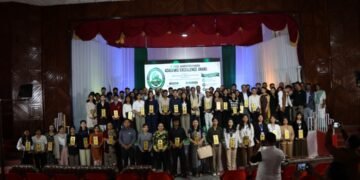
The programme concluded with a valedictory ceremony attended by Education Minister Lahkmen Rymbui.
Delegates from Telangana shared how the five-day experience had broadened their understanding of the North East, transformed perceptions, and strengthened their appreciation of India’s cultural diversity. The valedictory programme featured performances by students of Padma Silbi Passah.