








Shillong, Jul 14: Union Minister of State (independent charge) for Science & Technology and Earth Sciences, Jitendra Singh, today said the North Eastern Space Applications Centre (NESAC) has evolved into a vital institution supporting both national strategic priorities and the socio-economic development of the North East through space technology.
Singh said the Centre is contributing to geospatial mapping of the India-Myanmar border as well as inter-state boundaries in the North East, while simultaneously implementing a wide range of technology-driven projects in agriculture, disaster management, natural resource management, water resources and governance, thereby bringing the benefits of India’s space programme closer to the people.
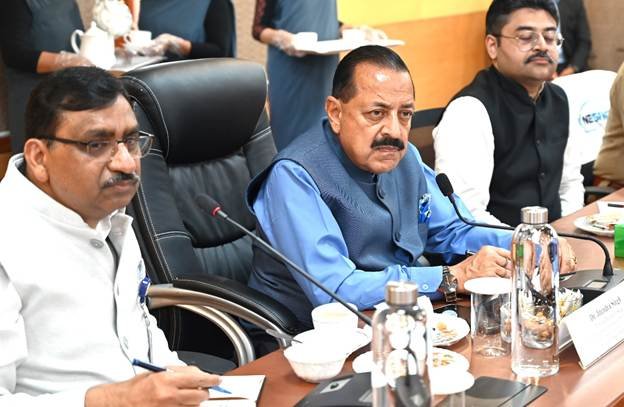
Singh made these remarks during his visit to NESAC at Umiam. He was received by SP Aggarwal, Director, who made a comprehensive presentation on the centre’s achievements and ongoing programmes. The presentation covered nearly 130 projects, including around 50 recently completed and 78 ongoing initiatives spanning agriculture, forestry, water resources, geosciences, urban and regional planning, geoinformatics and information technology, satellite communication, UAV applications, space and atmospheric sciences, disaster management support and outreach and capacity-building activities across the region.
Appreciating NESAC’s expanding role in translating advanced space technologies into practical developmental solutions, Singh said the centre has emerged as an important bridge between cutting-edge scientific capabilities and the developmental aspirations of the eight North Eastern states. He said the institution’s growing engagement with state governments has enabled space technology to become an effective tool for planning, governance, resource management and public service delivery.
The minister called for closer collaboration between NESAC, the North East Cane and Bamboo Development Council (NECBDC) and the concerned state governments to maximise the benefits of the central government’s ongoing bamboo mapping programme. He said the scientific mapping of bamboo resources would help strengthen the bamboo value chain, facilitate better resource planning, promote value addition and create sustainable livelihood opportunities across the region.
Singh also called for further improvement in the precision and location-specific capability of NESAC’s flood early warning system so that communities in vulnerable areas receive more timely and actionable information. He also encouraged the centre to work with state governments for wider adoption of successful water harvesting models, including the initiative implemented at the Ramakrishna Mission in Sohra to enhance long-term water security in the region.
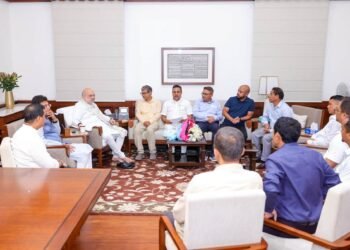
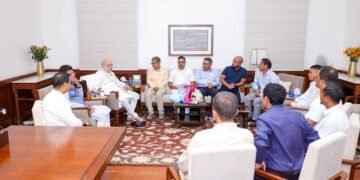
Meanwhile, Singh also chaired a review meeting today with senior officials of the Ri-Bhoi district administration at NESAC to assess the implementation of central government schemes in the ‘Aspirational District’.
Deputy Commissioner Abhishek Saini briefed the minister on the district’s progress across key sectors including healthcare, agriculture, education, rural infrastructure, drinking water supply and farmers’ welfare.
He also highlighted ongoing initiatives to improve roads, bridges and essential public services in the district.
Singh reportedly appreciated the district’s efforts and commended officials for their teamwork and dedication. He urged them to continue implementing central government schemes effectively and to adopt innovative approaches to accelerate inclusive growth.
Ri-Bhoi was identified as an ‘Aspirational District’ under a central government programme aimed at fast-tracking development in education, health, agriculture, financial inclusion, skill development and basic infrastructure.