









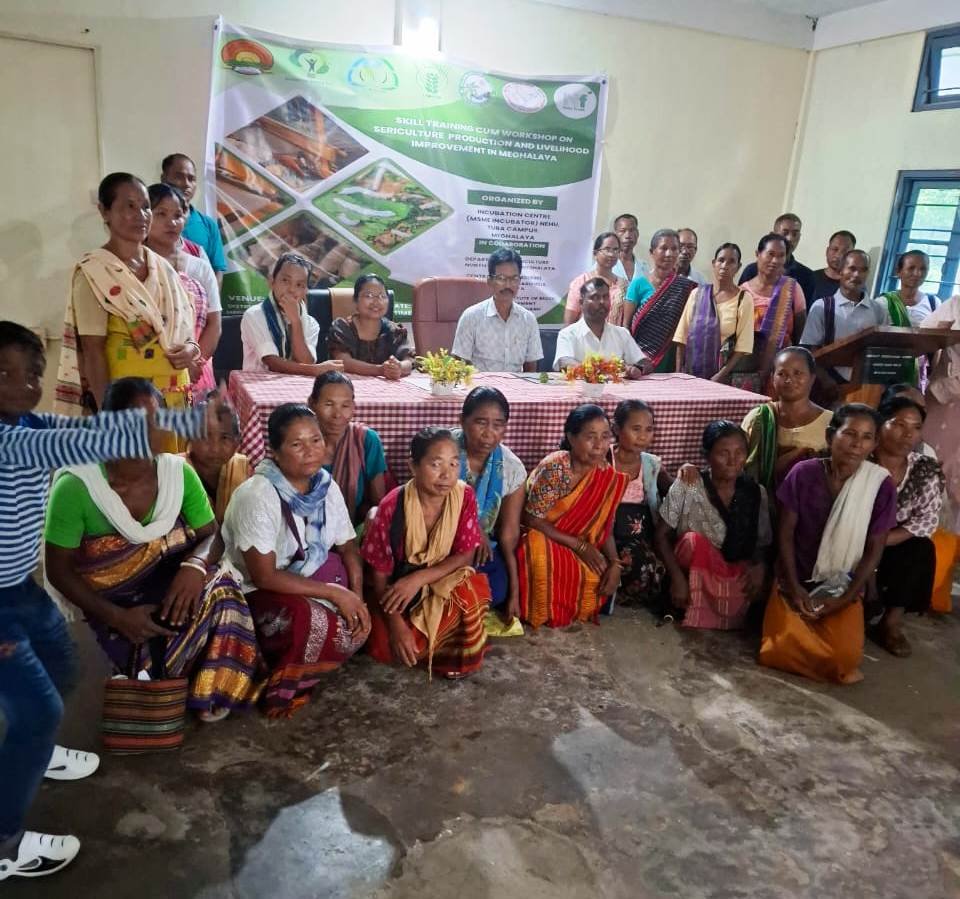
A workshop on skill development on sericulture and livelihood improvement in Meghalaya was held in North Garo Hills with a focus on enhancing productivity, market accessibility and value addition of Eri Silk production which is a crucial sector that supports rural livelihoods in the North Eastern region.
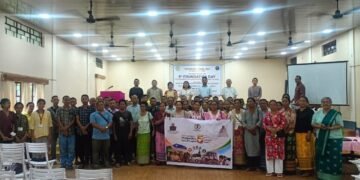
Held at the conference Hall, DSO, Resubelpara, the programme was organised by the Incubation Centre (MSME Incubator) NEHU Tura Campus in tandem with department of Textiles, North Garo Hills and ICAR National Institute of Biotic Stress Management (ICAR NIBSM) Raipur, Chhattisgarh.
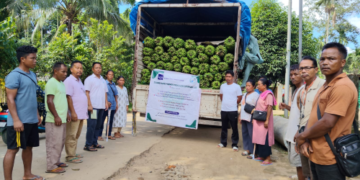
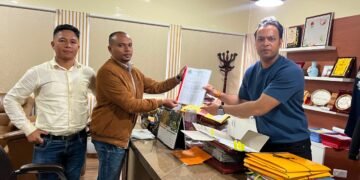
The workshop covered Eri Silk production, boiling, draining, yarn reeling, bobbin rolling, weaving and dying. Around 50 farmers and entrepreneurs benefitted from the programme while also receiving training and rearing equipment trays to support scientific eri silk rearing practices.
Deputy Director of Sericulture & Weaving Sanre G Momin in her address emphasised that Eri Silk which was also known as ‘Peace Silk’ or Ahimsa Silk which has its roots in Meghalaya and Assam border is extracted safely without harming the Eri Worm. “This wondrous process of extracting Silk from Eri worm echoes Meghalaya’s deep rooted belief in Ahimsa”, added Sanre Momin.
Nodal Officer of the centre, Dr R Sasikumara informed that over 500 rural beneficiaries have been introduced to scientific methods of cocoon production and facilitated direct linkages. “This has led to a 40 per cent increase in Eri Silk production in Meghalaya, ensuring better farmers’ earnings and reduced reliance on middlemen,” he said.
Sasikumara said that the State is targeting to boost Eri Silk production to 20 metric tonne annually, generating projected earnings of Rs 150 – 200 crore through value added products and global market expansion.
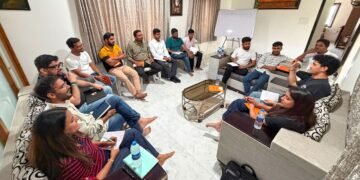
The workshop culminated with discussion on future prospects, intercropping models, integrating Silk farming, digital market platform and large scale eri silk farming.