








Shillong, May 24: Climate-resilient technologies introduced under the National Innovations on Climate Resilient Agriculture (NICRA) project are transforming the livelihoods of farmers in South Garo Hills, a press release stated recently.
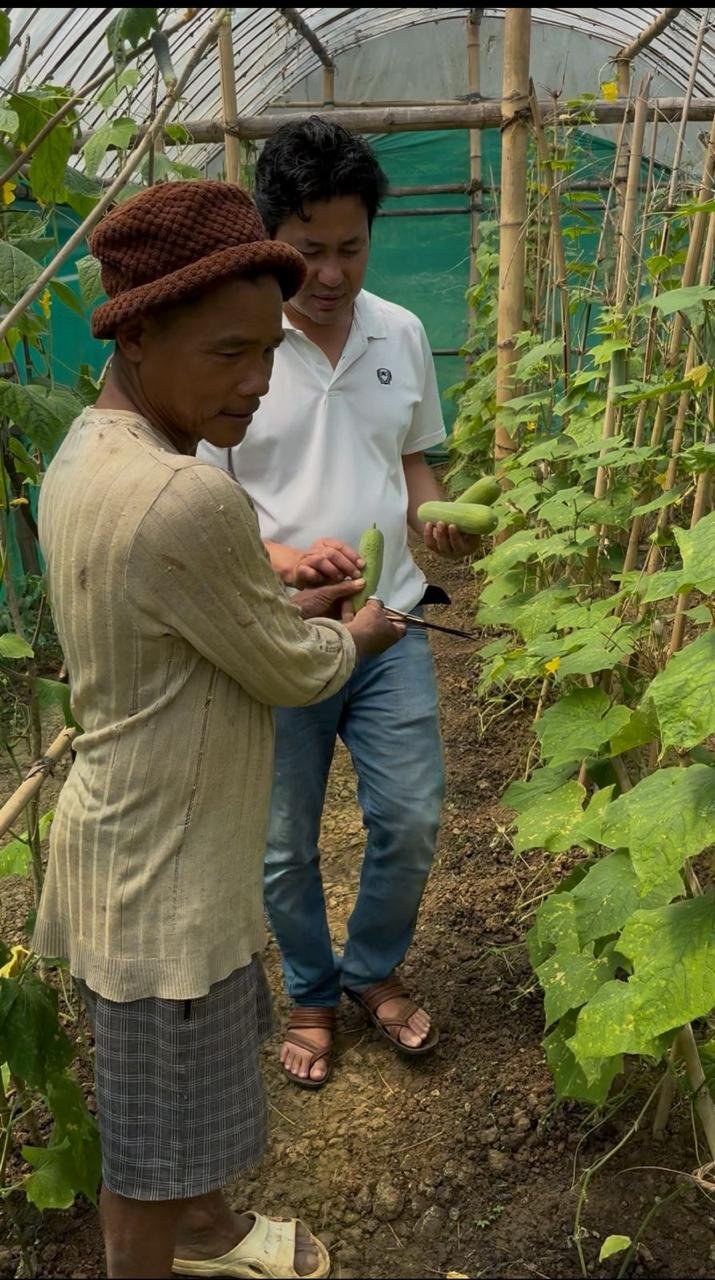
A notable success story has emerged from Asugre village under Chokpot C&RD Block, where progressive farmer Kenedy D Momin has significantly improved farm productivity and income through integrated climate-smart farming practices promoted by the Krishi Vigyan Kendra (KVK) South Garo Hills under the Central Agricultural University-Imphal (ICAR, ATARI, Zone-VII, Umiam).
For years, the farmer struggled with erratic rainfall, prolonged dry spells, low winter temperatures, and increasing pest and disease incidences caused by climate variability. These challenges severely affected crop cultivation and reduced overall farm profitability.
To address these issues, KVK scientists introduced several climate-resilient interventions, including a Jalkund water harvesting structure for supplemental irrigation in cabbage cultivation during dry spells, off-season cucumber cultivation under a naturally ventilated low-cost polyhouse (100 sq metres), and an Integrated Farming System (IFS) involving duck-cum-fish farming in a 0.05 hectare rainfed midland area.
The interventions yielded remarkable results during 2025–26. Cabbage cultivated with supplemental irrigation recorded a productivity of 221.6 quintal/ha compared to 184.9 q/ha under conventional farming. Similarly, off-season cucumber grown under the low-cost polyhouse achieved a productivity of 887.52 q/ha, far exceeding the productivity obtained under open-field cultivation.
The integrated duck-cum-fish farming system also generated substantial returns, producing 44.7 kg duck meat/unit/year and 112.3 kg fish/unit, resulting in a net return of Rs 60,410. Altogether, the NICRA-supported interventions generated a total net return of Rs 84,641, which was more than double the income earned under traditional farming practices.
According to KVK officials, this Farming System Typology (FST-II) model demonstrated higher system productivity and greater resilience during both normal and climatic stress years compared to non-NICRA villages. The initiative has helped farmers diversify income sources, reduce climate-related risks, and adopt sustainable agricultural practices.
The success of Momin now serves as an inspiration for farmers across South Garo Hills and highlights the importance of integrated climate-resilient technologies in strengthening rural livelihoods and ensuring sustainable agricultural development in climate-vulnerable regions of Meghalaya.