






By Benjamin Lyngdoh
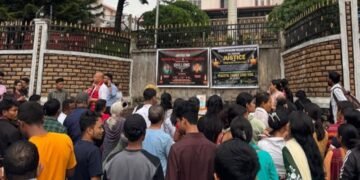
Now that the dust from the Lumpongdeng conflict has settled, an objective view of the episode might be of help to the stakeholders. As the days passed by, the conflict became less about ecological concerns and more about the victory of the people over the opaque functioning of the state government. It was about equating the project with the status of Meghalaya with respect to education, health, sex tourism, etc. A critical point to be factored is that the many who were in favour of the project did not dare to come forward and spell it out. This is a sorry indication of the nature of public discourse in Meghalaya. It is not a healthy democracy when information and logic are subsumed by fear and indifference. Nonetheless, there are lessons to be learned (and reminded of) from Lumpongdeng conflict for future reference.
Technical know-how
The Lumpongdeng project was to be executed and developed by Indian Hotels Company Ltd (IHCL) of Tata Group. Some investments require technical know-how. Money is not the only factor. Being an ecological area, the investment was less about money and more about finding an organisation with the technical know-how to execute such ecologically sensitive projects. IHCL has a rich experience of developing such ecologically sensitive projects while also laying primary focus on the environment and sustainability. They have been doing it for decades together while preserving the pristine environment and taking steps and focusing on waste disposal and management. Examples of such properties can be viewed on YouTube and social media for fact-checking. The comments are interesting. Not all are positive. But, that does not impugn what Tata Group has done and been doing for years.
Unemployment
According to the Periodic Labour Force Survey (PLFS) 2022-23, Meghalaya’s unemployment rate is 6% (persons of age 15 and above). Urban areas unemployment rate is 12.3%. Both the rates are higher than the national average. Projects like Lumpongdeng would bring employment opportunities for the local youth, many of whom are trained in the areas of tourism, hospitality, and wellness. A conversation with some of the youth indicates that they are in favour of such investments but with an eye on environmental sustainability. This is the kind of balance that needs to be looked at – investments with a specific focus on technical know-how. Further, the equating of such investments with sex/prostitution is demeaning and humiliating for the youth who are trained on such trades. Everything needs not to be viewed from the prism of skepticism.
Politics
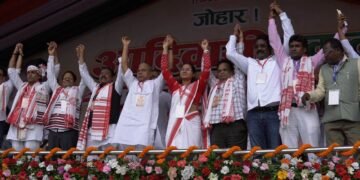
Politics and development are connected. But, when politics tries to present a skewed picture of development by citing wrong analogies, no one can save such a society. The issue with Meghalaya political parties is that they directly jump towards the cure instead of first focusing upon the diagnosis. The President of VPP, Bah Ardent Basaiawmoit highlighted how the youths of Meghalaya are engaged only in menial jobs in high-end hospitality sector such as star hotels and other properties. He pointed out that all top jobs are taken by ‘others’. That is indeed a problem which needs sorting out. But, the real issue lies in the nature of jobs in the tourism and hospitality sector. They are hard and highly demanding. These jobs are one of the most difficult and the lowest paid too (for beginners). The youth needs to step-up and be really ready for the sector if one is looking at it as a serious career option. The real issue is the shaping of the mind-set and the mental toughness. This is the area that needs intervention. In the recent case of the Greentech Foundation hunger strike, this is how political parties take advantage of any movement. Political parties will free-ride on any issue that would garner them votes (irrespective of what they say!).
Connecting the wrong dots
In Meghalaya there is one understanding that is ill-conceived. That being, ‘all investments in tourism and wellness are bad as it impacts upon the state exchequer to allocate money for the major social sectors like education and health’. In truth, a deeper understanding of where the money is coming from and who is actually developing the project is required. In the case of the Lumpongdeng project, the investment is to be done by IHCL. Hence, it is not a money issue, but, as originally fought upon by Greentech Foundation – ‘an environmental and ecological conflict only’. The fact is that the Lumpongdeng conflict was lost in the bombardment of news/information, bias and misrepresentation of facts and a cocktail of political involvement over the best part of 12 days of hunger strike. In the end, MDA 2.0 had to concede as the Shillong seat MP by-election and MLA election 2027/2028 is just round the corner.
Paidbah
Elections are all about ‘u paidbah’ (‘the masses’). This paidbah is predominantly driven by emotion. It does not possess the ability to think and assess logically on issues and conflicts that impact upon their lives and livelihood. In Meghalaya, the paidbah is driven by the need to protect itself from outsiders so much so that projects like the railways is a no-no and any sort of outside investments are to be opposed tooth and nail. Political parties know the psyche of the paidbah and will always try to use it to their advantage. In the past, Meghalaya Congress was good at speaking by appealing to the hearts and emotions of the paidbah. Today, this is solely the monopoly of VPP. These days even the other political parties like the NPP are using the term ‘paidbah’ a lot. It is time for the ‘paidbah’ to wake up.
Future mitigations
Imagine if the Greentech Foundation hunger strike did not have a political colour. Then the possibility of dialogue and understanding could have been possible. Once politics entered the hunger strike, any chance of a negotiation evaporated. The NPP led MDA 2.0 government too was dubious and opaque in the manner of presenting the details of the Lumpongdeng project to the public. Hence the future mitigations that can work are – first, be fair and transparent to the public about any developmental project, and second, in the event of any conflict and protests, nip it in the bud, call for talks and discuss pros and cons before the protest takes a political colour.
Meghalaya politics will change only if the masses (u paidbah) want it to change. After all, in the words of Charles de Gaulle, ‘politics is too serious a matter to be left to the politicians’.
(The author can be reached via email on benjamin@nehu.ac.in)