







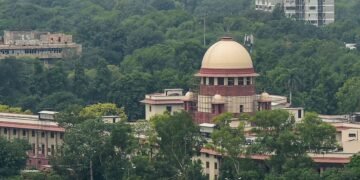





The Supreme Court is currently hearing petitions challenging a landmark 2018 order that allowed women of menstruating age into the Sabarimala temple in Kerala.
The hearing, however, is not limited to Sabarimala, a Hindu temple, but other restrictions found in the religious practices of different faiths.
The 2018 ruling was heralded as a huge win for women’s rights but, equally, as a serious affront to the religious sentiments of Hindus. To paint it as a man vs woman issue would be simplistic, however, as even the sole female judge on the Supreme Court bench at the time did not side with the majority opinion as she did not believe it was the court’s place to interfere in religious observance.
Sabarimala was a special case. While most if not all Hindu temples restrict menstruating women from stepping inside, Sabarimala went one step further and banned women from 10 to 50 whether they were menstruating or not.
Other religions have their gender quirks too, though. Parsi women who have married outside the community are banned from entering fire temples. Christian denominations, from protestant to Catholic and beyond, often limit or prohibit female leadership in churches. On the face of it, these practices may seem inherently unfair in the 21st century but to the faithful they might be absolutely necessary.
Beyond matters of gender equality, courts have in the past interfered in religion before. The most famous case in India was that of the Babri Masjid, its demolition and subsequent raising of a temple dedicated to Ram on the site. Even abroad, though, courts have had their say on religious practice.
In 2012 a regional German court ruled that infant circumcision was a violation of a child’s rights. This caused uproar in the country’s Muslim and Jewish communities and the parliament later enshrined the right of childhood circumcision, which effectively overturned the ruling.
The central government has argued that the 2018 ruling was incorrect and should be reversed. The bench hearing the case includes Justice BV Nagarathna, the lone female judge in the top court, and judges drawn from different faiths, castes and regions. Having different genders, religions, castes and regions represented should make whatever ruling is reached more palatable to the public.