

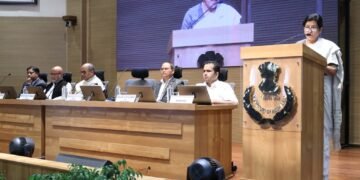








Shillong, Nov 6: An international conference themed, ‘The Indian Knowledge System in the Curriculum: Pedagogical Perspectives’ was organised at the English and Foreign Languages University (EFLU), here in collaboration with ICSSR – NERC, Shillong.
The conference held on November 4, aimed to explore the integration of India’s vast and diverse knowledge systems within contemporary educational frameworks, fostering dialogue on decolonized and inclusive pedagogical approaches.
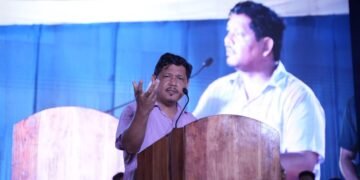
Indian Council for Cultural Relations (ICCR) Regional Director Dr. N. Munish Singh highlighted the significance of intercultural exchange through conferences towards improving the role of indigenous knowledge in education. He emphasised the unique cultural richness of the North-East, describing it as a repository of traditions, philosophies, and languages that together form a vibrant part of India’s civilization mosaic. He reflected on how discourse around IKS is essential in today’s context — not only to preserve heritage but also to inspire innovation and resilience in the modern world.
EFLU Vice Chancellor Prof. N. Nagaraju in his presidential address spoke about the significance of holding such a conference at a time when India is rethinking education through the lens of heritage and innovation. He remarked that through such initiatives, EFLU Shillong continues to uphold the university’s ethos of combining linguistic scholarship with cultural insight.
EFLU Director Prof. Mousumi Guha Banerjee stressed on the significance of indigenous knowledge in education, highlighting the importance of preserving indigenous traditions and cultural memory, especially those of the North-Eastern region. She spoke of the amalgamation of mind, body, and soul that lies at the core of IKS, explaining how traditional knowledge promotes balance, ethical living, and sustainability.
Technical sessions brought together scholars, educators, and researchers from India and abroad to deliberate on the pedagogical value of traditional Indian knowledge systems and their relevance in contemporary curriculum design and provided fertile ground for discussion, reflection, and exchange. Participants explored the Indian Knowledge System through diverse perspectives — spanning language and literature, oral traditions, ecology, pedagogy, gender, and technology.
Three books, Legends of Manipur: Retelling the Puyas by Dr. Rosy Yumnam; Studies in Language, Literature and Linguistics and Language, Literature and Culture: Multidisciplinary Perspectives in the Context of NEP 2020 were released on the occasion.
These books, each a contribution to the ongoing dialogue on language, culture, and education symbolized the university’s ongoing commitment to research and its deep engagement with the philosophical and pedagogical roots of Indian knowledge.