











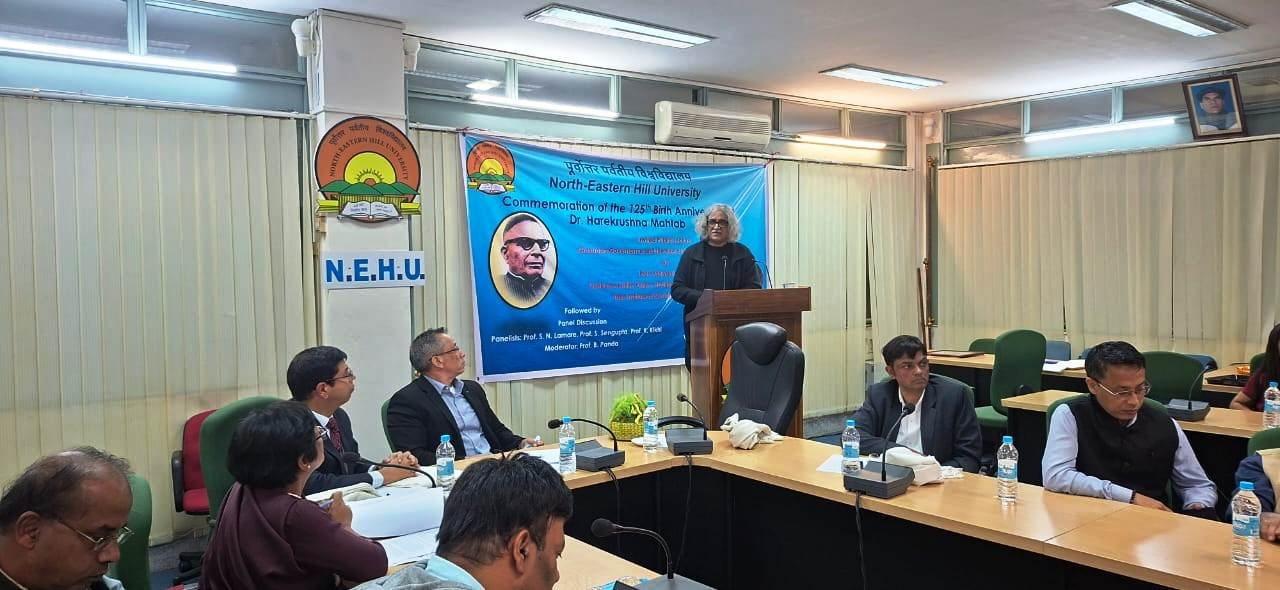
Shillong, Oct 21: The North-Eastern Hill University (NEHU), Shillong, commemorated the 125th birth anniversary of Dr. Harekrushna Mahtab, one of India’s most distinguished freedom fighters, politicians, and literary figures.
The event featured an invited lecture by Prof. Ashwani Kumar, Centre for Public Policy, Habitat and Human Development, Tata Institute of Social Sciences (TISS), Mumbai, on the theme, ‘Grassroots Governance and the Rise of Maternal Welfare in India.’
Kumar delved into the intersection of governance, gender, and social welfare, contextualising India’s maternal welfare evolution within global and local frameworks. He stressed the importance of humility and gratitude in governance, quoting poet and Nobel laureate Octavio Paz to underscore the moral dimension of social policy:
“In our clamorous times, when the earth feels fragile and humanity faces unprecedented challenges, it seems better to first acknowledge our flaws and then express gratitude for those whose generosity makes life more beautiful and bountiful,” he said.
Kumar traced how Dr. Mahtab’s vision of grassroots governance inspired transformative welfare measures in India, particularly in the domain of maternal health and women’s empowerment. He highlighted programs such as Subhadra Yojana, Janani Suraksha Yojana (JSY), and Mission Shakti in Odisha as models demonstrating how locally grounded governance can foster social justice and equity.
He noted that the reservation of seats for women in Panchayati Raj Institutions (PRIs) has been a transformative mechanism for embedding maternal welfare within governance. Programs like MGNREGA, mandating at least one-third participation of women, have provided economic agency and decision-making power, reinforcing women’s role in shaping local development agendas.
Kumar also discussed the growing integration of maternal welfare and women’s empowerment in Northeast India. He cited Meghalaya’s inclusive socio-economic model launched in October 2025, which supports new mothers through nutrition, neonatal care, and locally driven enterprises. Initiatives like “She-Rise” in Laitkroh, East Khasi Hills, which manufactures reusable sanitary pads, were highlighted as examples of linking women’s health, entrepreneurship, and environmental sustainability.
He concluded that India’s evolving maternal welfare state reflects a unique synthesis of participatory governance, gender justice, and cooperative federalism, making the country “a laboratory for innovative welfare practices grounded in local knowledge and community participation.”
NEHU Pro- Vice Chancellor Prof. Sumarbin Umdor, who chaired the event reflected on Meghalaya’s socio-economic transition following the Supreme Court’s ban on timber logging in the late 1990s, which disproportionately affected rural livelihoods. He emphasised that “the challenges of that period underscored the importance of women’s employment and maternal welfare as key components of inclusive development.”
The event also featured a panel discussion moderated by Prof. Bhagirathi Panda. The panel comprised Prof. S. N. Lamare (Department of History), Prof. S. Sengupta (Department of Political Science), and Prof. K. Kikhi (Department of Sociology), all from NEHU. The discussion stimulated engaging exchanges among faculty, staff, and research scholars on the intersections of governance, gender, and development.
The commemoration not only celebrated the legacy of Dr. Harekrushna Mahtab but also reaffirmed NEHU’s commitment to fostering academic dialogue on governance, policy innovation, and social equity in contemporary India.