












By Bijoy A. Sangma
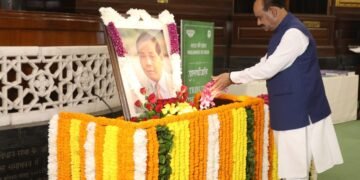
On 25 October each year, the people of Meghalaya pay homage to Captain Williamson A. Sangma – the founding Chief Minister, the architect of its statehood, and the moral compass of its politics. This day marks his death anniversary, a solemn occasion when the state honours the man who gave its hills a unified voice and its people a dignified place in the Indian Union. Captain Sangma’s story is not just about political leadership but also about conviction, humility, and an unyielding belief that democratic change must emerge through dialogue, not confrontation.
Early Life and Education
Born on 18 October 1919 in Baghmara, South Garo Hills, Williamson A. Sangma grew up in a time when opportunities for tribal youth were limited. The colonial system offered little space for indigenous aspirations, yet his determination was extraordinary. He pursued his early education in the region before moving to Jaganath Intermediate College in Dhaka and later to Christian College in Serampore, West Bengal. These institutions widened his worldview while keeping him anchored in his roots.
From Soldier to Statesman
In 1942, as the world was gripped by war, Sangma joined the British Indian Army and rose to the rank of Captain, a rare achievement for someone from the remote hills of northeast India. The discipline, courage, and sense of duty he imbibed during his military service shaped his later political style. After leaving the army in 1946, instead of seeking comfort in a military career, he chose to serve his people in the newly independent India. His decision marked the beginning of a lifelong journey in public life,from soldier to statesman.
A Vision for Unity Amid Diversity
Captain Sangma entered politics at a time when the hill tribes of Assam – the Garos, Khasis, and Jaintias- felt politically marginalised. He became one of the founding members of the Garo National Council (GNC), which initially sought to promote the rights and welfare of the Garo people. But Captain Sangma’s vision quickly expanded beyond Garo boundaries. He understood that the hill peoples shared common aspirations – the desire for self-determination, recognition, and respect for their traditions.
In the late 1950s, as linguistic and regional identities across India reshaped political boundaries, Captain Sangma began working toward unity among the hill tribes. He reached out to like-minded leaders such as B.B. Lyngdoh, Stanley Nichols Roy, and Hopingstone Lyngdoh, who shared his conviction that peace and progress could only be secured through constitutional means.
The All Party Hill Leaders’ Conference and the Birth of Meghalaya
This collective effort culminated in the formation of the All Party Hill Leaders’ Conference (APHLC) in 1960 – a landmark political movement that sought a separate hill state within the Indian Union. Under Captain Sangma’s calm yet firm leadership, the APHLC became the voice of unity and dignity for the hill people. Unlike other regional movements of that era, Captain Sangma insisted on a peaceful and constitutional path. “The pen and patience will achieve what the gun cannot,” he once remarked, reflecting his belief in dialogue over discord.
The culmination of these efforts came on 21 January 1972, when Meghalaya was officially carved out of Assam and accorded full statehood. Captain Williamson Sangma became its first Chief Minister, guiding the new state with humility and foresight. Meghalaya was not born out of agitation or violence but through perseverance and constitutional dialogue, a testament to Sangma’s faith in democratic ideals.
Governance and Institution Building
As Chief Minister, Captain Sangma faced the formidable task of transforming a political aspiration into a functioning state. He governed with composure, fairness, and an inclusive vision. Recognising Meghalaya as a tapestry of diverse tribes, he worked to ensure that unity did not come at the cost of identity. His respect for the Sixth Schedule of the Constitution, which safeguards traditional institutions through autonomous district councils, was instrumental in preserving local governance while integrating the region within India’s federal framework.
He first led Meghalaya as Chief Minister from 2 April 1970, during its autonomous state phase, and continued until 3 March 1978, after full statehood. He returned to office in the 1980s, serving until February 1988. His leadership through these formative years ensured political stability and continuity in an era when many new states struggled with factionalism. In 1989, he was appointed Governor of Mizoram, serving until early 1990, a fitting national recognition of his stature as a statesman of integrity.
A Legacy of Education and Cultural Pride
Captain Sangma believed that education was the cornerstone of empowerment. He often said that “a state’s strength lies in the education of its youth.” That belief finds living expression in the institutions that bear his name today. The Captain Williamson Sangma State University stands as a monument to his conviction that higher education must reach even the most remote corners of Meghalaya. Similarly, the Captain Williamson Sangma State Museum in Shillong preserves and showcases the rich cultural heritage of the Khasi, Jaintia, and Garo peoples – a tangible reflection of his lifelong effort to harmonise tradition with progress.
The town of Williamnagar, named in his honour, embodies the same spirit of hope and determination that defined his leadership. Each of these institutions reminds Meghalaya that statehood was not merely a political achievement but a social and cultural awakening.
Leadership of Integrity and Grace
Captain Sangma’s leadership style was distinct in an age when charisma often overshadowed character. He preferred quiet action to grandstanding, consensus to confrontation, and fairness to favouritism. Those who worked with him recall his modesty, his willingness to listen more than to speak, and his consistent commitment to putting people before politics. Even his critics admired his equanimity and incorruptibility. His calmness in handling political storms became the foundation of Meghalaya’s democratic culture.
He believed that public office was a trust, not an entitlement. His personal life mirrored his public values – disciplined, simple, and deeply rooted in community. These qualities endeared him to people across political divides and made him a respected figure not only in Meghalaya but across India’s Northeast.
Challenges and the Mark of a True Statesman
The early years of Meghalaya were not without difficulty. Balancing the interests of multiple tribes, ensuring equitable development, and building administrative institutions from scratch required both courage and tact. Sangma navigated these complexities with patience and dignity. He often reminded his colleagues that statehood was only “the beginning of responsibility,” urging them to convert political victory into developmental action.
While coalition politics and shifting allegiances occasionally tested Meghalaya’s young democracy, Captain Sangma’s steady leadership anchored it in constitutional discipline. His ability to maintain stability amid turbulence remains one of his most enduring contributions.
Lessons for Today’s Leaders
In an era when politics often prizes short-term visibility over long-term vision, Captain Sangma’s example offers profound lessons. He demonstrated that leadership is about purpose, not power; about transforming people’s aspirations into enduring institutions. His life proved that it is possible to preserve one’s identity while embracing modernity, and to advance local interests while strengthening the national fabric.
For today’s young leaders in Meghalaya and across India, his story offers a roadmap: humility over arrogance, patience over populism, service over self. Rising from a small Garo village to the Chief Minister’s office, and eventually to the Raj Bhavan, he embodied the ideal that integrity and faith in democratic principles can overcome even the most entrenched obstacles.
An Enduring Inspiration
On this 25 October, as Meghalaya observes his death anniversary, it is fitting to reflect on both his achievements and the enduring values he championed – unity, justice, and self-reliance. More than three decades after his passing, his vision remains profoundly relevant. In a time when politics is often divisive, Sangma’s inclusive spirit continues to guide Meghalaya’s identity and conscience. His politics was not about dominance but about dialogue, not about rhetoric but about results.
He understood that leadership must unite, not divide; heal, not harm. In doing so, he not only founded a state but also defined its soul. His was a politics of quiet strength – ethical, patient, and deeply human.
A Life that Still Speaks
Captain Williamson A. Sangma passed away on 25 October 1990, but his legacy continues to shape Meghalaya’s moral and political landscape. His name lives on in the university, the museum, and the generations of leaders he inspired. But beyond institutions, his true memorial lies in the unity and dignity of the people he served.
As Meghalaya looks toward the future, grappling with challenges of development, environment, and governance, Captain Sangma’s example remains a guiding light. He showed that a small state, if driven by integrity and purpose, can make a large moral impact. His journey from soldier to statesman reminds us that leadership rooted in humility and vision does not merely change systems, it transforms societies.
Captain Sangma’s life was, above all, a reminder that greatness is not measured by power held, but by people served.
(The writer is a development professional, policy analyst, and commentator on public affairs, constitutional values, public leadership, social justice, and religious freedom, with extensive experience in global leadership roles and contributions to public policy and social transformation. email:bijoy.sangma@gmail.com)