







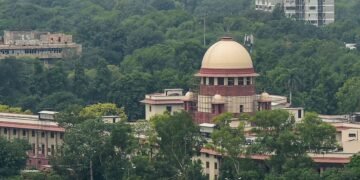





In 2022, the Meghalaya government was pulled up by the High Court over an amendment brought about by the government in the Meghalaya Minor Minerals Concession Rules, 2016 on January 29, 2018. It was about the definition of “incidental” mining in the context of extraction of minor minerals such an unintended extraction which arises out of non-mining activities such as construction of roads or other major infrastructural projects.
‘Incidental’ mining has now surfaced again with a pressure group questioning the approval that allowed seven cement companies in Jaintia Hills to extract over 3.28 crore metric ton of limestone. The subject is set to become a major controversy in Meghalaya, where large quantities are extracted and moved to cement plants, potentially bypassing laws and causing massive revenue loss. Even the court had maintained that the amendment appears to facilitate exploitation disguised as incidental activity.
There have been reports that individuals not only engage in incidental extraction just to construct buildings or residential pathways but the term has been widely misused that even the court had said, “a person may dig deep in his ground to extract some minor mineral and claim to have ‘incidentally’ extracted the same while preparing the field for cultivation.”
Tens of crores of rupees in revenue have been lost from 2018 to 2021 from illegal extraction of minor minerals by tweaking the definition with no check or balance, which the court has noted. As the issue has again been brought to the fore, questions are being raised whether such large-scale extraction truly qualifies as incidental or a violation of the central Mines and Minerals (Development and Regulation – MMDR) Act, 1957.
If cement companies use the “incidental” label to extract huge quantities of limestone for their own profit, bypassing regulations and taxes meant for major mining it now stands true what the court has called a “free loot” and a “mad scramble among the most favoured to make merry at the cost of the State.”
The provisions are not only vague but serve as a loophole for larger mining enterprises to bypass regulatory frameworks designed to protect the state’s ecological balance. The state needs clarity in legislation to prevent potential abuses that might arise due to misinterpretation of what constitutes incidental mining and lawmakers need to enforce regulations that ensure sustainable mining practices.
The court’s observations should serve as a significant reminder that there is a need for robust legal frameworks in managing mining operations. The current state of ambiguity surrounding incidental mining will jeopardize ecological balance.