












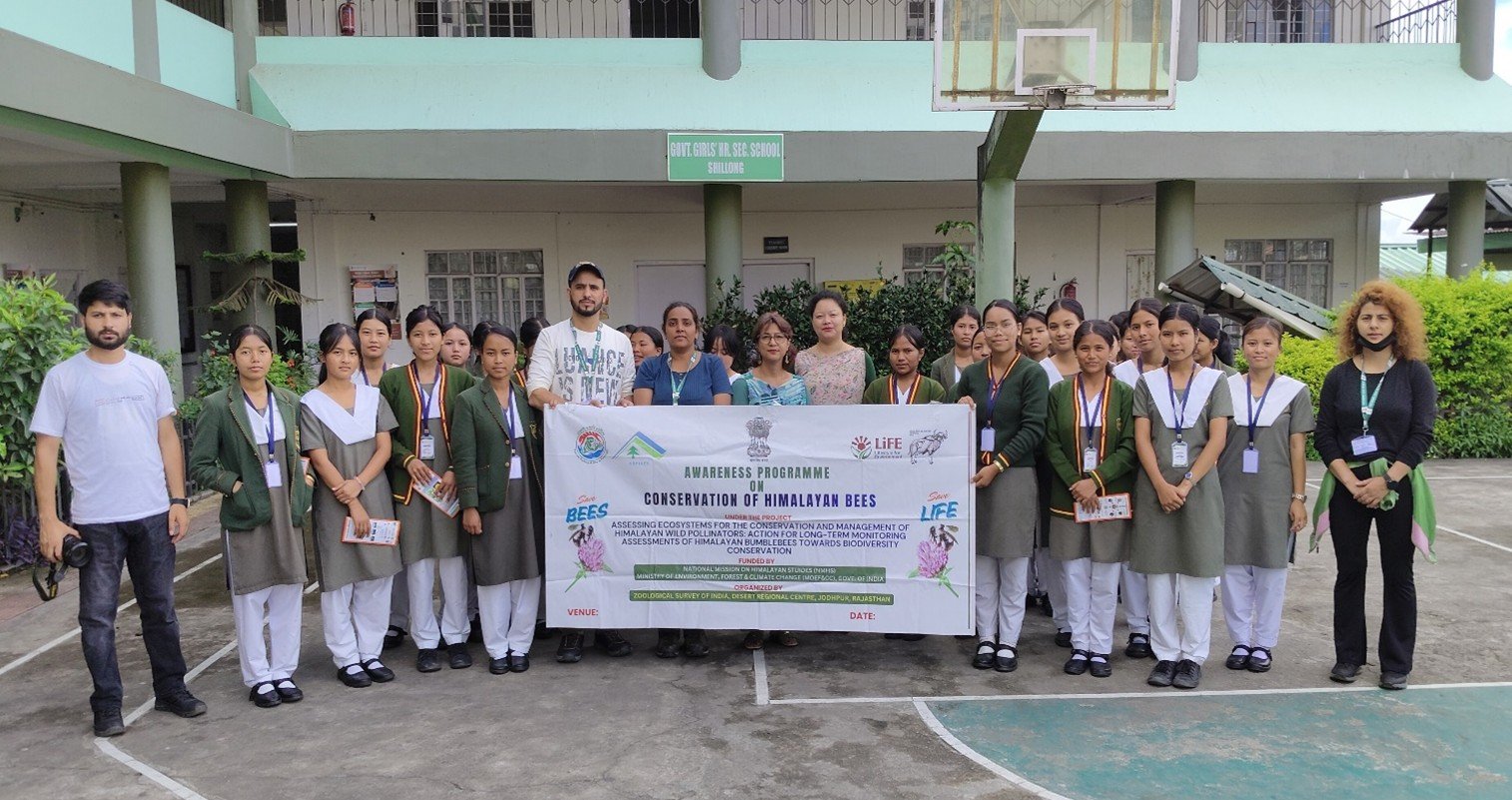
Shillong, Jul 22: An awareness and outreach programme dedicated to the conservation of Himalayan wild pollinators, with particular emphasis on bumblebees, was organised at Shillong Jail Road Boys’ Higher Secondary School and Government Girls’ Higher Secondary School, Jail Road, Shillong.
The initiative brought together students, teachers and other scientific staff to foster greater understanding of the importance of pollinator conservation and biodiversity protection.
The programme was conducted as part of the National Mission on Himalayan Studies (NMHS)-supported research project titled ‘Assessing Ecosystems for the Conservation and Management of Himalayan Wild Pollinators: Action for Long-Term Monitoring Assessments of Himalayan Bumblebees towards Biodiversity Conservation’.
The project is being implemented by the Desert Regional Centre, Zoological Survey of India (ZSI), Jodhpur, under the leadership of RH Raina, Scientist-E and Principal Investigator, with the guidance and support of Dhriti Banerjee, Director of the Zoological Survey of India.
The awareness sessions focused on the indispensable role of Himalayan bumblebees in maintaining healthy ecosystems and enhancing agricultural productivity throughout the Himalayan region. Participants learned about the growing challenges confronting these native pollinators, including climate change, habitat degradation, land-use alteration and other human-induced pressures.
The programme underscored the importance of sustained scientific research, ecological monitoring and active public participation in safeguarding these ecologically significant species. Special focus was also given to capacity building by encouraging students to develop scientific awareness, ecological understanding and conservation skills. In addition, the programme promoted the objectives of Mission LiFE (Lifestyle for Environment) by inspiring participants to adopt environmentally responsible lifestyles, conserve biodiversity and actively participate in community-led environmental stewardship.
During the programme, the research team highlighted the major components of the ongoing project, which include documenting the diversity and geographical distribution of Himalayan bumblebees, investigating their ecological relationships and habitat requirements, developing DNA reference libraries for accurate species identification and generating scientific data to support effective conservation planning and evidence-based management strategies.
The programme was led by Ishfaq Majeed Shah, Research Associate, together with Preeti Choudhary (Research Associate), Jitendra Kumar Chouhan (Junior Research Fellow), Nirmala Pokhrel (Junior Project Fellow) and Tariq Ahmad (Project Assistant), all from the Desert Regional Centre, Zoological Survey of India, Jodhpur.
The programme concluded with an engaging interactive session in which participants exchanged ideas on biodiversity conservation and reaffirmed their commitment to protecting Himalayan pollinators through scientific research, environmental education and collaborative conservation efforts.