






Union Finance Minister Nirmala Sitharaman has acknowledged the ongoing community-led efforts to document and seek UNESCO heritage status for the living root bridges.
“Recognition is not for showing off, but for showing the world that you did it first. Your practices are not only effective—they’re replicable. Global recognition will help inspire others,” Sitharaman said during her visit to the iconic living root bridge at Siej village on Saturday.
Highlighting the uniqueness of the living root bridges, she stated, “At a time when the world is searching for sustainable solutions, the people of Siej have shown what is possible through simple, nature-aligned practices. You have found a way to survive, move, and grow without harming your surroundings. It’s extraordinary how local indigenous solutions can serve as global examples.”
The Minister interacted with village elders, local leaders, and beneficiaries of the Payment for Ecosystem Services programme, an initiative supported by the World Bank, KFW, and ADB, to understand how indigenous communities are preserving and innovating age-old ecological practices.
Expressing appreciation for the traditional knowledge systems that have been preserved over generations in Meghalaya, the Minister praised the community for maintaining a culture of respect for nature and the intergenerational commitment given to the eco-cultural legacy for decades.
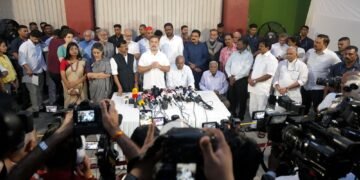
Sitharaman also visited Sohbar, becoming the first union minister to have visited the village, located along the Indo-Bangladesh border in East Khasi Hills district.
Addressing a gathering, the Union Minister emphasized that border villages like Sohbar are not the last, but the first point of contact for those entering India. “I chose this location because the Prime Minister believes that border villages are not the end of India, but its beginning. These are the eyes and ears of our nation, and they deserve priority development,” she said.
Sohbar, is one the 92 villages in Meghalaya included in the second edition of the Vibrant Villages Programme (VVP).
The Union Minister outlined four key development themes for VVP in Sohbar, which includes road infrastructure, telecom and digital connectivity, television coverage and electricity access.
She assured the people that within a 5 km radius, they would have access to a banking facility, ATM, or financial institution, helping villagers grow businesses right where they are.
With over 1600 residents in Sohbar, she encouraged people to take ownership of their growth journey, to build businesses, attract tourists, and show the world what border communities can offer.
Before wrapping up her four-day visit, the Finance Minister will visit the Ramakrishna Mission Ashram School in Sohra on Sunday.