











The Joint Action Committee on Border of Meghalaya (JACBOM) is carefully preparing its case to bring before the Supreme Court where it will challenge the Meghalaya-Assam border agreement signed earlier this year.
Speaking to Highland Post, Senior Lawyer Erwin Sutnga said that JACBOM continues to get documents including the 1878 document that describes the boundaries of the Khasi states that stretches up to Kamakhya. The documents also prove that other areas like Ratachera, etc are part of the Jaiñtia Kingdom.
“The British have all the documents. There is also a compilation of maps from 1833-1838 that shows that Blocks 1 and 2, Kamakhya, Ratacherra, etc fall under the Khasi-Jaiñtia states,” Sutnga said.
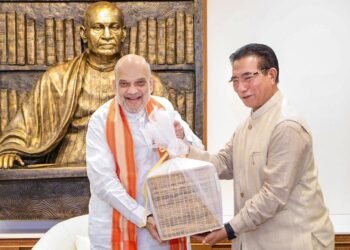
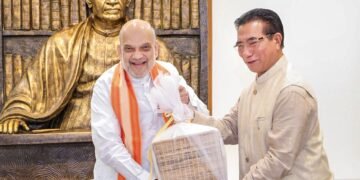
The border agreement, signed between the Chief Ministers of Meghalaya and Assam in New Delhi, was meant to resolve the longstanding dispute between the two states in six ‘less contentious’ areas. However, though the states have roughly split the 36 sq km of disputed territory between them, many residents in these areas, civil society organisations, pressure groups and the opposition are fiercely opposed to the agreement.
The state government has chosen to stick with the deal, claiming that it cannot be renegotiated, and blamed the previous government for not claiming some of the land that will now go to Assam once the agreement is approved by Parliament.
When asked how long the preparation will take before JACBOM is ready to move court, he said that any approach towards the apex court needs to be exercised with abundant caution.
“It’s hard to tell about the time frame since we continue to get more documents, but we will try to speed up this process to the best of our ability,” he said, adding that they are working day and night on the matter.
Sutnga, who unsuccessfully contested the 2018 election on a National People’s Party ticket before breaking with the ruling party, also maintained that this is not a question of winning or losing but a question of justice.
He also called for the ‘inter-state council’, under Article 263 of the Constitution, to be constituted so that what belongs to Assam should go to Assam and vice-versa.
“If it is impossible to return certain lands to Meghalaya, then the state should receive compensation, which will help us solve many problems, such as paying teacher salaries,” he said.
While the NPP’s allies in the Assembly are happy with the deal, other members of these allied parties, especially in the Khasi Hills Autonomous District Council (KHADC), are not.
One such, nominated MDC and senior United Democratic Party (UDP) member Bindo Lanong, recently said that the agreement is full of holes and cannot be supported, which is why many Himas have decided to challenge its legality.
“If the court finds that there is reason to believe that the MOU (memorandum of understanding) signed was done in haste, or improperly, and stays the agreement, then this is already a win-win situation,” he said.