



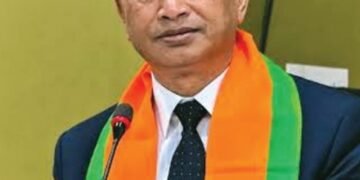








Shillong, May 3: Prof Lakhon Kma has confirmed he will not contest the upcoming Shillong Lok Sabha by-election as an independent candidate, even as talks to join other parties are ongoing.
Speaking to Highland Post recently, Kma said, “I am certain not to contest as an independent candidate.” He added that smaller parties and independents have a minimal impact in Parliament.
Kma mounted just such an independent campaign in the 2024 election but garnered a mere 18,000-plus votes, enough for less than a 2 percent share. The winner, Ricky AJ Syngkon, died suddenly in February, necessitating the by-election.
Kma stressed that Meghalaya needs an MP who can effectively liaise between the Centre and the state. “Going to Parliament alone and speaking for a minute or two makes no impact. It is always good to have a big group, probably a national party,” he said.
For a state like Meghalaya, Kma said, aligning with the ruling party at the Centre can be beneficial, provided it does not compromise the state’s needs and aspirations. “It has to be on your own terms and not that they will dictate your terms and conditions,” he said.
“An MP is not sitting in Parliament for only one state but also raises national issues that concern everyone, even though the main concern is for your regional constituency,” he added.
Kma said working with the ruling party also helps ensure fund flow, noting that “without funds, the noblest idea becomes futile.”
He said being on the ruling side could help resolve long-pending issues like the border dispute, Inner Line Permit (ILP) and the lack of medical and engineering colleges – many of which involve central government funding.
“Most importantly, issues which are purely central like ILP – if the central government doesn’t want to give it, you will never get it, and if it does, it can give you the next day,” Kma said.
“ILP is a long-pending demand of our stakeholders. If a government is ready to accommodate issues which are long pending and ready to give a resolution and not just lip service, I see no reason why anybody should not work with a ruling party in Delhi,” he opined.
He argued that even though the National People’s Party (NPP), which rules Meghalaya, works with the Bharatiya Janata Party (BJP), which is in charge at the Centre, allocations remain “restricted” because the NPP is not the BJP. “There is no free flow unless it is theirs (the BJP’s). So a smart move would be for our MP to align with the ruling party with a condition for the needs of the state but with bargaining power as well to resolve our long-pending issues,” he said.
When asked, Kma admitted that the people of the state have not accepted the BJP as a party in Meghalaya. “This would be a headache for the party and they have to come out with something convincing,” he said.
“A party like the BJP that has never come to power in our state in a full-fledged way — if they want to come to power in 2028 or win an MP seat, then they have to come out with all-convincing offers,” he added.
He said the BJP must explain why leaders or the public should join it. “If the leaders don’t even know why they are in the BJP, then how can they convey the same message to the people that they should be voting for the BJP?”
“If there is a concrete assurance that ILP would be given if they come to power, then people might think why they should opt for another party when a party can give us what we have not achieved for the last several years,” he said. “Whether ILP will work or not we don’t know, but it’s always good to experiment and fail than to not experiment at all.”
Kma said the same applies to the inclusion of Khasi and Garo languages in the Eighth Schedule. “Our posturing here is not going to help as the ball is with the Centre.”
“For Delhi, it will not be an issue to give it any given day. Yes, these are long-pending demands and the Centre should respect the sentiments of the state. But if it doesn’t respect the sentiments and is waiting to use it as a bargaining chip, then it is okay if they give it with an assurance,” he said.
“No matter what we do here, ultimately Delhi is going to decide. But they need to gain something out of it and like to take credit. So these messages have to be conveyed to Delhi with seriousness, and Delhi has to give its commitment with seriousness. Then you take it to the public and let the public decide,” he added.