











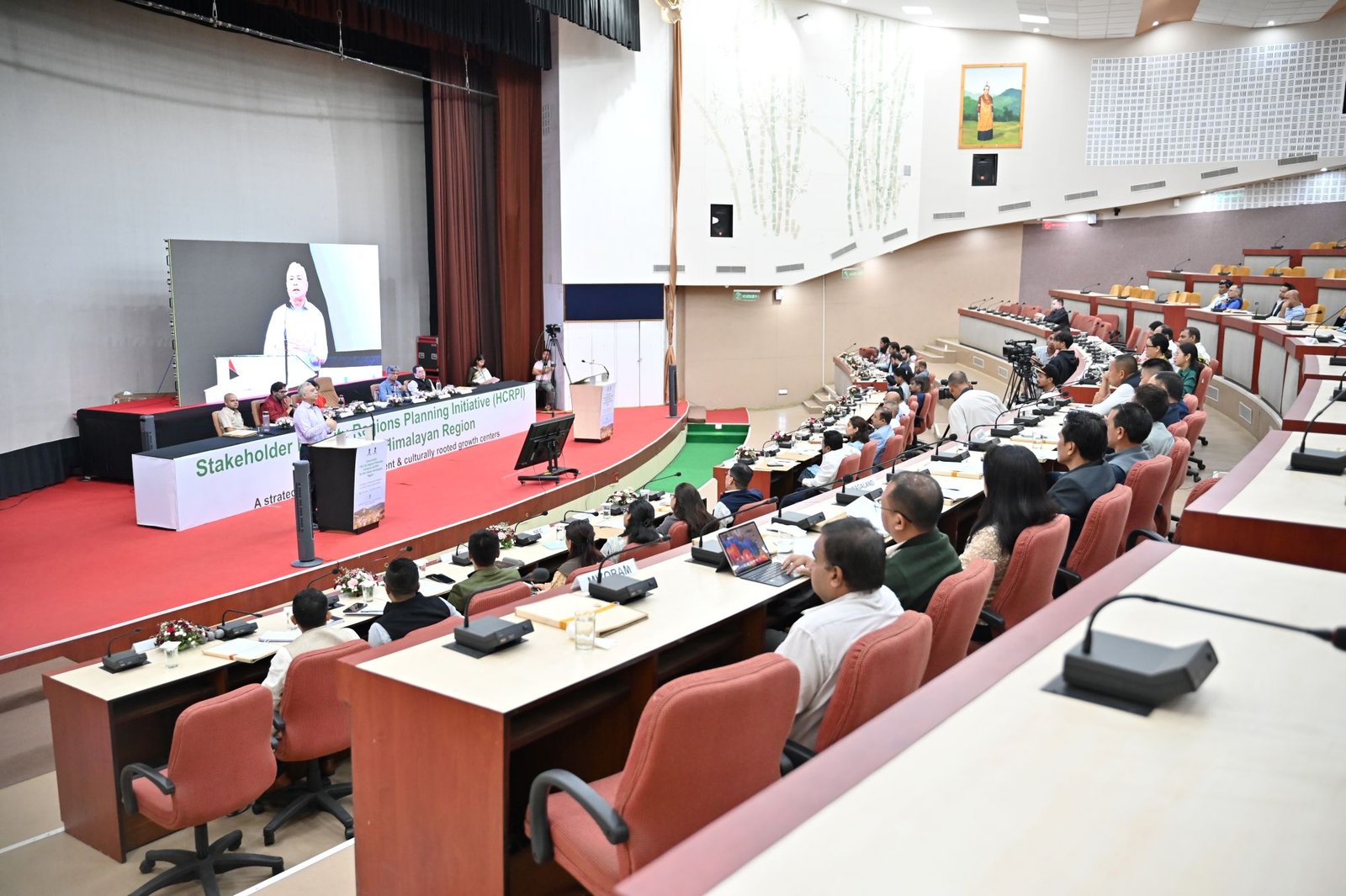
Shillong, Jul 14: The North Eastern Council (NEC) in collaboration with NITI Aayog, organised a ‘Stakeholder Consultation on the Hill City Regions Planning Initiative (HCRPI)’ here yesterday.
The consultation is a step towards developing a comprehensive, climate-resilient and terrain-sensitive planning framework for sustainable urban development across the Indian Himalayan Region (IHR).
The IHR is experiencing rapid urbanisation amidst fragile ecosystems, difficult terrain, increasing climate risks and unique socio-cultural landscapes.
Conventional urban planning approaches, primarily designed for the plains, often fall short in addressing the complexities of hill settlements. Recognising these challenges, NITI Aayog launched the HCRPI and constituted an executive committee on urban development in the Indian Himalayan Region in collaboration with the NEC, bringing together domain experts, practitioners and policymakers to formulate an integrated planning framework for hill city regions.
The proposed framework seeks to provide practical guidance on regional planning, ecological carrying capacity assessment, climate resilience, sustainable infrastructure, economic development, governance, financing mechanisms and implementation strategies tailored to the unique characteristics of hill regions.
The stakeholder consultation has been convened to obtain valuable inputs from states and Union territories of the IHR for the preparation of the framework. The discussions focused on the opportunities and challenges of hill urbanisation, identification of priority interventions, selection of potential pilot regions and formulation of a shared roadmap for sustainable, resilient and economically vibrant hill city regions.
The programme commenced with a welcome address by Anna Roy, Programme Director (Managing Urbanisation) at NITI Aayog, followed by a special address by Satinder Kumar Bhalla, NEC Secretary.
The technical sessions featured presentations by eminent experts covering key aspects of sustainable hill city planning. Roy provided the context and objectives of the initiative, while urban expert Jagan Shah presented national and international best practices in hill city planning. Former deputy mayor Tikender Singh also deliberated on governance, policy, spatial planning and the political economy of the Himalayas. Prof Arup Sarma of IIT Guwahati presented on carrying capacity assessment for hill cities and Snehit Prakash, BORDA Asia, discussed urban service delivery and infrastructure gaps in the IHR.
The consultation is expected to generate valuable policy recommendations and foster greater collaboration among governments, experts and institutions for promoting environmentally sustainable, climate-resilient and economically inclusive urban development across the IHR. The programme concluded with a “Way Forward” session outlining the next steps for finalising the Hill City Regions Planning Framework and identifying future collaborative actions for its implementation.