






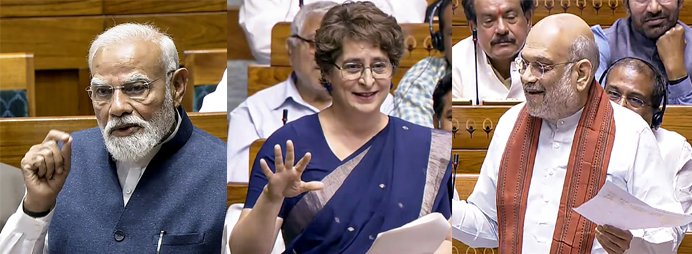
New Delhi, Apr 16: Strongly backing the implementation of women’s reservation in legislatures in 2029, Prime Minister Narendra Modi on Thursday made it clear that no state will be discriminated against in the delimitation of constituencies, even as the opposition claimed democracy will be finished in India if the Constitution amendment bill is passed.
Intervening in the debate in Lok Sabha on the three bills introduced for amendment of the women’s quota law and to set up a delimitation commission, Modi also said if any political party opposes the women’s quota law, it is quite natural that he (Modi) would be politically benefited.
“Those who oppose women quota bill will pay a price for a long time,” he said.
“Here, some people think that there is political self-interest of Modi in this move. If you oppose it, natural I will gain political benefit, but if you walk along, no one will gain any political advantage. We don’t want credit,” he added.
Allaying fears of some states over the delimitation exercise, particularly those from the southern and eastern regions, the prime minister said no state will be discriminated against under the move.
“I want to say from this House today with a great sense of responsibility that whether it is the south, the north, the east, the west, small states or big states, this decision making process will not discriminate against any state or do injustice to anyone,” he said.
Modi also made it clear that the proportion of Lok Sabha seats in any state will not come down as a result of the delimitation exercise.
“There will be no change in that proportion (of Lok Sabha seats) either, and the increase will also be in the same proportion,” he said.
In his short response to the debate during the day, Union Home Minister Amit Shah said the Lok Sabha seats in five southern states will go up to 195 from the present 129, an increase of 50 per cent, when the total seats in the Lower House will be enhanced to 816.
He alleged a false narrative is being spread to float misleading information.
Shah also said the proposed women’s reservation will be implemented only in 2029 and till then all polls will be conducted under the present system.
He said the percentage of power will increase from 23.76 per cent to 23.87 or almost 24 per cent.
“Lok Sabha seats in Karnataka will increase to 42 from the present 28; in Andhra Pradesh, the number of Lok Sabha sets will increase to 38 from 25; in Telangana, it will be 26 from present 17; in Tamil Nadu, the number of Lok Sabha seats will go up to 59 from the present 39; and in Kerala, it will be 30 seats from the present 20,” he said.
According to the bill, the Lok Sabha seats will go up to a maximum of 850 but Shah explained that it was a rounded figure and the seats will remain at 816.
Explaining how the total number of seats in the new Lok Sabha is fixed at 816, the home minister said it is exactly 50 per cent more than the existing number of seats.
Participating in the debate, Congress leader Priyanka Gandhi Vadra said the government began finishing off democracy by putting pressure on institutions, such as the Election Commission (EC) and the judiciary, but now, an “open attack” has been launched on democracy with the Constitution amendment bill.
She asked why can’t the government give 33 per cent reservation to women on the current 543 seats of the Lok Sabha.
“The government began finishing off democracy by putting pressure on institutions, such as the Election Commission, the judiciary, the media etc., but now, an open attack on democracy is being launched,” Gandhi said.
If this Constitution amendment bill is passed in Parliament, democracy will be finished in India, she added.
Samajwadi Party president Akhilesh Yadav accused the BJP-led central government of turning ‘nari’ (women) into a “nara” (slogan) for political benefits and demanded reservation for OBC and Muslim women under the proposed women’s quota law.
Yadav, during the debate, said the Samajwadi Party has always supported reservation for women and furthered the cause of women-led development.
All socialist leaders have believed in gender and social justice, he said.
The former Uttar Pradesh chief minister sought to corner the ruling party on the women’s reservation issue, saying the BJP and its allies have governments in 21 states and Union territories, but they have only one woman chief minister in Delhi.
NDA partner TDP’s MP Byreddy Shabari, while extending support to the women’s quota bills, said the nation is now talking about women-led development and the proposed legislation will give them an opportunity to lead the country in the rightful way.
Another NDA partner, Janata Dal (United) [JD(U)], extended support to the bills, and asserted that the Modi government is committed to “nari shakti”.
JDU MP Dileshwar Kamait said the role of women in country’s development will have to be expanded to realise the goal of Viksit Bharat by 2047.
The Constitution (131st Amendment) Bill to tweak the women’s quota law was introduced in Lok Sabha on Thursday after a division of votes.
Two ordinary bills — the Delimitation Bill and the Union Territories Laws (Amendment) Bill to implement the proposed amended women’s quota law in Union territories of Delhi, Puducherry and Jammu and Kashmir — were also introduced in the House.
The bills were introduced after a fiery 40-minute debate following which the opposition pressed for the division of votes to introduce the Constitutional (131st Amendment) Bill.
The bill was later introduced with 251 members supporting it and 185 members voting against the introduction. (PTI)