












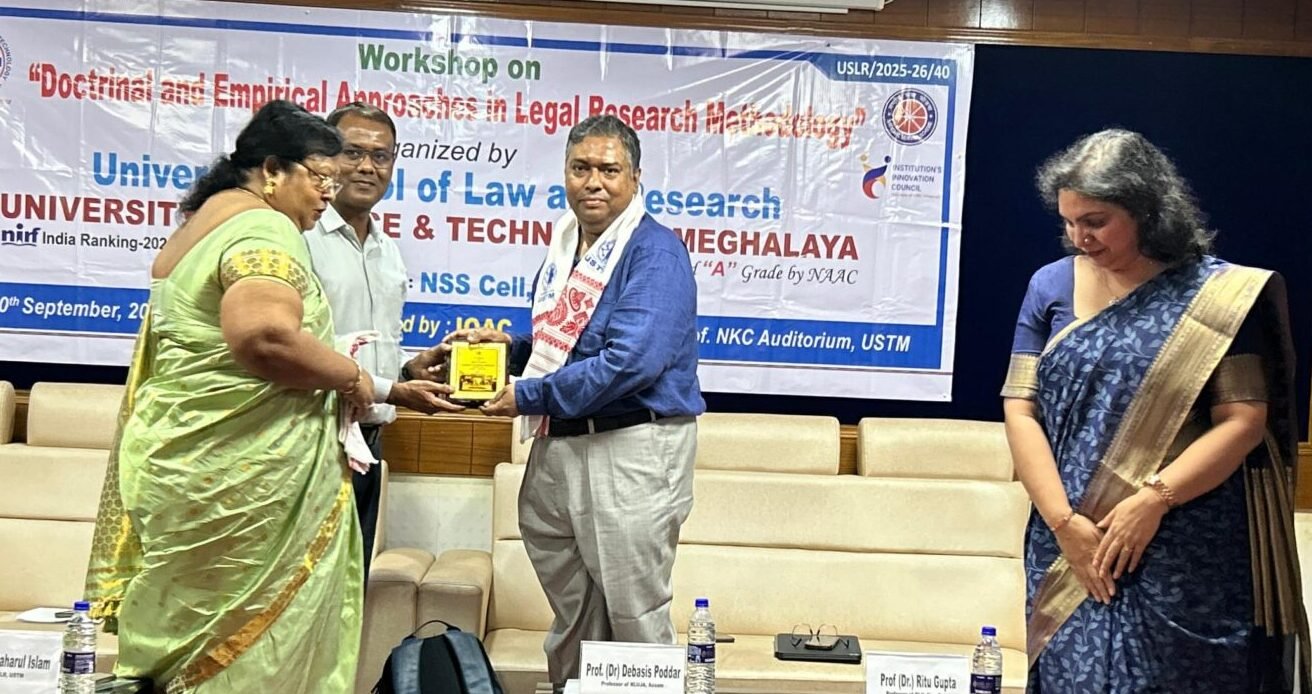
Shillong, Sep 22: A workshop on ‘Doctrinal and Empirical Approaches in Legal Research Methodology’ was organised by the University School of Law and Research (USLR), USTM which was attended by faculty, research scholars, and students of the law department.
Legal research, which is the foundation of legal education and practice, enables scholars and practitioners to understand, interpret, and apply the law effectively.
The doctrinal approach often referred to as “library-based research,” focuses on analysing statutes, case laws, and authoritative commentaries. It seeks to clarify and systematize legal principles, ensuring coherence and consistency in the legal framework and is essential for developing accurate interpretations and strengthening the theoretical foundations of law.
The empirical approach employs tools such as surveys, interviews, and field studies to examine how legal rules impact people, institutions, and communities. By revealing the gap between law in books and law in action, empirical research enriches legal studies with real-world insights.
Prof. (Dr.) Ritu Gupta of the National Law University, New Delhi, delivered a talk on empirical legal research methodology. She explained the purpose of research, the role of ethics, qualitative and quantitative methods, and the importance of systematic sampling. She emphasised that legal research must aim to benefit society and cautioned against overreliance on AI without deeper study.
Prof. (Dr.) Debasis Poddar of NLUJA Assam spoke on doctrinal legal research methodology. He highlighted its role in interpreting statutes, precedents, and principles like the basic structure, while also clarifying its distinction from “indoctrinated research.” He stressed that doctrinal and empirical methods complement one another and noted the growing relevance of AI in legal research.
The session was followed by an interactive discussion between the speakers, faculty, and students.