








By Lurshai Chynret
High above Shillong rises a hill that has kept vigil over this valley longer than any ministry, manifesto, or bureaucratic file. Its name is U Lum Shyllong. Khasi elders speak of it not as real estate or geography, but as the living breath of the land – the sacred abode of U Lei Shyllong, the guardian deity woven into the origin, memory, and moral order of the Khasi people. Today, that breath is laboured and troubled. What began on a quiet hillside in Madan Laban has ripened into an existential trial for Shillong: do the commons of a Sixth Schedule people belong to open Dorbars and living custom, or to closed files and hurried commercial deals?
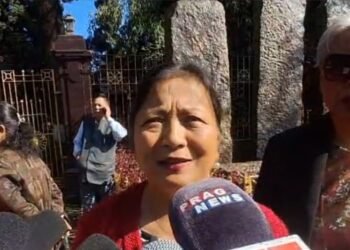
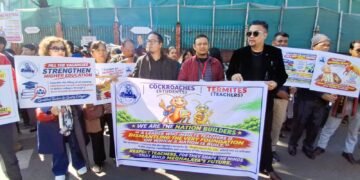
At the moral centre of this trial stand the women of the Joint Action Committee (JAC) Against the Shillong Ropeway Project. Since 6 November 2026, they have kept an indefinite sit-in near Civil Hospital, right beneath the statue of our patriot, U Kiang Nangbah. They are largely mothers and grandmothers from Laban and Lawsohtun – women who, in the traditional sense that defines a matrilineal society, embody the continuity of the hearth, clan, and life itself. Yet here they are, huddled under a makeshift tent braving the cold winter and harsh November rain, asking not for office or patronage, but for water security and for the sanctity of U Lum Shyllong. Their moral clarity pierces through every bureaucratic euphemism: when a mother falls gravely ill, a household does not appoint a committee to study her fever while continuing to administer poison; it halts the poison first. Safeguarding the nine perennial springs cradled within the 204.66-hectare Riat Laban Reserved Forest (notified as far back as 28 March 1988) is not anti-development sentiment; it is elementary self-preservation. Moreover, to embrace relocation is not to retreat from tourism, but to rescue it from self-sabotage. Shifting the alignment onto willing, uncontested terrain would dissolve years of impending litigation, spare a fragile urban watershed, and restore public faith. In a Sixth Schedule polity, commercial ambition cannot simply vault over the collective will of a Dorbar Shnong.
That those in authority refuse so sensible a compromise reveals the true anatomy of this crisis. The quarrel is not over cables or trolleys; it is over opacity, the commodification of the sacred, and what happens to a society when custodians forget the limits of their trust. For too long, power has operated on the quiet assumption that Khasi courtesy is a synonym for compliance – that citizens are too polite to demand written records or interrogate convenient silences. In Shillong today, caretakers behave like proprietors, while the rightful inheritors of the land are treated like trespassers in their own heritage and branded as “outsiders”.
This inversion strikes at the bedrock of Khasi customary jurisprudence: who can alienate community land? Under Khasi custom, a Rangbah Shnong serves the people under a sanad from the Syiem of Hima Mylliem. As per the KHADC’s 2007 Mylliem Syiemship Act, Section 2(o), defines a Rangbah Shnong as a locality’s traditional head, and he is bound by customary practice and collective Dorbar Shnong resolutions rather than unilateral acts, while even the Syiem answers to the Dorbar Hima. Therefore, community land cannot be alienated behind closed doors by selective signatures. In Khasi, a headman is a nongkhmih, nongsumar, and nongiada (a keeper, nurturer, and protector), never a nongdie (a seller). On 28 October 2026, JAC representatives met the Syiem of Hima Mylliem, Ainam Manik Syiem, seeking revocation of the sanads of headmen tied to the 16 January 2023 Riat Laban Dorbar Pyllun land lease, alleging they acted without a popular mandate, while also petitioning the Rangbah Shnong to withdraw the signed lease. Until the time of writing this article, no written revocation has been announced, leaving residents in Laban and Shillong to rumour while mothers wait in a makeshift tent for a recorded verdict.
Such institutional silence corrodes the deeper ethic of democratic trust that Dr. B. R. Ambedkar placed at the heart of the Indian Republic. Addressing the Constituent Assembly in November 1949, Ambedkar warned that political democracy cannot endure unless anchored in social democracy and “constitutional morality”. When decisions migrate from open Dorbar halls to backroom files, that moral contract collapses. Power that refuses to examine its own breach of public trust will never comprehend why citizens cease to believe its assurances.
Closer to home in South Shillong, that refusal of honest self-examination has staged a perplexing political theatre. Laban-Mawprem MDC Ricky Shullai, nephew of South Shillong MLA and Cabinet Minister Sanbor Shullai, publicly broke ranks by questioning tree felling, threatened springs, and contractor licensing. Voters ask whether they are witnessing a genuine rupture of conscience or a calculated division of labour across the same electoral base: while the nephew voices neighbourhood anxiety, the uncle has stayed away from the mothers holding a sit-in vigil. Equally telling was the 19-South Shillong Advisory Committee meeting at the State Convention Centre on 11 November 2026, which collapsed in five minutes. The JAC maintains the session was abruptly terminated after a pre-drafted resolution was read out; the minister counters that uproar followed his call for an independent technical panel from IITs and NITs and his warning that delays escalate project costs. Yet proposing a fresh committee after insisting for months that existing clearances are faultless exposes an acute contradiction. Either the sitting minister doubts his own government’s record, or he is performing a late-stage pivot, casting himself as a cautious arbiter while preparing to blame protesting citizens for delays. When public office becomes an exercise in tactical distance, citizens chase shadows while the forest is already gone. Therefore, residents of Shillong scarcely need imagination to foresee where the “committee route” leads. Officialdom habitually takes refuge behind jurisdictional buck-passing whereas files gather dust in the Secretariat. In such hands, a committee is not an instrument of governance; it is an alibi.
While committees immobilise accountability inside government, commercial lobbies outside have lectured the public on civic reputation, only to stumble over contradictions. On 17 November 2026, Parambir Singh Sehdave, President of the Federation of Shillong Hotels, cautioned against halting the Shillong Peak Ropeway midway, arguing that 2023 departmental approvals made stopping it seem “unfair” and cast Shillong “in a very bad light.” Yet he confessed: “I am not an environmentalist. I don’t know the area, what is the impact on the environment there and the catchment area there.” That admission exposes the hollowness of purely commercial advocacy: one cannot plead ignorance of a mountain’s hydrology whilst judging citizens saving their drinking water. Celebrating near-full December occupancy around the Cherry Blossom Festival, he urged moving it into lean monsoon months like August and September, when occupancy dips toward 20 per cent, treating nature’s seasons as movable props for room-night yields. Within twenty-four hours, on 18 November 2026, he retreated, claiming the Federation had “never extended its support” to the ropeway, seeking a “balanced approach”, and blaming media misinterpretation. Citizens should study that reversal carefully: occupancy charts cannot manufacture potable water, and tourists in trolleys cannot drink cables when taps run dry.
Instead of heeding to such cautionary signs, ministers and official defenders have doubled down on political gaslighting, shifting goalposts whenever empirical questions grow inconvenient and reducing public trusteeship to a clerical checklist. Tourism Minister Paul Lyngdoh claims relocation means starting from zero, brushing aside citizens defending their water, while Deputy Chief Minister Prestone Tynsong waves away dissent with impatience. Authority avoids open Dorbar minutes and public scrutiny. Meanwhile, roughly ₹2.5 crore in annual MLA scheme funds risks turning entitlements into political patronage and headmen into petitioners for state largesse.
Against this chorus of evasion, on 17 November 2026, North Shillong MLA Adelbert Nongrum petitioned the Chief Secretary to halt work on the Shillong Peak Ropeway Project, invoking the Indian Forest Act, 1927, the Forest (Conservation) Act, 1980, and the Forest Rights Act, 2006. It was a principled intervention: a commercial ropeway has no place in a protected space. After placing those laws on record, he sat with the mothers at U Kiang Nangbah statue. His presence beside them points to the central truth beneath the makeshift tent: justice deferred by endless procedural theatre is punishment. Shillong does not need concrete branding at the price of its watershed or the desecration of U Lum Shyllong.
In the Khasi moral universe, land (Ka Ri), water (Ka Um), and motherhood (Ka Longkmie) are bound together by reverence, kinship, and inter-generational duty. Forcing our mothers and grandmothers to sleep in a makeshift tent whilst leaders hide behind technicalities and comfort of their offices is a grave failure of stewardship. Until then, the duty rests with every citizen of Shillong to stand beside the mothers at U Kiang Nangbah statue, demand open Dorbar resolutions and written accountability, and compel the state to honour its public trust and guard U Lum Shyllong for generations yet unborn.
(The author is resident of Madan Laban Rum, Laban, Shillong)