






By Jerry Pyrtuh
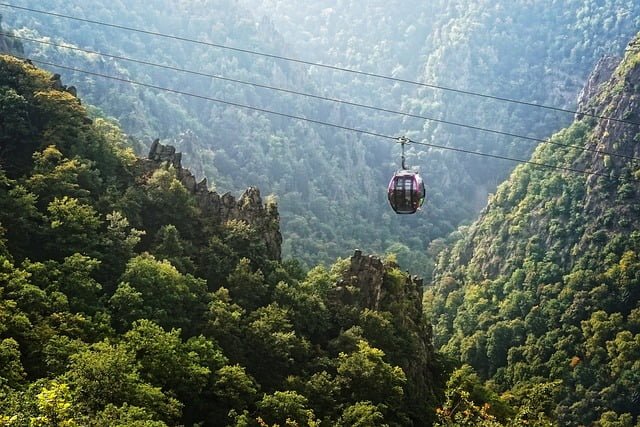
The Rs. 151-crore ropeway project raises concerns that extend well beyond debates over sustainable and unsustainable development. The question is not just whether a ropeway should be constructed at Shillong Peak, but rather what its construction tells us about the kind of developmental future we aspire for Meghalaya.
I want to suggest that the project is symptomatic of an imagination that privileges spectacle over essential systems and touristic consumption over the will of local populations. When the aspirations of tourists and investors become central to the state’s developmental agenda, the resulting ignorance on local needs becomes a deeper political problem that needs to be situated within Meghalaya’s bigger picture. Some notes:
- At the beginning of this year, the government announced its target on reaching a $16 billion economy by 2032. Investments in the Tourism industry have become one major way for translating this economic optimism into action. New policies and schemes, such as the beautification projects, the Tourism infrastructure scheme, and so on, are strategically packaged around the ‘right kind’ of language. As they appear in gazettes or newspapers, we see them along with phrases such as community engagement, sustainability, ecological responsibility, and cultural sensitivity. Almost promising on paper, these taglines have come to act as deceptive code words under which any form of political and personal interest may be carried out unchecked. It is not surprising therefore, that infrastructural changes in the state have largely concerned themselves with ‘ornamental’ development. We have received more statues and murals than we can count, strange urban designs centered around the ‘car’ as a marker of city-life, highway projects with constructed roads already showing signs of damage (Nitin Gadkari announced the total budget as Rs. 52,400 crores), the Rs. 438.23 crore mega monolith tower in Mawkhanu, amongst many others. As these projects seek to invent the image of progress in Meghalaya, we are also left to wonder about the sectors that have received little to no attention.
The NITI Aayog has continuously ranked Meghalaya as one of India’s poorest states. It has especially raised concerning numbers with regards to the poverty rates in places like West Khasi Hills, East Jaintia Hills, West Jaintia Hills, and Ri Bhoi district. Moreover, Community health centers across the state have been reported as ill-equipped just as schools have been under-resourced. Currently, deficit teachers are protesting for dignified pay while the government has refused to acknowledge their request. The problems of Meghalaya are endless should we choose to look further. The point here is that as ‘tourism’ takes priority, the government has traded development that concerns the everyday needs of ordinary citizens for one that values spectacle. In prioritizing ornamental infrastructures over essential systems, people who call Meghalaya their home are completely sidelined to make room for the ever-expanding playground of the tourist. At the Responsible Tourism Summit & Awards 2026, the chief minister announced, “We will be a responsible tourism model for the world”. So far, the terms of these responsibilities have stood thoroughly perverted by desires to bulldoze the state in an attempt to reshape it into a feverish dream destination. The chief minister’s efforts to sear the stamp of “Meghalaya Tourism” thus limits the state to a mere site to be marketed for the pleasure of its visitors. It is here where the tourist-economy obscures the common people of Meghalaya, rendering them as second class citizens.
- As ministers and their ilk tout the economic allure of tourism, they make a case for who the benefactor of this new developmental strategy is. Here, the ‘tourist’ emerged as the figure privileged by our governing institutions. Local populations are, or have been, or will be roped into service industries that have to perpetually cater to this figure. The tourist is fed by the best of restaurants, they are housed in pristine homestays and hotels, they take pictures in ‘tribal’ attires and pictures of ‘tribal life’, they compare Meghalaya to Switzerland or Scotland or some other European destination, and they praise tribal hospitality in their 1-minute reels on Instagram or Facebook. The problem here, if it is not already apparent enough, is that the colonial structure of social relations is reestablished through our postcolonial institutions. When the British arrived in the hills, particularly through the East India company in 1824, they saw this place as an opportunity for expanding trade as much as it was an opportunity for their leisure. Local expressions of hospitality were appropriated into servitude towards ambassadors of the empire. As Shillong became the ‘hill station’ and the ‘summer capital’, the British determined themselves as lords who dictate civilizational values and administrative systems.
Ideas of tribal servitude acts as the means for locking up the local populations within a monolithic vision that restricts any historical change. The connection between tribal life and servitude can be read as a system that opposes expressions of tribal subjectivities. In other words, it ontologizes the ‘tribal’ as an actor whose existence is defined by the demands of the powerful other. The contemporary case laid out by the dynamics of the tourism economy makes this assertion quite clear. Tourism reorganizes the demands for tribal servitude through models of hospitality and through the commodification of cultural difference. This assigns the social order in which the locals must exist at the feet of the tourist. Tribals must serve the tourist, they must sacrifice themselves- their water, their earth, their own needs- to accommodate the desires of the tourist, they must even cut off the limbs of their god so that the city can belong to the tourist at the instance of a sight. How this becomes a logical arrangement is only because the colonial encounter laid out the foundation that turns our history into a house of mirrors. There, we are perpetually fooled into believing that progress only comes when we live in service of the powerful other.
- In noting the dangers in which we are made passive to the powers and aspirations of governing institutions, the aim is to disturb it and to refuse with all our might the tools that conspire against us. Let us return to the colonial example. One historical figure who captures this imagination of resistance is a woman whom the English botanist and friend of Darwin, JD Hooker, wrote with scorn in his Himalayan journals, 1891. Identified simply as an ‘old lady’, Hooker arrived sometime in 1850 at her jowye (Jowai) doorsteps in need of accommodation. The old lady provided a ‘clean’ and ‘very long’ cottage but her patience with Hooker and his companions grew thin “before two days were over”. According to Hooker, the lady had tried to smoke them out by burning a fire of green wood and later, caused a racket by hosting other guests for supper. Hooker eventually left the accommodation on the 30th of September of the same year. Granted that multiple interpretations of this event are within the realms of possibilities, I am inclined to read it as a sign that intimately registers tribal refusal against colonial exploitation. The old lady’s actions cannot be alienated from what the English were doing during this period in history. After the Anglo-Khasi war that ended with the defeat of U Tirot Sing in 1833, the empire became a punitive force in administering life across the hills, whether it was the imposition of heavy taxes or forced labor or their policies of imperial subjugation. The old lady cast her suspicion on Hooker, and in so doing, she performed a political act that challenged the reach and the conduct of the empire. This is a lesson on resistance.
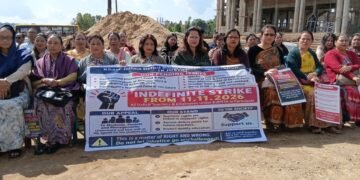
It is this same suspicion that can be carried over as we negotiate with the postcolonial governing impulse to reduce us into passive recipients of development. It is certainly one that many women are deeply aware of. Kong Spility Lyngdoh Langrin channelled it until her dying breath when she refused to give up her land for Uranium mining. Kong Agnes Kharshiing and Anita Sangma reached for it when they risked their lives by following coal trucks to Tuber, an act that resulted in their violent attack by the mafia that had not heeded the NGT ban on ‘rat-hole’ coal mining. Kong Angela Rangad carried out a hunger-strike when she refused to let the money from the Chief Minister’s Relief Against Wage Loss scheme disappear into the pockets of our ministers and bureaucrats, and she has in many other instances shown us what a politics that puts people first means. As the mothers protest on the streets of Shillong over the ropeway project, it is this same suspicion that they call upon. This is a suspicion about loss, about losing not only our land but also who we are as a people when we gamble everything whilst drunk on the intoxicating promise of a tourist-first development.
- Some have understood the protests around the ropeway project as a ‘Shillong-centric’ concern. This, I beg to differ with. The question is not simply an emotional appeal to preserve Shillong peak as a way of keeping the identity of the town intact, nor is it merely a theological or cosmological debate over ‘Lei Shyllong’ as a god presiding over us as a people, neither is it an ecological presupposition over what Shillong will lose when the ropeway is constructed. Although all of these have clear merits on their own, yet a certain paradox here also requires our attention. The paradox: Shillong is increasingly organized around the prospects of tourism, while the developmental needs of other places and populations remain insufficiently addressed. Projects like the ropeway, I believe, are symptoms of what Shillong-centric development looks like, not evidence of a Shillong-centric outrage. As I have established in point 1., efforts to develop Shillong for the touristic gaze have starved many sectors and places in Meghalaya. We cannot treat the ropeway as an isolated activity that bears little consequence to public life. It perhaps goes without saying that the money our governments put towards these projects can be better used elsewhere, especially towards where needs remain most unmet. When considering the case of development, we cannot be restricted by an imagination of modernity that is ripped out of the colonial playbook. On the contrary, any reasonable idea must at its core be concerned with the delivery of systems and infrastructures that accommodate the visions and the demands of those that are the most marginalized.
A ‘Smart’ design should not mean reshaping Meghalaya into a technological and ornamental hub, but into a place that is able to accommodate every single citizen. This is perhaps already a known fact- it is the thing that we feel when we read about women birthing babies on dirt roads because no hospital is in sight, or when we hear of drops in literacy or school-retention rates, or when we see people struggling for food or water or medicine, and when climate change touches our forests and our crops alike.
I am convinced that we have the heart to sense the faults of governance and therefore, the vision to direct developmental goals towards collective ends. Should we allow the tourism industry to be the singular determinant of our futures then we surrender the will to liberate each other from History’s waiting room. We have spent a long time being told what progress should look like and what sacrifices must be made in its name. The women protesting the ropeway remind us that another political imagination is necessary, one that casts suspicion and refusal over the developmental conditions we are forced upon and one that tirelessly demands that the terms of our social change be determined by the people who must live with its consequences. The time is more than ripe for us to smoke out the regime of ornamental development in order to put first the material conditions that can make meaningful citizenship possible.
(The author is a PhD student of History and Sociology of Science at the University of Pennsylvania)