

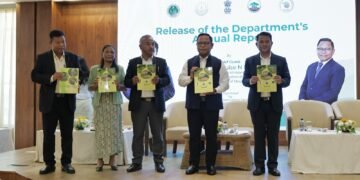








The Election Commission of India (ECI)’s plan to initiate a Special Intensive Review of the electoral rolls in Meghalaya as announced by the State Chief Electoral Officer last week is a welcome move to bring the crucial voter rolls up-to-date. But such a move coming in the context of the contentious SIR in Bihar, where it has raised much hue and cry, any reference to SIRs in any state causes uneasiness and even fear among many sections of the citizens who are already targeted and suffering being labeled as ‘migrants’, ‘foreigners’ ‘Bangladeshi’ and such other names. Some heads of states have openly refused to allow SIRs to be held in their jurisdiction fearing manipulation of the voters list.
While that level of fear would not be possibly present in Meghalaya, where electoral politics does not follow the formula of the region known as the cow belt states, i.e. the Hindu-Muslim, caste calculations and the like does not apply here, it is the local tribes verses the others which holds sway. There have been demands on and off over the years to clear the electoral rolls of migrants. Migrants being the operative term, it could get pretty messy if this word is not defined clearly and with clarity.
It is a mater to be noted that the ECI said that among several reasons for holding the SIR, is that urbanization and frequent migration has created risks of duplicate entries. This means that there are persons hailing originally from one state where they have their voter ID, eventually enrolling in another state where they have migrated to and being a voter in that state too.
However, when asked to explain the method as to how such voters with duplicate entries could be identified and removed from the list, the CEO of Meghalaya could not give a satisfactory answer. The question therefore remains as to the measures being taken by the ECI to ensure that the rule of ‘one person, one vote’ is strictly followed. As a guesstimate, it would not be wrong to say that Meghalaya could have quite a number of such voters with double entries.
In a span of 20 years, between 2005 and 2025, the number of voters increased by about 10 lakhs. This number is quite large as it amounts to an average of 50,000 voters being added to the electoral list every year. To some it could be proof that it is not only the 18 year olds lining up as new voters but others.
The CEO has clearly laid out the documents that are required to prove one’s identity as well as back up one’s claim to be in the electoral rolls. This also includes the AADHAR card which was earlier refused to be recognized as a document for the purpose by the ECI. It took a ruling of the Supreme Court of India to force the ECI to accept AADHAR as one of the documents that a voter can submit as proof of identity.
In the backdrop of the controversy of the Bihar SIR process, one can only hope that the Meghalaya SIR goes ahead smoothly and that all the bona fide citizens irrespective of race, caste, creed and religion are added to the SIR rolls without having to have any problems.