












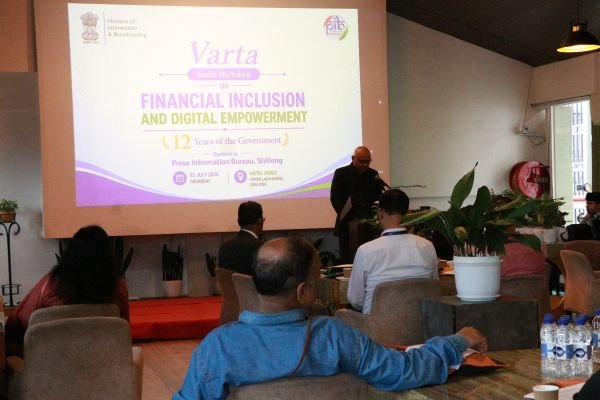
Shillong, Jul 2: Meghalaya has just shy of 10 lakh zero balance bank accounts, according to Ejaz Ahmad, Deputy General Manager of State Bank of India, Shillong.
Ahmad said this during a media workshop on ‘Financial Inclusion & Digital Empowerment – 12 Years of the Government’ here today.
He said that the central government’s vision of making banking accessible, affordable and technology-driven has delivered tangible outcomes across the state. Meghalaya today has 9.99 lakh Pradhan Mantri Jan Dhan Yojana (PMJDY) zero balance accounts, equivalent to 42,152 accounts per lakh adult population, with SBI alone accounting for 3.55 lakh accounts, representing 36 percent of the total PMJDY accounts in the state.
Delivering the inaugural address, Olden Nongpluh, General Manager of RBI Shillong, said the last 12 years have witnessed a paradigm shift in financial inclusion through the Jan Dhan-Aadhaar-Mobile (JAM) trinity, direct benefit transfer (DBT) and digital public infrastructure, which have expanded banking access, improved transparency and accelerated digital adoption across the country.
He also informed that 98 per cent of account holders in Meghalaya have adopted at least one digital mode of transaction, with efforts underway to achieve universal and meaningful digital adoption.
Ahmad further informed that enrolment under the government’s flagship social security schemes has expanded significantly, with 5.08 lakh beneficiaries under Pradhan Mantri Jeevan Jyoti Bima Yojana (PMJJBY), 9.36 lakh under Pradhan Mantri Suraksha Bima Yojana (PMSBY) and 1.02 lakh under Atal Pension Yojana (APY) in Meghalaya. SBI continues to be the largest contributor, accounting for 32 per cent, 49 per cent and 50 per cent of enrolments under these schemes respectively.
Speaking on India’s digital transformation, Ahmad said the country recorded 21,860 crore digital transactions during 2025–26, while Meghalaya alone registered 32.76 crore digital transactions during the same period. He added that DBT and Aadhaar-based authentication have transformed welfare delivery by ensuring benefits reach genuine beneficiaries directly, eliminating leakages, curbing corruption and strengthening public trust.