










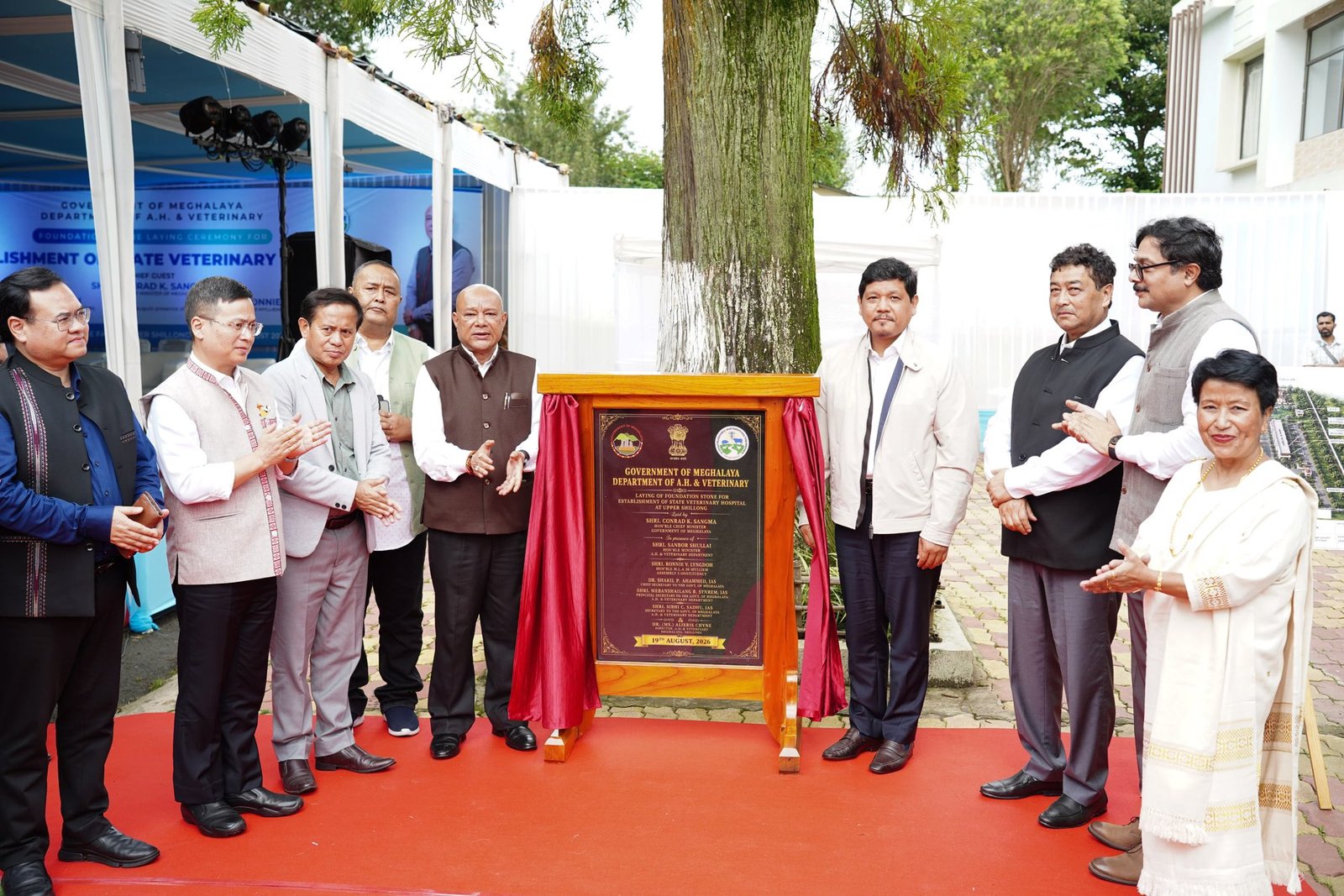
Shillong, Aug 19: Chief Minister Conrad K Sangma on Wednesday laid the foundation stone for the new State Veterinary Hospital at Upper Shillong and for the boundary wall of Ka Seng Bah Nongshat Nongkheiñ Hynñiewtrep Hynñiewskum Baniun Village.
The ₹65 crore hospital will come up on 161 acres of departmental land. It is designed as the apex referral institution with district and subdivision facilities as spokes.
The new hospital will provide modern diagnostics, radiology and imaging, surgery, orthopaedics, inpatient services, laboratory and pharmacy under one roof, along with 24×7 emergency and critical care.
Officials said it will reduce referrals outside the state and strengthen animal disease surveillance and public health preparedness. More than 25 per cent of cases at the existing hospital are referrals, highlighting the need for a larger facility
Addressing the gathering at Indo Dan guest house, the Chief Minister said the hospital must function as a hub with machines, equipment, medicines and manpower at all levels. “The larger purpose should be to create livelihoods and minimise demand and supply differences through a systematic approach,” he said.
He urged the Animal Husbandry & Veterinary department to prepare a comprehensive five-year plan, and to focus on entrepreneurship, investment, clear timelines and quality control. “Let us ensure that this veterinary hospital is one of the best hospitals and research centres in the Animal Husbandry and Veterinary sector for the entire North East,” he said.
At Baniun village, the Chief Minister laid the foundation stone for the boundary wall of Ka Seng Bah Nongshat Nongkheiñ, at a cost of ₹41,69,260 funded under CMSDF 2025-26.
The Seng, established in 1982 at Madanriting, assists people who follow the indigenous faith “Ka Niam Tynrai” and provides guidance on traditional rites, rituals and healing practices.
Calling it a step to uphold tradition, culture and identity, Sangma said: “It is only with unity and respect and by working together we can move forward as a society and as a state.”