











Shillong, Jul 5: At a time when Meghalaya is seeking to make it easier for coal mine owners to restart operations, Jharkhand’s experience of so-called scientific coal mining and rehabilitating the land once the mineral is extracted should give Meghalaya policymakers and the general public much pause for thought.
Rat-hole, not open cast mining, was the norm in coal-rich areas of Meghalaya up until 2014 when the National Green Tribunal (NGT) banned the practice completely on environmental and safety grounds. Although illegal operations have continued since then, the state government worked to bring Meghalaya into the national coal framework by engaging with the Union Coal Ministry and Coal India Ltd.
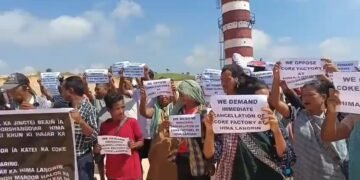
Meghalaya is at a point where so-called scientific mining is supposed to get the industry going again but stakeholders, especially in East Jaintia Hills, have been protesting that the 100 hectare prerequisite is too onerous for small-scale miners. The state government has agreed with this and will try and get the central government to loosen the requirement. Ministers have also agreed that open cast mining is infeasible in Meghalaya where the coal seams are thin.
There are also regulations on the need to return coal mines to their pre-extraction state after the minerals have been taken out. Despite the rules, implementation is weak.
A report was published today by The Reporters’ Collective (TRC) on ‘The Deadly Reality of Jharkhand’s Abandoned Coalfields’ that highlighted this.
Jharkhand has the largest coal reserves in the country. Its report card, however, shows that it scores badly when it comes to rehabilitating the land.
According to TRC, seven incidents of gas leaks and land subsidence in its defunct mines have killed 20 people in the last year.
Since the rat-hole ban, Meghalaya’s numerous coal mines that pockmark the land have also been abandoned – that is unless illegal extraction is going on – and accidents and worse do take place. Last month, a man drowned in a flooded abandoned mine in East Jaintia Hills after he had gone there to extract water. Then, just a few days ago, another man was murdered and had his body dumped in a mine, again in East Jaintia Hills. Mining accidents in illegal operations are more common, such as the February blast in Thangkso (EJH again) where more than 30 people were killed.
One of the arguments for restarting coal mining in Meghalaya is that locals are dependent on it for their livelihoods and have suffered great hardship since 2014. But even if mining does restart, what will happen to locals when the coal runs out is up in the air. The central government, TRC found, had looked at upcoming mine closures in Jharkhand and found that the companies involved had not taken the workers’ futures into much consideration.
And, instead of filling in closed mines, companies would just abandon them, leaving the people living around them at risk of death and injury.
One example of reclamation that the central government holds up as an example is that of Piparwar, Jharkhand’s largest open cast coal mine before it was closed in 2020. Plantation now covers more than a quarter of its 1,120 hectares and there is also an ‘eco-park’ on 12 hectares.
Local tribals, according to TRC, are critical of the way work has been done, such as how the trees that have been planted “are useless” compared to those that grew before and which the tribal community used for medicine, fruit, firewood, etc. Open cast mining is still continuing on an adjacent site and now a company wants to extract coal through underground mining beneath Piparwar. All of this is making the locals anxious for the future.
Mines that are not closed properly could also provide avenues for illegal mining and loss of life. And not reskilling stakeholders, which Meghalaya perhaps should have focused far more effort on after 2014, could see the curse of coal affect the lives of locals far into the future.