










Shillong, Aug 28: The Comptroller and Auditor General of India (CAG) has flagged concerns regarding the state of Meghalaya’s debt profile in the report for the year 2024-25, which was tabled in the Assembly today.
Debt is a contentious issue in Meghalaya politics, with the opposition frequently arguing that the state’s liabilities are getting out of control. However, the government has argued that it is borrowing for Meghalaya’s growth and that much of the loans are interest-free.
From the Covid-19 pandemic year of 2020-21, Meghalaya’s overall debt has nearly doubled from Rs 13,618.73 crore to Rs 26,601,45 in 2024-25. This includes a 50-year interest free loan from the central government under Special Assistance to States for Capital Investments amounting to Rs 5,192.91 crore.
Over the five-year period, the growth rate in overall debt exceeded the growth rate in GSDP at current prices except in 2021-22, which witnessed faster GSDP growth post-Covid. “This trend of persistent excess suggests rising debt stress,” the CAG said.
Over the 10 years from 2015-16 to 2024-25, overall debt growth outpaced nominal GSDP growth rate except in 2015-16, 2017-18 and 2021-22.
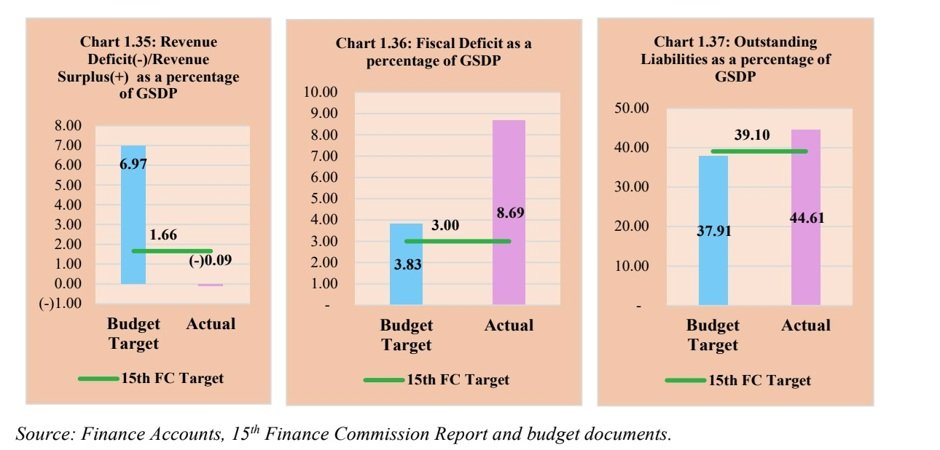
In terms of debt to GSDP ratio, Meghalaya’s figure rose to a high of 44.61 per cent in 2024-25. The ratio measures the state’s capability to repay its debt. A low value of debt to GSDP indicates that the state’s economy is vibrant to pay the debt without incurring further debt. Conversely, a high ratio signifies that the state’s burden is substantial compared to its economic output and indicates financial vulnerability and reduced fiscal flexibility.
Although Covid caused this ratio to worsen, there was also a boom in the economy in the following year. From 2022-23, the debt to GSDP ratio has only expanded. This resulted in the state breaching the target set for overall liabilities-GSDP ratio under the Meghalaya Fiscal Responsibility and Budget Management Act 2006 throughout the 2020-21 to 2024-25 period.
“Therefore, the state requires persistent spending restraint and higher growth boosting expenditure to reduce its reliance on borrowing before its debt gets into a spiral condition,” the CAG said.
Meghalaya even failed to adhere to lower Finance Commission targets in 2023-24 and 2024-25, “suggesting misalignment of the borrowings with the GSDP growth.”
The report also highlighted the increasing use of borrowings to service previous debt. A low net borrowing availability points to constrained fiscal space. Over the five-year period from 2020-21 to 2024-25, the share of borrowings used to service previous borrowings grew sharply from 43 per cent to 73 per cent. “This trend indicates a substantial decline in the proportion of borrowings available for productive use, such as asset creation and revenue-augmenting investments, which bottomed out in 2024-25.”
This low net borrowing availability for productive use suggests constrained fiscal space. However, the CAG did note that the figure of 73 per cent was still an improvement on the 81.26 per cent seen in 2015-16.
“Overall, these indicators suggest that the state’s fiscal space has gradually narrowed and debt sustainability has come under pressure,” the CAG added.
While the growth–interest differential (a metric comparing the economic growth rate compared to interest rates) remained mostly favourable, “its stabilising effect has been offset by continuing primary deficits,” the report stated.