









Editor,
If you still haven’t understood the intent behind the Cockroach Janta Party (CJP) protest, then hats off to your foolishness. And to those who have understood it, my heartfelt respect goes out to you.
The CJP protest initially gained quite a lot of support as a focused, student-led movement demanding accountability for systemic failures specifically regarding the NEET paper leak, exam administration flaws, and the fair implementation of educational policies. I was in complete alignment with the agitation during this initial phase when the focus was strictly on injustice faced by students in India. These were matters that directly affected merit and the future of youth in this country.
However, I consciously stepped away when the movement was co-opted and anti-national elements were deliberately associated with it. The protest platform gradually shifted from educational integrity to an arena used to raise anti-India slogans, glorify separatist ideologies, demand the release of individuals jailed for anti-national activities, openly abuse constitutional institutions, and invite support from fringe groups. Once the core cause was replaced by this divisive narrative, I consciously distanced myself from it.
I was left asking: What is the true intent of the CJP? What business do fringe figures or individuals like Syed Qasim Rasool Ilyas, former national chief of the banned outfit SIMI and father of Delhi riots accused Umar Khalid, have on a student platform? You are not being told the full truth about who is orchestrating these events behind the scenes.
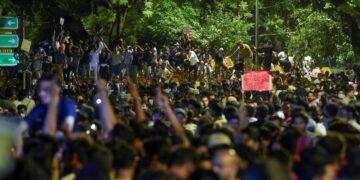
The recent “Sansad Chalo” march led by the CJP in New Delhi ended in chaos and violent clashes with the Delhi Police. Over 118 police officers were injured, public property was damaged, and dozens of protesters were detained. Yet, as commentators and political analysts debate the aftermath, a fundamental question remains: Who really bears responsibility for this disaster?
When the lathi charge took place on the streets, who actually bore the physical brunt? Innocent students. Youth who were provoked, brought out onto the roads, and pushed toward Parliament were the ones facing the batons. Meanwhile, those who instigated the crowd were nowhere to be found on the frontlines. Sonam Wangchuk wasn’t facing the batons there, Abhijit Dipke wasn’t there, Arvind Kejriwal wasn’t there, Atishi Marlena wasn’t there, nor was Manish Sisodia.
Now ask your heart: Do those who incite the crowds ever face the batons themselves? They never will! Did a single political figure get hit by a baton? Not one.
While politicians claim to “fight for the students,” they do so from a safe distance. Did Manish Sisodia send his own child onto the field? Did Arvind Kejriwal or Atishi Marlena send their children to protest? None of these leaders send their own family members into harm’s way. They send your children to face the police batons instead.
Even more brazen was the behavior of key organizers during the height of the tension. At the very moment innocent students were clashing with law enforcement on the streets, one prominent student influencer was comfortably sitting at a metro station eating a burger. Later that evening, he casually posted a video explaining with complete shamelessness: “Oh, at that time I felt like eating something nice, I was hungry, I saw a burger, so I ate a burger.”
Students were taking beatings on the pavement, while the faces of the movement were eating fast food and making content!
Those who drama-acted for weeks in the name of a “peaceful protest” saw the situation rapidly devolve. Where did truckloads of stones suddenly come from at Jantar Mantar? Are police officers merely targets meant to absorb stone-pelting? Don’t law enforcement personnel have families? Don’t they have lives? Over 118 police officers were left injured—who will answer for them? Also, consider the sheer audacity of marching toward THE INDIAN PARLIAMENT. The most sensitive high-security zone in the nation, especially while the Monsoon session was in full swing with top-ranking delegates and MPs present. Despite explicit warnings from the Delhi Police that no authorization had been granted, these individuals persisted. I don’t know what was the expectation? Did they truly believe the authorities would greet their illegal encroachment with red and purple carpets? What if one of these guys turns out to be some suicide bomber or for that matter vandalises the parliament house who is going to take accountability for it? Sonam Wangchuk? Abhijeet Dipke? Arundhati Roy?
Beyond the violence on the streets, look closely at the political demands embedded within this movement. Posters shared widely across social media under the guise of supporting activist Sonam Wangchuk contained alarming demands, such as “BAN NEET”.
What kind of logic is that? If a 10th-grade exam paper gets leaked tomorrow, do we ban 10th-grade board exams permanently? Banning an entire national entrance examination system altogether is not a solution—it is absurd. Furthermore, demands calling to “REJECT NEP” (New Education Policy 2020) expose the underlying political agenda. The New Education Policy was introduced after decades to reform an outdated system. Rejectionists want the same stagnant, legacy framework to continue so that young people remain perpetual tools for political provocation.
They claim to take to the streets for the sake of education, yet they actively block educational reforms and disrupt democratic institutions like Parliament. Just think about how big of a game is being played with you!
In conclusion, although this protest seemed to be fighting for student rights, the real picture on the ground was something else altogether. Real student interests were subverted by politics, radicalism, and provocateurs who drove young people into dangerous situations while remaining at a safe distance. When a protest built on the pretext of peaceful education reform devolves into violence and involves throwing stones at policemen and disrupts Parliamentary proceedings, then it is no longer a student protest. Ultimately, the students will suffer physically and legally, whereas the puppeteers will reap from the student’s sacrifice.
Hrishikesh Raychaudhuri
Shillong
Via e-mail