











By Dr. Shabaree Yasmeen A. Sangma
Meghalaya passed a law to protect its catchment areas in 1990, yet it lay virtually unused for thirty-five years. The problem was less a matter of neglect than one of design. In a state where most land and forest belong to communities, clans and individuals rather than the government, a protection law cannot work by mere notification – it requires the active participation of the people who own and manage the land.
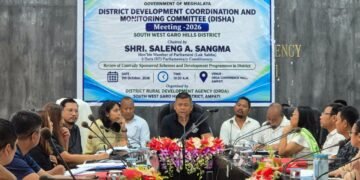
Last week, for the first time, that participation began to take shape. Two villages, Pomlakrai in the Umiew catchment and Durakalagre in the Ganol catchment, signed agreements with the Government, marking the first step towards protecting these catchments while creating alternative livelihood opportunities for the communities that depend on them. The two catchment areas collectively cover 52,198 hectares, encompassing 226 villages across 9 blocks. The initiative is still in its early stages, however, as far as can be established, it represents a first for the country and deserves more attention than it has received.
Consider what is at stake. The Umiew catchment is the principal source of water supply to Shillong city. The Ganol catchment underpins Tura’s water security, including the Rs 398 crore Greater Tura Water Supply Scheme now being built. The reliability of a pipeline depends entirely on the health of the upstream forest and soil. When catchments are cleared, rain runs off in a rush and carries silt into reservoirs, instead of soaking in to feed springs through the dry months. Every resident of Meghalaya knows the paradox: abundant rain in the monsoon, yet scarce water in the winter. Much of this problem is linked to the condition of the state’s water catchment areas.
The agreements form part of MegARISE, a Rs 344.4 crore programme supported by the German development bank KfW and scheduled to run from 2022 to 2029. The programme covers 77 micro-watersheds across the Khasi and Garo Hills. It spans nine blocks across the 7 districts of Khasi Hills, Garo Hills and Ri-Bhoi regions. The program targets protecting the Catchment areas, soil & water conservation and integrated watershed management of the state’s two largest towns. What makes the approach interesting is that it pays attention to why people may depend on catchment resources in the first place. Families need livelihoods. A conservation plan that overlooks this reality risks asking local communities to bear the financial cost of protecting water used downstream. At the same event, the Chief Minister linked MegARISE with the FOCUS Plus programme for farmers, explaining how one supports livelihoods while the other protects the water, soil and forests on which livelihoods ultimately depend. Both the programmes operate side-by-side strengthening the ecological sustainability and financial security of the farmers of these regions. Long-term conservation becomes more viable when communities have both a reason and an economic pathway to protect the landscape.
There is a long road ahead. Two villages are just the beginning for a programme that spans 226 villages. An agreement must be honoured on both sides, with benefits that reach households, not just committees. The Water Policy of 2019 envisaged water resource councils down to the village level; those councils will need real authority and money to make catchment protection stick. A seven-year, donor-supported initiative must eventually transition into systems that the state and local communities can independently sustain. Still, the principle established last week is worth watching in Meghalaya’s hills: catchment protection may work best when conservation is built with the people who live and depend on the land, rather than imposed on them.
Other states with significant community-managed land and forest systems, such as Nagaland and Mizoram, could draw key insights from the outcomes that unfold. The rest of us should pay attention as well, especially when turning on a tap in March reveals how valuable a healthy catchment really is.
(The author is from the Department of Botany, Tura Government College)