







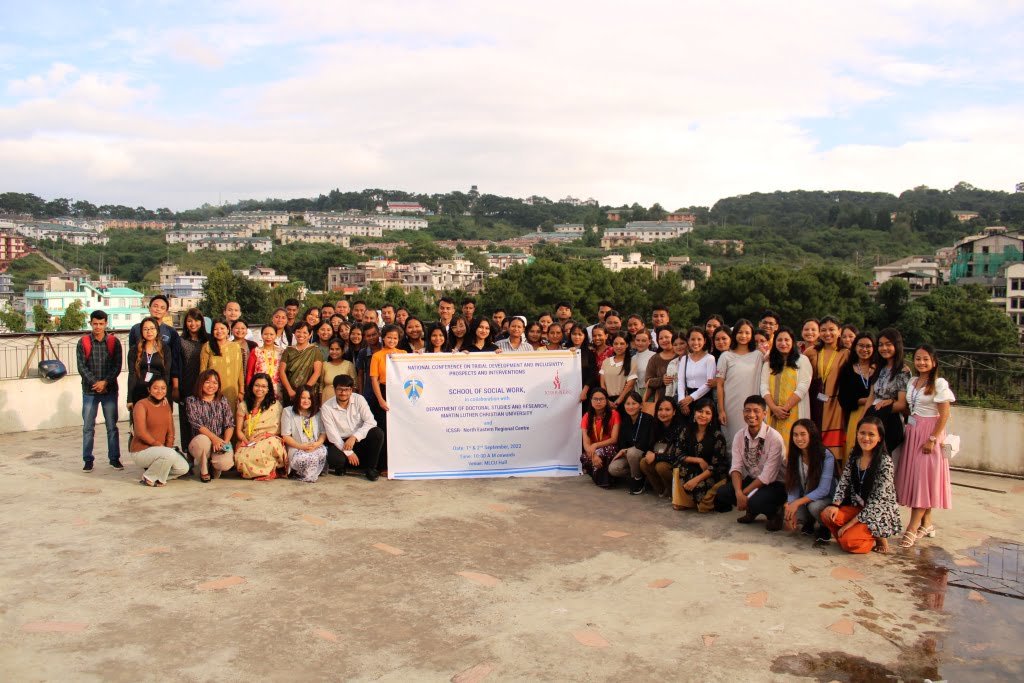
Martin Luther Christian University’s School of Social Work, in collaboration with university’s Department of Doctoral Studies and Research and the ICSSR North Eastern Regional Centre, organised a two-day national conference on ‘Tribal Development and Inclusivity: Prospects and Interventions’, which concluded today.
The conference was attended by speakers from the state and experts, faculty and students from across the country who presented papers on the themes of ‘Preservation of Tribal Folktales, Music and Culture’; ‘Entrepreneurship and Livelihood in Tribal Areas’; ‘Health and Indigenous People’; ‘Women in Tribal Communities’; ‘Development Policies and Tribal Interest’; ‘Traditional Governance’; ‘Ecology and Indigenous People’; and ‘Tribal Family System and Values’.
While giving the introduction to the conference, Seilienmang Haokip, faculty of School of Social Work, spoke about the unique culture and tradition of the tribal communities which are deeply interwoven with their natural environment, including land and forest.
He added that in spite of many efforts globally and nationally to integrate and protect tribal groups, tribal groups are vulnerable while their culture and identity are at stake and, in the context of North East India, the policies and projects of the state have been found to be deeply infused with the idea of militarization that obfuscates the relevance of traditional belief and practices.
While speaking as one of the keynote speakers, Theyiesinuo Keditsu, Assistant Professor at Kohima College, talked about the need for conservation of tribal folklore, music and culture. She highlighted that the recognition of indigenous knowledge today is an act of empowerment by the indigenous people. The existence of such knowledge has been obscured by mainstream Eurocentric knowledge.
The second keynote address was given by Mayfereen Ryntathiang, the president of Grassroot, who asserted the importance of identity and culture as a means for income generation for indigenous communities. She also stressed the inevitability of exploitation by third parties that may commercialize intellectual property and indigenous wealth without proper historical and traditional values and concluded with the message to protect, promote and preserve indigenous cultural values.