







By Gregory Shullai
Among the Pressure Groups in Shillong today there is no lack of those who are entitled to call themselves soldiers of misfortune in a distinctive and an honourable sense, it is especially to them that someone should recommend the secret wisdom of the best way forward because after what happened on the 19th of August 2026 and the resultant fallout in the neighbouring State of Assam to the cars and the people in the cars bearing a Meghalaya registration, it is obvious that in going about their demands their fate is hard and their hopes are uncertain, because they have no say in how the authorities will go about their part.
It is quite a feat to be able to devise some form of comfort for the youth or to suggest some form of advice in going about their demands after the unexpected backlashes that some people were subjected to…but to what avail? Social pressure groups are basically groups that are concerned about the future of the State and the welfare of the citizens of tomorrow. Their concern for the children of the future leaves them wondering how to go about getting the government to do things in the interest of the present generation of children who are gripped with a sense of insecurity and just can’t find a way to feel at home today. The youth feel a sense of displeasure and dissatisfaction at the ideals of the present government because what these ideals do is provide a false and fragile sense of feeling safe and secure in this unfamiliar time of swift transition; and that as far as the hopes and happiness that the authorities talk about in the interest of the youth – they are plain and simple passing showers. The youth are now alarmed that the foundation that supported society in the past has turned into thin ice these days and that there is nothing that Government or parents can say or do that can convince them that their beliefs and understandings are misplaced. And they are right because with the changes that have come nothing seems to last and those who are struggling to earn their daily bread and build a roof above their head constitute a force that see only one way out of this situation and that is to vent their anger at politicians are in it only for themselves.
We know it well, the times we live in today is corrupt, immoral and inhuman, and we have based our needs for far too long in accordance with our hopes that our elected leaders would fulfil their promises and usher in opportunities for the youth based on their strengths and assets. But it is evident that our elected leaders are mistrustful at best, and that the people in power are not worth what we thought they were. They only look after their own…we have only to look at the number of political appointees in the State and examine for ourselves the value or the output of these men and women to understand that the functioning of the government is anything but in the interest of the youth; even by the standards of the elderly, it is not rational, not upright and not honest. We know it well that the government we have elected is not something we can depend on and that we have interpreted it for far too long in a false and a mendacious way, that is to say that they act in accordance with their personal needs alone. Politicians always make promises and raise the hopes of the youth but they always turn out to be mistrustful, and they are not worth what we thought they were; that is about as certain as anything which our mistrust has got a hold of.
As far as the youth are concerned the present offers nothing worth conserving in the interest of sustaining their welfare in the future and they know only too well that the good old days that their parents talk about are something that will never return. What they want is some counterweight to the changeable and restless inclinations of the present so that they can pursue with cool impartiality, with cool logic, with regular work, something upon which they can build their future without causing them frustration and anxiety.
But for now, all that is wishful thinking, nothing is being conserved of the present for the future, there is no way that society can remain stagnant. Changes from the north, south, east and west are coming thick and fast and if the youth do not stay abreast with these changes they will be mercilessly left behind because there is no way that we can return to the past. It is bad enough that precisely when politicians boldly speak of the progress that they are ushering in by stating the progress that some individual or individuals have achieved, even reading about them on the hoardings that line our streets, we have the ugliest suspicions. Hoardings on billboards, and posts we come across on Facebook, are merely an expression of the fact that the established social structures we once depended upon are facing a profound weakening – even a total breaking down of what once used to be. Politicians are weary of having to state the facts that the youth are faced with, they themselves are weary of what the present has brought upon the people and they have no more energy to make promises, but being the men and women who have willingly and delightfully shouldered the responsibility of governing the State there is no way out for them but to make excuses or even to cover up their weaknesses and their failures. Everything is one big masquerade. If a cover up of their weaknesses is what the State leaders resort to, the youth on the other hand find delight only in others who vent their anger as they do and who refuse to compromise or to reconcile with the truth of what they are confronted with. It is clear that with all this deception and tongue in cheek talk, the present holds the distinction of being the most regressive and the most unrighteous that the State has ever seen, and that the dogma that the strengthening and the enhancement of the people is on the ascendency is all bunkum because nothing is being done to relieve the feeling of being ill at ease: that is how the youth see it.
If we look at what is going on with the coalition that is running the State, it is very clear that the degree of self-belief displayed by the leader of the coalition is neither here nor there. something is amiss, there is a pessimistic gloom, something that smells of weariness, disappointment and the fear of more disappointments. Evidently the leader is not in a position to command his colleagues, the consequence of which is that he must preserve himself even at the expense of law and order in Shillong.
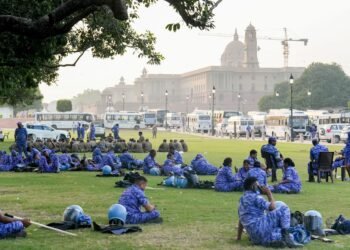
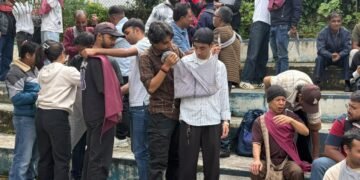
Perhaps the way the youth went with their agitation on the 19th August was not conducive to the present time. Demonstrations should not be permitted on the streets of Shillong; there is no excuse, and it is not a coincidence that a demonstration on the streets goes out of control, therefore what happened on the 19th is consequently a failure on the part of the authorities. The authorities should have by now established a location/s where demonstrations can be held. This is something that is long overdue in Shillong – and we have plenty of fields for precisely that. Perhaps, if it were so the demonstration in Shillong would have involved men and women, young and old under one banner.
In any agitation we need to weigh out the unintended consequences that could surface such as what is happening now with the blockade in Jorabat. The people populating the Jorabat areas, even if no one is making any statement on it, are not Assamese as we know them. Mostly they are the people who have come from the Indian heartland and have settled down there, because if they were the regular Assamese, such reactions as were witnessed on the 19th and 20th August would not have erupted against cars bearing Meghalaya number plates. Assamese have always been sympathetic to the interests of the Khasis and vice versa and such anti-Meghalaya reactions were never heard of in the past, but perhaps I lack factual details in this regard and am making a cloudy guess at what really is prevalent there. About the need for unity among the people of the North Eastern States, I have my own thoughts – that is to say, I do not think it to be a good thing for us to target each other in any way when rallies and processions are taken out against Government. I do recall that there was an indescribable intimacy between the Assamese and the Khasis earlier as both communities fondly remember how they once lived peacefully together in Shillong when Shillong was the capital of Assam. And even decades after the States were reorganized, the people continued to share that friendship with a limitless confidence between themselves. What used to be the understanding between the people of the neighbouring States can no longer be taken for granted now. The climate in Assam has gone contrary to a pan North Eastern culture and this is a most unfortunate reality which has brought about terrible repercussions when people agitate and the agitation unexpectedly turns violent. This is something that must be factored into any demonstration that our pressure groups plan in future because at present wild rumours are going around and we need to be extremely cautious, and not react blindly; a new approach that factors the new circumstances is indispensable.
Maybe, we Khasis are still not as openminded as the Assamese or the other races in our neighbourhood, and in that sense, we are a spoilt community who though we are well acquainted with the ways of other races in the final analysis we end up with the preference of wanting to live in isolation of other races. Secondly it could also be because though we proudly claim ourselves to be Khasis we cannot deny the fact that we are racially mixed in our descent to such an extent that consequently we do not feel tempted and desirous to really talk about racial determination. We are, in one word – and let this be our watchword – good Khasis who take their lineage from their mothers and therefore are exclusive of any other race in our neighbourhood. This uniqueness is something that leads us to deem ourselves as a race different and better than others, especially better than those that identify themselves from the religion they practice. To us religion is a lower standard upon which to identify a race – it is not even local.