











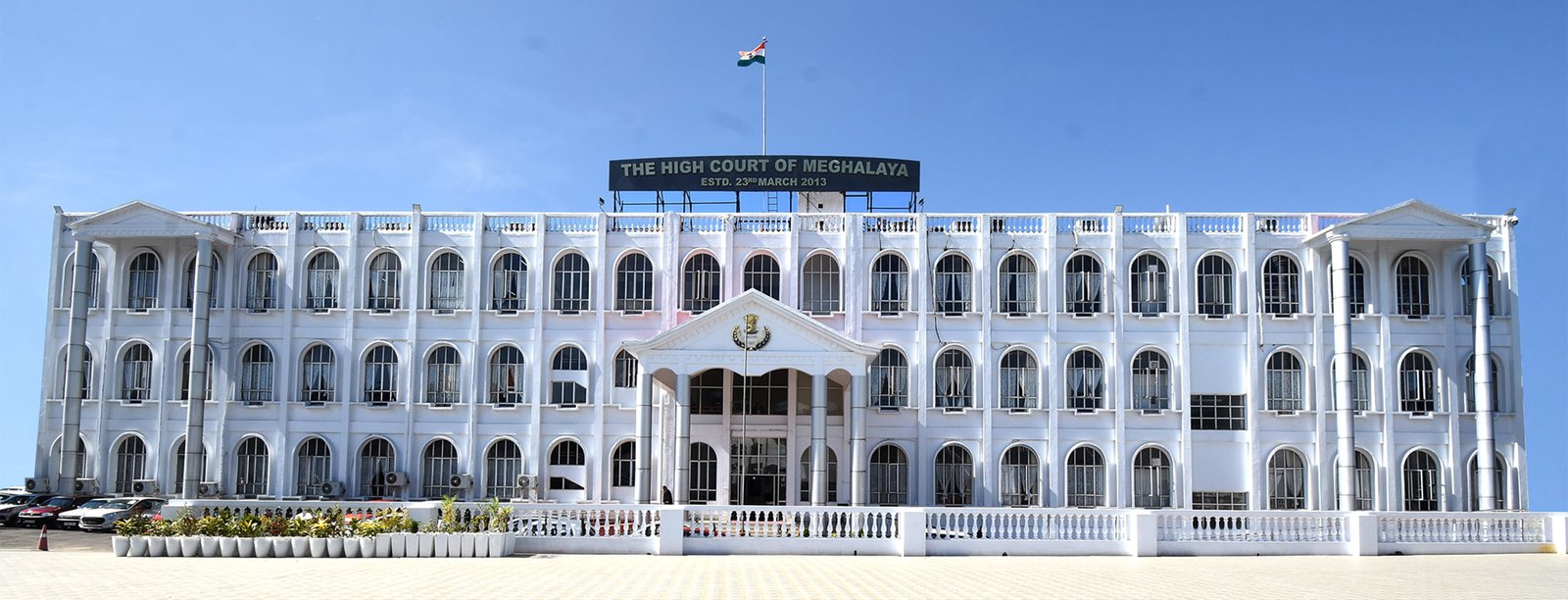
Shillong, Aug 5: The Meghalaya High Court acquitted a woman who was serving a life sentence for allegedly murdering her husband in 2015, holding that the prosecution failed to prove its case beyond reasonable doubt
A division bench comprising Chief Justice Revati Mohite Dere and Justice Wanlura Diengdoh set aside the conviction of Jenorin D Sangma, holding that the case rested entirely on circumstantial evidence but failed to satisfy the stringent legal standards required for conviction.
The Ri-Bhoi Sessions Court had on February 14, 2020 convicted Sangma under Section 302 IPC and sentenced her to life imprisonment, and under Section 201 read with Section 34 IPC for causing disappearance of evidence.
According to the prosecution, Sangma murdered her husband Dhantharu Mushahary in 2015 and buried his body in Chibra village. The case surfaced on January 30, 2017 after she allegedly made an extra-judicial confession to the headman of Iongkhuli village, following which Pillangkatta Police Outpost registered an FIR.
The high court said the case rested entirely on circumstantial evidence and did not meet the legal standards required for conviction. The prosecution had relied on three circumstances — an extra-judicial confession, the 164 statement of co-accused Prabhat, and the discovery of the dead body at the instance of the appellant.
The bench noted that the key witness to the alleged confession turned hostile. It said an extra-judicial confession is weak evidence and must be corroborated, which was not done.
On the co-accused’s 164 statement, the court said it did not establish Sangma’s complicity and instead raised questions about four other persons present at the scene whose role was not investigated.
The court also found the recovery of the body under Section 27 of the Evidence Act flawed. There was no memorandum panchnama of any disclosure, and panch witnesses stated the police showed them the spot. The prosecution further failed to produce a DNA report to prove that the exhumed body was that of the deceased.
Citing the Supreme Court’s five golden principles in Sharad Birdhichand Sarda and guidelines on extra-judicial confession in Sahadevan, the court held the chain of evidence was incomplete and did not exclude every hypothesis except guilt.
The bench quashed the conviction and sentence and ordered refund of any fine deposited by her, and sought a report from the District Legal Services Authority (DLSA), Ri-Bhoi, within eight weeks on whether compensation recommended by the trial court had been paid to the deceased’s minor children under the Victim Compensation Scheme.
In another judgment, the bench upheld the life sentence awarded to Rain Dhar for the 2015 murder of Trebor Hinge in West Jaintia Hills, holding that the prosecution proved the case through eyewitness and medical evidence.
The Sessions Judge, West Jaintia Hills District had in 2024 convicted Dhar under Section 302 IPC and sentenced him to rigorous imprisonment for life with a fine of Rs 5,000.
According to the prosecution, the incident took place on February 11, 2015. The FIR was lodged by Kynjai Hinge, younger brother of the deceased, based on information from eyewitness Nika Thubru.
The high court said the prosecution proved its case through direct evidence and that there was no reason to disbelieve her testimony. This was corroborated by medical evidence that stated the deceased died due to shock and haemorrhage from multiple sharp-force injuries.
The court said the recovery of the tukri (dagger) under Section 27 was not fully proved, but the conviction did not depend on it.
The bench confirmed the conviction and sentence and directed the DLSA to submit within four weeks a report on whether Rs 3 lakh compensation recommended for the victim’s parents had been paid.