









Shillong, Jul 10: The Meghalaya government is set to strengthen measures to curb cattle smuggling along the India-Bangladesh border, with plans to set up district-level task forces, establish checkpoints in vulnerable areas and make changes to the standard operating procedures (SOPs) for the maintenance of seized cattle.
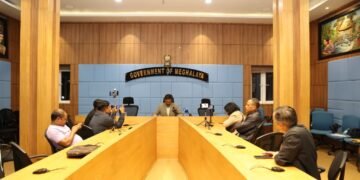
The decisions were discussed during a meeting on Friday between officials of the Animal Husbandry and Veterinary Department and the Border Security Force (BSF), led by Inspector General (IG) of the Meghalaya Frontier.
Animal Husbandry and Veterinary Minister Sanbor Shullai, who chaired the meeting, said the discussions centred around the recently issued five-point notification on the maintenance of seized cattle and ways to improve coordination among the BSF, police and the Veterinary Department.
“We had a very good discussion with the IG BSF, his team and the Veterinary Department. We reviewed the five-point notification issued by the department and discussed measures to strengthen its implementation,” Shullai said.
The minister said the BSF has been requested to intensify checks along the international border in coordination with the police and border magistrates to prevent cattle smuggling.
He also said the state government urged the BSF to expedite the completion of border fencing. According to official records, around 27km of fencing remain incomplete in the Khasi and Jaintia Hills region, while about 7km are yet to be completed in Garo Hills.
“The BSF has been asked to provide detailed information on the stretches where fencing is still pending so that the matter can be taken up for early completion,” Shullai said.
Another proposal discussed was the establishment of joint check points in vulnerable cattle smuggling routes. These check points would be manned jointly by the BSF, police and Veterinary Department officials to improve surveillance and enforcement.
The Veterinary Department has also been asked to constitute Special Task Forces in all districts for the transportation of seized cattle to designated animal shelters, as provided under the revised SOP.
As per the notification, the Task Force will be headed by the Block Development Officer (BDO) of the concerned C&RD Block and will include the officer-in-charge of the local police station, the jurisdictional Veterinary Officer, the District Animal Husbandry and Veterinary Officer, and the Sub-Divisional Animal Husbandry and Veterinary Officer as members.
The SOP also expands the powers of the police to act as a seizing authority alongside the BSF and Customs. It mandates that an FIR be registered immediately after cattle are seized and that all seized animals be identified through ear tagging, microchipping or other approved methods before being shifted to government-recognised animal shelters.
Shullai said a few amendments would still be made to the notification based on suggestions received during the meeting.
The BSF has sought 13 days to submit a detailed report on the issues discussed, following which another meeting will be held between the force and the Veterinary Department to finalise the changes.
During the meeting, BSF officials informed the government that cattle smuggling has been declining year after year due to increased enforcement along the border.
The force also highlighted the challenges it faced in caring for seized cattle in the absence of designated animal shelters. According to BSF officials, many seized animals died because there was no proper facility to house them. Personnel were initially forced to cut fodder themselves to feed the animals, but later engaged local residents to help provide fodder until the cattle could be shifted.
The government expects that the revised SOP, the creation of district-level task forces and closer coordination between enforcement agencies will ensure better care of seized cattle while strengthening efforts to check cross-border smuggling.