










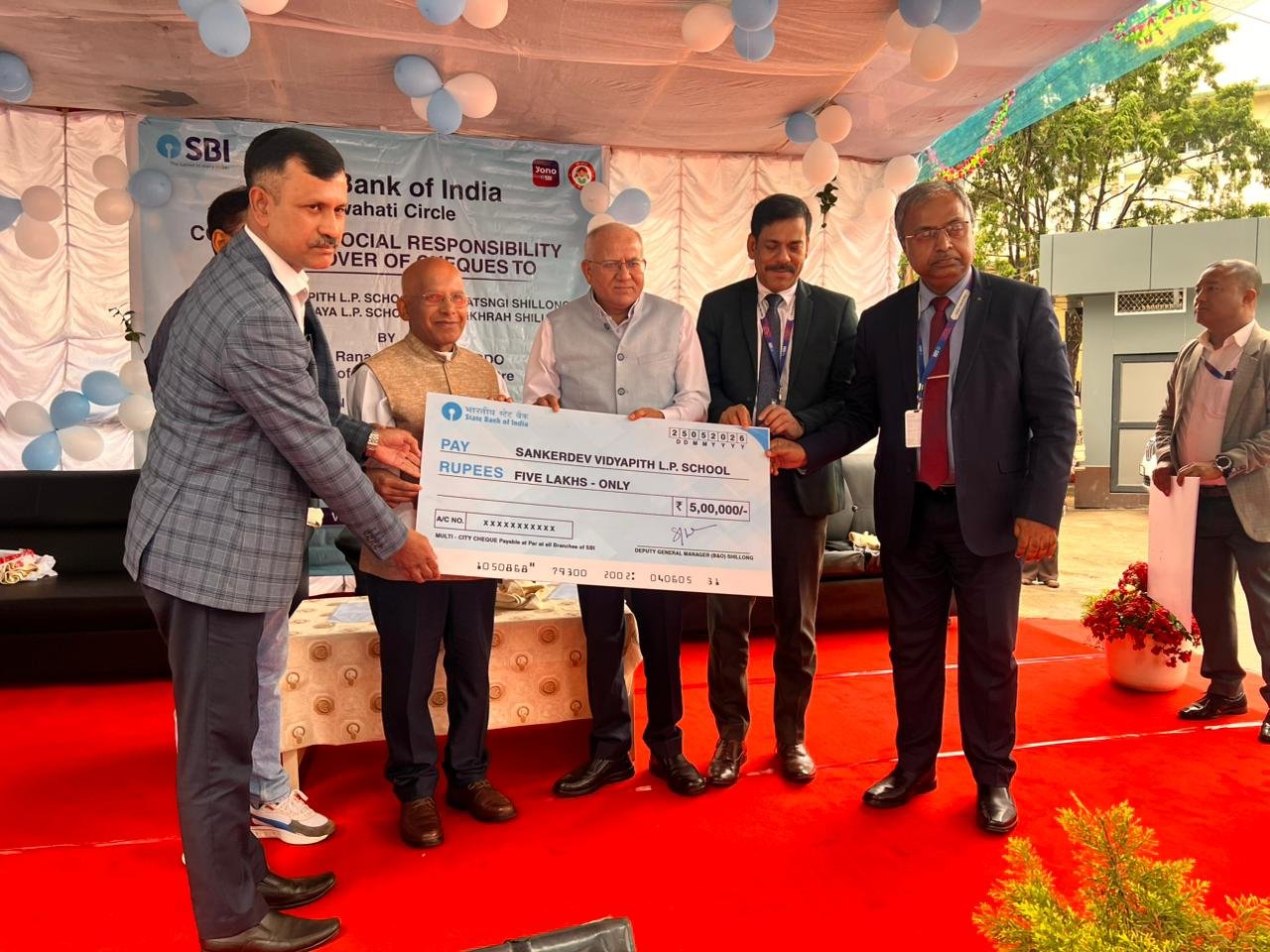
Shillong, May 25: SBI extended its philanthropic efforts under the corporate social responsibility (CSR) by donating a total of Rs 9.43 lakh to two lower primary schools in Shillong.
The funds allocated included Rs 5 lakhs to Sankardev Vidyapith LP School in Lumshatsngi and Rs 4.43 lakhs to Arya Kanya Vidyalaya LP School in Laitumkhrah. The contributions are intended for essential upgradation works, ensuring that the facilities meet the educational needs of the students.
The cheques were presented by Deputy Managing Director (HR) & CDO, SBI Corporate Centre G.S. Ranaat SBI Shillong Branch in the presence of Satish Kumar Sharma, DGM & CDO, SBI Local Head Office, Guwahati Circle, and Samir Kant Jha, DGM, SBI Shillong Module.
Rana emphasised the bank’s role in community development. By investing in education, SBI is not just enhancing the infrastructure of schools, but also fostering a brighter future for the younger generation, he said.
Sankardev Vidyapith L.P. School, established in 1952 and managed by the Srimanta Sankardev Cultural Centre, is facing a severe financial crunch due to limited revenue and rising maintenance costs. The CSR support will help execute necessary repairs.
Arya Kanya Vidyalaya L.P. School, set up in 1942 under Arya Samaj, provides education to children from weaker sections. The Govt-recognised school runs on minimal fees and lacks resources for digital literacy and smart classroom tools. “Students are missing out on these vital learning experiences,” the school said.
The DGM, SBI Shillong Module said the two schools were selected for providing education to girl children and underprivileged students and for their selfless work in providing education to those who cannot afford tuition fees.
Jha told Highland Post that SBI receives between 10 to 12 CSR applications every quarter but has stringent criteria for selection. Each proposal is assessed based on the organisation’s registration status and its societal impact.
He said that SBI maintains a robust monitoring system following the distribution of CSR funds and that the bank actively tracks how the funds are utilised, ensuring they are not diverted to other activities. “Till now we have not found any case of diversion,” he said.
Jha said there is no fixed CSR budget specifically earmarked for education versus health, allowing for flexibility in funding according to the needs of the community, especially in the northeast region.