



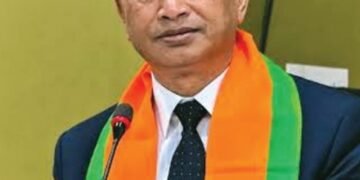







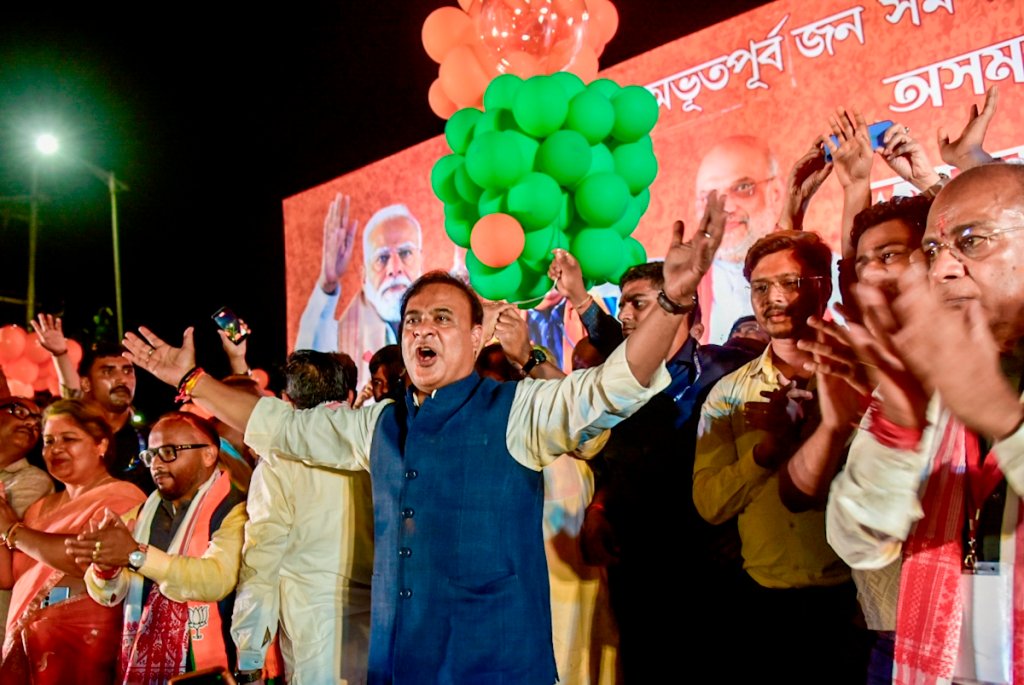
Guwahati, May 4: Assam Chief Minister Himanta Biswa Sarma retained the Jalukbari seat with a margin of 89,434 votes, underlining his continued political dominance in the state even as the BJP leader’s tenure remains marked by both strong support and sharp criticism.
Widely credited with expanding the BJP’s footprint in Assam and across the Northeast after switching sides from the Congress in 2015, Sarma’s rise to the top post in 2021 followed years of calculated political groundwork.
Since taking charge, the 57-year-old leader has pushed development initiatives, rolled out welfare schemes and focused on safeguarding the land rights of indigenous communities.
His tenure, however, has also been marked by controversial measures and rhetoric, particularly targeting Bengali-speaking Muslims of Bangladeshi descent, who are called ‘Miyas’ in the state.
Actions like eviction drives on alleged encroached land, a crackdown on child marriage, moves against polygamy, enforcement of the Cattle Protection Act, closure and conversion of government-run madrasas, and demolition of certain religious institutions have drawn criticism from opposition parties, which accuse him of deepening social polarisation.
Sarma’s campaign remarks, including statements perceived as targeting minorities, triggered nationwide criticism.
His comment — “will break the backbone of the Miyas’ during the next five years” — and urging people to pay less to them than they deserve for the services they render led to criticism not only within the state but across the country.
He remained defiant through controversies, though a row involving allegations by Congress leader Pawan Khera against his wife led to a sharp exchange that even drew mention in a Supreme Court order granting relief to Khera.
Opposition parties, especially the Congress, have also repeatedly alleged corruption during his tenure and questioned the business dealings of his wife, Riniki Bhuyan Sharma, charges denied by the chief minister.
Once regarded as the most influential politician in the Northeast, Sarma has emerged as a key BJP campaigner, aggressively advocating the party’s core agenda in poll-bound states.
Political analysts, however, have criticised his rhetoric as divisive and unbecoming of a constitutional office-holder.
After losing his electoral debut in 1996, Sarma has represented Jalukbari continuously since 2001, winning as both a Congress and BJP candidate. A minister in successive governments since 2001, he earned a reputation for administrative effectiveness and political strategy.
Mentored by former Congress chief ministers Hiteswar Saikia and Tarun Gogoi, Sarma rose steadily within the party before differences with Gogoi led to his exit in 2015.
The BJP quickly inducted him, leveraging his influence to strengthen its presence in the Northeast.
As convenor of the North East Democratic Alliance (NEDA), he played a pivotal role in bringing all eight northeastern states under the NDA’s ambit, either through BJP governments or allied partners.
Sarma began his political journey during the anti-foreigner Assam Agitation of the 1980s, initially working with All Assam Students’ Union (AASU) leaders such as Prafulla Kumar Mahanta and Bhrigu Kumar Phukan before entering mainstream politics. Spotted by Saikia, he wrested the Jalukbari constituency from Phukan as a Congress nominee in 2001 and became a minister under Tarun Gogoi’s leadership.
Gogoi, impressed with Sarma’s political skills, appointed the young debutante as minister of state for agriculture, planning and development and later during the same term, gave him additional responsibilities.
The Congress, facing an anti-incumbency wave in 2011, depended heavily on Sarma’s skills in strategies and managed to come to power for the third time in a row. During this term, a rift developed between Sarma and Gogoi’s son Gaurav, and most attribute it to a conflict over political succession to Tarun Gogoi.
Sarma was sidelined within the Congress, and he resigned from the ministry, the assembly and subsequently from the party in 2015, before joining the BJP.
He was instrumental, along with Sarbananda Sonowal, in forming the party’s first government in Assam in 2016. He held key portfolios including finance, health, education and public works before succeeding Sonowal as chief minister in 2021.
Born in Jorhat to noted Assamese poet and novelist Kailash Nath Sarma and literary activist Mrinalini Devi, he earned a master’s degree in political science in 1992. Sarma obtained an LL.B in 1995 and practised at the Gauhati High Court for five years. He is also a PhD in political science from Gauhati University in 2006.
Sarma has a daughter and a son. (PTI)