




By Gregory Shullai
Things In commenting on a topic as delicate as that of a cleric who has apparently gone rogue, there is a need for one to become politely blunt in telling the people the truth behind who and what he thinks deserves the ignominious label of a rogue cleric. Someone has to bring out this hard truth and who else if not me – very few in Shillong would do it though everyone knows that to be able to criticize and to accept criticism is a sign of a higher culture. Sometimes individuals, especially priests, purposefully invite and provoke criticism of the things they do for the simple reason to understand what it is that they are doing that annoys or pleases the congregations. In this manner they understand the heart and soul of their congregations. All this may be very confusing to the common men and women who question what their priests do, knowing that their belief and disbelief, trust and mistrust is born and experienced through their relationship with their priests. And taken in context with the return of a prodigal priest to demit office to someone else the mixed emotions that surface is nothing short of an experiment in which we ourselves are the guinea pigs – we know not whether to forgive or condemn.
Normally it is a sad day when the successor is encumbered with indecent delaying tactics on the part of his/her predecessor. For most successors such an experience is a crisis without equal; but not for those who abide in faith in their understanding of things even when their understanding is in direct proportion to their profound and tormenting doubts, and in the posting of the Right Reverend Sylvanus Christian as the Moderator’s Episcopal Commissary for the DNEI w.e.f the 10th April 2026 the CNI has found one whose faith subdues the physical attributes inherent in one’s secular life. In a similar manner the congregation know the blessing of being able to let doubts be bygones and step instead into faith, but that is easier said than done for them, as their routine dealings are more of a secular nature than on faith. There can be no doubt that many parishioners are experiencing this tug of war within themselves but are obliged to resist categorizing it as a matter of faith or body and so retain their integrity with an open mind and an unlimited view of what is taking place. The congregation (most who are or were employed in public service) know that any attempt to delay the handing over charge is quite the contrary of what the noble man does, they know the basic concept “good” in advance and spontaneously out of themselves. They create an indelible idea of what it is to be bad in such events. That is precisely what is happening in the handing and taking over charge of the Diocese of North East India (DNEI) in Shillong. The parishioners are being called upon to judge for themselves who is good and who is bad in this transfer of charge episode.
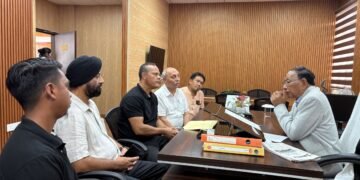
The Deputy Moderator of the Church of North India (CNI) has been appointed as the Moderator’s Episcopal Commissary for the DNEI w.e.f the 10th April 2026 but till the 16th April the taking over charge had not come about, and this has upset those concerned to no limited extent. The coming of this order was a bringer of glad tidings to the parishioners like nothing ever before as they had been fighting tooth and nail to get the bishop of the DNEI removed after coming to learn of the indecencies that he was involved in throughout the Diocese. It was very clear that misdeeds of such a magnitude had never occurred in the Diocese before and only with the arrival of the successor in Shillong on the 15th of April were there hopes again of a return to respect and truth in the way the Diocese is managed. By the time this letter comes out the handing and taking over would have hopefully been complete but no one will ever forget the confusion that was caused in the process – it was not without the suspected calamities. A situation of this nature normally arises when truth enters into a tussle with lies and dishonesty, and that is when we have upheavals, seismic shake ups, the likes that move mountains and valleys; and the parishioners of the DNEI experienced exactly that…something that they had never dreamed of before, something that demanded them to exercise more than just their presence of mind to ease the burden that was being cast upon them and the Deputy Moderator.
The indecencies in the manner in which some clerics go about their duty is a sad truth that is being encountered in many churches throughout India. The fate of some men and women who are appointed to a chair in holy places and who find themselves incapable of handing over the seat to a successor is one of Christianity’s biggest embarrassments. To be the incumbent who indicates an unwillingness to hand over the holy seat; that is the sign of an unsound nature, one in whom there is an excess of pride and greed and a desire for power On the other hand to be a true man of the robe, the kind that is incapable of taking his enemies’ insults, accidents, even misdeeds seriously is the kind that displays a strong full nature in whom there abides an excess of goodness to form, to mold, to recuperate and to forget. Individuals with the latter inherent nature are the kind that don’t hold onto grudges, they have no memory of the intended insults and embarrassments and vile actions against them and are unable to consider forgiveness simply because they forget the intended wrongs.
What is it that causes many believers to suffer the fate of following their faith as if it were an open wound? How would one define the fate that one suffers from the religion that one follows? Basically, it is the knowledge that one’s faith has done as much damage as it could to transfigure the individual into a believer – a believer in what a cleric says and does over the life of an individual with aspirations to rise from one stage to the next with honour – essentially to earn a place of redemption in the afterlife. When everything that the believer holds as inviolable has been violated by a priest even the hymns one sings become songs of decadence and no longer the songs that uplift body and soul to a higher plain. To be cheerful in such cases is like mocking oneself – like one who presses home the fact that when one is hurt deep within, laughter is the best medicine, as if to say that laughter is the way to avoid remembering and telling and talking about the ugly truth. But, does anyone really believe that a believer could bring out into the open everything that he knows against his priests? No that doesn’t happen – a believer will always hold back or keep secret anything that would bring his belief in his priest crumbling down – the believer honours his priest no matter what evidence is brought against the priest. Priests do not understand this.
Ultimately an attack on another priest – the Controlling Authority of the aberrant priest is where the blame is directed especially when the Controlling Authority has utterly lost the perspective of what is the best course of action, and the values on which this best course should rest upon. This is what has beset many church organizations in India including the Church of North India. When the best course of action against an errant cleric is his dismissal from the brotherhood, and when instead the organization holds onto the wayward cleric the organization is deservedly made to bear the brunt of slowly but surely crumbling. And this comes about because of an attack on the organization by the congregations – blaming it (the Synod) for becoming ever lazier and more and more impoverished in its instincts by supporting the opposites of that upon which the organization was established – gobbling down the principles upon which ones’ faith and secular order were established and taking everyone involved in it to a disastrous state. Such a failure to take a stand against that which is detrimental to the organization and to show neutrality and selflessness instead is the principal cause for a great disaster that is inevitable to any organization.
This sense of justice of the religious organizations that find all causes prayerfully just and accord forgiveness freely to wrong doers as they do to the righteous, inevitably leads to the breaking down of the organization.
It is here that some blunt truths must be told and identities exposed where the decencies and indecencies have emerged the most. Indecencies were taking root in the Church of North India (CNI) and in particular here in the Diocese of North East India (DNEI). With the change of guard (Moderator) in the CNI Synod there is an air of expectancy that the CNI will once again chose the right path in proceeding forward. Those evil actions which outraged the congregations of the DNEI the most were based on the belief that the man who harmed the congregation the most was given a free hand by the Synod to perpetrate his evil upon the entire Diocese. It was this belief that the bishop chose to harm the Presbyters and Pastorates that aroused hatred and a thirst for revenge, spite, and the whole deterioration of the people’s imagination, which led them to demand that the Diocese be rid of the person.
To the Synod of the CNI let me offer one word of advice; to do harm out of a drive for self-preservation is not sinful, but to ignore one who harms while considering it as a requital – that is the result of an erroneous judgement.