
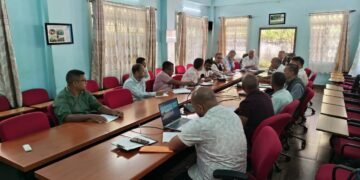











Shillong, Oct 31: Power Minister Metbah Lyngdoh attended the Regional Workshop on Renewable Energy – North Eastern Zone held in Guwahati on Friday.
Highlighting Meghalaya’s commitment to clean energy, Lyngdoh stated that Meghalaya has been one of the few states in the country focused on sustainable and renewable power development since its inception. The state has an estimated hydropower potential of 3,000 MW, along with 80 MW of wind energy and over 1,000 MW of solar potential.
Currently, more than 50 per cent of Meghalaya’s power requirement is sourced from renewable energy, while the state’s own generating corporation operates a 100 per cent green portfolio of 367 MW.
To further accelerate the sector, the Meghalaya government has introduced the Meghalaya Power Policy 2024 aimed at harnessing the state’s renewable energy potential, attracting private investment and promoting public-private partnerships (PPPs) and joint ventures with central public sector undertakings (CPSUs).
The minister announced that Meghalaya has recently allotted two small hydro projects (37.5 MW cumulative capacity) and one large hydro project (270 MW) to private developers. In addition, the Meghalaya Power Generation Corporation Limited (MePGCL) has completed detailed project reports for 12 small hydro projects (63 MW cumulative capacity), which are proposed to be developed under PPP mode.
Lyngdoh also claimed that the state’s Solar Mission has been a success. Launched in February 2021, 3,500 rural households, 1,609 primary schools, small businesses, health centres, etc have been equipped with solar hybrid systems with battery backups, he informed the gathering.
Further, the State has installed over 10,000 solar street lighting systems (130 kW cumulative capacity) and is implementing three solar mini-grid projects (50 kW each) with energy storage systems and cold storage facilities supported by funding from the Asian Development Bank.
Under the PM-KUSUM Scheme, Meghalaya has adopted a farmer-centric approach, providing 45 per cent state subsidy on solar pump installations, reducing the farmer’s contribution to only 5 per cent. The state is currently in the process of installing 2,000 additional solar pumps.
Lyngdoh, however, highlighted challenges related to the benchmark cost of rooftop solar installations, currently fixed at Rs 55,000 per kWp for North Eastern states, whereas the actual cost is closer to Rs 80,000–Rs 85,000/kWp due to difficult terrain and logistics. He requested the Union Ministry to review and revise the benchmark cost accordingly.