

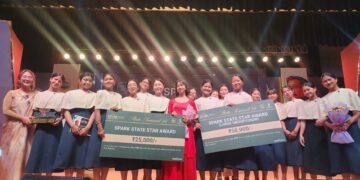




Shillong, Oct 25: New Delhi’s Kiran Nadar Museum of Art (KNMA) in collaboration with Martin Luther Christian University (MLCU) is to open a two-day art exhibition called microSPILLS featuring new artwork and thoughts of 13 young practitioners that present their concerns on the question of land, movement, memory and relations.
The artists have all been drawn from the different states of the North East. They are Antarul Haque, Archita Bharadwaj, Bandita Talukdar, C Lalrempuii, Daiamonlang Khyllep, Genish Sougrakpam, Ibakotlang Diengdoh, Lote Miso, Manenjungla L Aier, Müdotsülü Rhakho, Rachel Choden Tamang, Rekilbert L Mairang and Yambou Kong Kang.
The programme has been conceptualised and curated by Avik Debdas and Chinmoy Deori and mentored by the team from SNANE – Lapdiang Syiem, Devadeep Gupta and Joshua Sailo – and Praveen Ashokan.
Three onsite programme coordinators – Careen Joplin Langstieh, Balaiamon Kharngapkynta and Casper Syiem – have been working hard to put together the exhibition, which will open its doors to the public on Monday from 12pm. Between 2 and 3pm there will be an exhibition walkthrough with the curators, mentors and artists and from 3pm there will be a performance by Genish Sougrakpam and Miso.
The following day, the award-winning film of Meghalaya director Dominic Sangma, Rapture, will be given a special screening side-by-side with the exhibition.
The exhibition has evolved through three months of intensive co-learning activities. The 2026 edition combines online study and discussion during August and September with onsite sessions at MLCU in October.
This year’s conceptual framework emerges from the Khasi folktale of Ka Ïew and Ka Ngot, retold by Esther Syiem in her multilingual edition of the children’s book Race of the Rivers. The tale follows two sisters, daughters of the deity U Lei Shyllong, whose distinct journeys across the landscape become intertwined with the formation and movement of rivers.
The story offers a lens through which to consider land not as a static territory or bounded possession, but as a field continually transformed through movement, negotiation, memory, and relation. While one sister traverses rugged highlands and stony terrain, the other flows persistently towards the plains, crossing boundaries and reaching places her sister cannot. Their trajectories suggest different modes of spilling: one that fractures established paths and another that seeps across them.
Building on this narrative, microSPILLS 2026 asks: What happens when land spills beyond ownership? When rivers overflow, forests expand, and terrain refuses containment? How might land be understood through the relationships, everydayness, and movements that shape it, rather than through the boundaries imposed upon it? Here land is imagined beyond its physical presence.
The programme considers how territorial and institutional frameworks attempt to organise land through fixed categories of geography, identity, and language. In contrast, the movement of rivers and the relations embedded in landscapes open possibilities for thinking beyond these structures. microSPILLS seeks to create a sustained platform for artistic expression and critical exchange among young practitioners from North East India.
Along with mentors, the programme led by guest lecturers and contributors include artist and curator Ala Younis, artist Ibrahim Mahama, anthropologist and writer Mridu Rai, curator and researcher Anna Sireilliu, artist Treibor Mawlong, cultural theorist and art historian Santhosh Sadanandan and filmmaker Dominic Sangma.