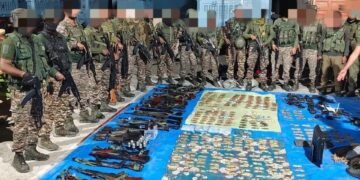













Shillong, Oct 25: In a blow against drugs by the central government, the Narcotics Control Bureau (NCB) has launched ‘Operation Trident’, with 38 teams striking 38 locations simultaneously across Assam, Mizoram and Manipur.
The crackdown is in line with the Centre’s policy of zero tolerance against drugs and strategic shift from a seizure-centric to a network-centric approach.
The massive three-state multiagency blitzkrieg was launched against transnational narco-financial syndicates across Assam, Mizoram and Manipur, a press release stated today.
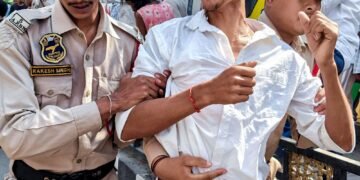
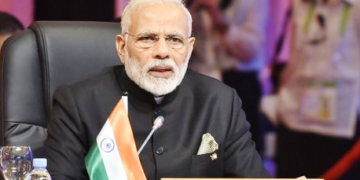
In a post on X, Union Home Minister Amit Shah said “Our agencies launched a barrage of simultaneous crackdowns across 38 locations in Assam, Mizoram and Manipur on 23 October, smashing an international narco-cartel. The operation revealed Rs 100 crore worth of hawala transactions, froze 1,424 bank accounts, attached properties worth Rs 17.82 crore, seized 500 detonators and Rs 12 lakh in cash and led to the arrest of 18 people.”
India has set itself an ambitious target of eradicating every drug network by the end of 2029.
“India will hammer until the last nail is driven into the coffin of drug cartels. Heartiest congratulations to the anti-narcotics team comprising central agencies, and police forces of the three states,” Shah added.
The NCB spearheaded ‘Operation Trident’ in the early hours of October 23. The NCB, in coordination with Mizoram Police and Enforcement Directorate (ED) launched a massive, simultaneous crack-down to dismantle the operational and financial backbone of a major transnational drug trafficking cartel.
Preceded by days of covert intelligence fusion, joint target-mapping and high-level tactical briefings among central and state enforcement agencies, the operation was designed to simultaneously strike both the logistics nodes and the illicit financial arteries of the syndicates.
The coordinated strikes extensively covered key urban hubs and sensitive border corridors, including Aizawl, Champhai and the strategic Indo-Myanmar border trading town of Zokhawthar in Mizoram, alongside linked operative bases in Churachandpur in Manipur and the Cachar, Assam transit corridor. Despite challenging terrain and vast geographical spread, exceptional inter-departmental coordination ensured that all searches, enquiries and financial audits were executed simultaneously, preventing the flight of suspects or the concealment of illicit assets, the release added.
The multi-state operation stems from sustained, intelligence-led backward and forward linkage investigations initiated by the NCB, Mizoram Police and ED in the network cases identified for thorough probes. Sustained probes unmasked a prolific transnational syndicate led by Myanmar-based kingpin Thangcintuang alias Chintuang alias Tluanga (wanted in over 10 NDPS cases across NCB, Champhai Police, and Mizoram Excise), who orchestrated the cross-border routing of methamphetamine and heroin across the Myanmar–Mizoram–Manipur–Assam–Tripura corridor into mainland India and Bangladesh.
Prior phases of the investigation successfully neutralised key pillars of this cartel, including Thangcintuang alias Chintuang alias Tluanga, the kingpin, who was arrested in Delhi following intensive inter-state surveillance, intelligence development, and sustained follow-up operations.
Key facilitator Vungkhanthawna who coordinated movement and delivery of Myanmar-origin consignments was arrested and subsequently detained under the stringent PITNDPS Act.
Lalrampari, the primary hawala operator, was arrested by the NCB in August 2024. Investigations exposed nearly Rs 100 crore in illicit hawala transactions linked to the network, prompting joint action with the ED and freezing of illegally acquired properties. Abu Saleh alias Saifuddin, the Assam Corridor logistics head, was arrested from Cachar, Assam in November last year. He was responsible for coordinating narcotics transportation across the Assam corridor and linked to multiple NDPS cases.
Detailed financial profiling and digital forensics from these breakthroughs revealed a wider web of facilitators, shell entities and money mules, necessitating the massive, synchronised strike of Operation Trident.