

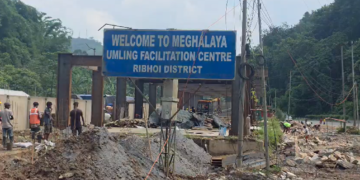










Shillong, Oct 29: Shillong MP Ricky J Syngkon has drew the attention of the centre over what he termed as “severe environmental degradation” of the Umngot River in West Jaintia Hills, allegedly caused by construction activities under the Shillong-Tamabil road expansion project.
In his letter to Union Transport Minister Nitin Gadkari and Environment Minister Bhupender Yadav, the MP said the river once celebrated as “Asia’s cleanest river” has turned “muddy and lifeless” this October — a period when its waters should be crystal clear.
He highlighted that local communities, tourism operators and environmental organisations are alarmed by this development.
Syngkon alleged that large-scale hill cutting and the dumping of excavated soil and debris into the Umtyngar and Umngot river systems by the National Highways and Infrastructure Development Corporation Limited (NHIDCL) have violated environmental safeguards. He said no spoil-barrier management or containment measures were in place, leading to heavy siltation in the river.
The Shillong–Tamabil road expansion project is being funded by the Japan International Cooperation Agency (JICA). The MP questioned whether JICA’s stringent environmental and social safeguards had been adhered to, demanding that proper Environmental Impact Assessment (EIA) and monitoring reports be verified.
He further said the Meghalaya State Pollution Control Board has not yet taken action despite clear evidence of violations, drawing parallels with a similar case involving the Bhagirathi River in Uttarakhand, where the National Green Tribunal (NGT) imposed a Rs 2 crore penalty for comparable offences.
Syngkon said the Umngot River supports hundreds of families through tourism-based livelihoods such as boating, homestays and handicrafts. “Its global reputation for ‘floating boats’ has been badly affected, with many tourists cancelling their trips this season,” he said.
In his letter, Syngkon urged the ministries to take immediate steps, including a halt to all hill-cutting and soil disposal activities impacting the Umngot and its tributaries, a joint inspection by a high-level central team, and environmental compensation against NHIDCL on the lines of the NGT’s Bhagirathi case.
He also called for quarterly independent monitoring of roadwork impacts, revision of the project design to protect environmentally sensitive zones, and preparation of a river restoration and rehabilitation plan.
“The Umngot River is not merely a water body, it is a living symbol of Meghalaya’s heritage and the spirit of sustainable coexistence,” Syngkon wrote.
“If immediate remedial measures are not taken, we risk losing a globally renowned natural wonder,” he warned.