












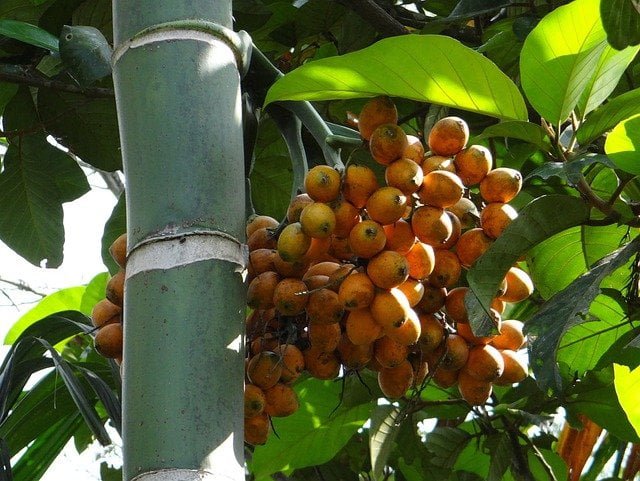
Shillong, Nov 2: Areca (or betel) nut, one of the major horticultural crops of Meghalaya, is currently facing several production challenges, particularly the increasing incidence of bud rot disease, which has contributed to declining productivity in recent years.
The compound annual growth rate (CAGR) of areca nut production in Meghalaya dropped to 1.79 percent during 2010–20, compared to 9.25 percent between 1990 and 2000, while the all-India growth rate stood at 9.82 percent.
Many farmers cultivate areca nut as a monocrop without adopting sustainable management practices, further affecting productivity and profitability.
To address these challenges and promote scientific areca nut cultivation along with cocoa as an intercrop, a series of stakeholders’ meetings and training programmes were organised across Garo Hills by the ICAR–Central Plantation Crops Research Institute (ICAR–CPCRI), Kasaragod, Kerala, in collaboration with the Krishi Vigyan Kendras (KVKs) and the Department of Horticulture.
ICAR–CPCRI focuses on research to enhance the sustainable productivity, quality and utilisation of coconut, areca nut, cocoa and palm. The institute is presently intensifying its outreach in the North Eastern states through region-specific interventions, capacity-building programmes, demonstrations of improved technologies and supply of quality planting materials.
As part of this initiative, a team of scientists led by Vinayaka Hegde, Head of Crop Protection Division, ICAR–CPCRI, organised five training programmes and four field demonstrations across West, South, North, East and South West Garo Hills in collaboration with local KVKs and the Department of Horticulture from October 27 to October 31.
Hegde highlighted that “there is ample scope for integrating cocoa and black pepper with arecanut in the Garo Hills. Greater emphasis on companion cropping and effective management of bud rot disease will help improve productivity and enhance farmers’ income, thereby strengthening the livelihood of arecanut growers in Meghalaya.” He added that 10 training programmes are being conducted across arecanut-growing districts of the state as part of this initiative.
Scientists Bhavishya, Thava Prakasa Pandian and Jilu V. Sajan from ICAR–CPCRI explained the strategies to improve palm health and productivity. They identified Phytophthora, a fungal pathogen, as the causal organism of bud rot, whose incidence is aggravated by moisture stress and boron deficiency. The team recommended a holistic management approach, including mulching the palm basin, digging catch pits, planting pineapple on hill slopes and providing irrigation wherever possible.
The experts also suggested lime application to correct soil pH, use of organic manure, wood ash, and borax to enhance palm health, and preventive spraying of Bordeaux mixture (1 percent) on the crown to protect palms from bud rot. Farmers were encouraged to follow phytosanitation practices, including the removal of diseased palms, and to replant with high-yielding varieties such as Nalbari, Kahikuchi Tall, and Mohitnagar developed by ICAR–CPCRI.
The scientists also emphasised the importance of Trichoderma, a beneficial biocontrol agent effective against soil-borne pathogens. Trichoderma talc formulations developed by ICAR–CPCRI were distributed to 190 farmers, while a demonstration on the use of carbon fibre telescopic poles was conducted at five locations. The poles were shown to be highly effective for spraying Bordeaux mixture on tall arecanut palms and for harvesting nuts from the ground, eliminating the need for physical climbing.
In total, around 720 farmers benefited from the training and demonstration programmes. The ICAR–CPCRI team also visited arecanut plantations in Songsak block (East Garo Hills) and Rerapara block (South West Garo Hills) to assess field conditions. The visits revealed that lack of scientific practices and moisture stress were key factors limiting productivity.