








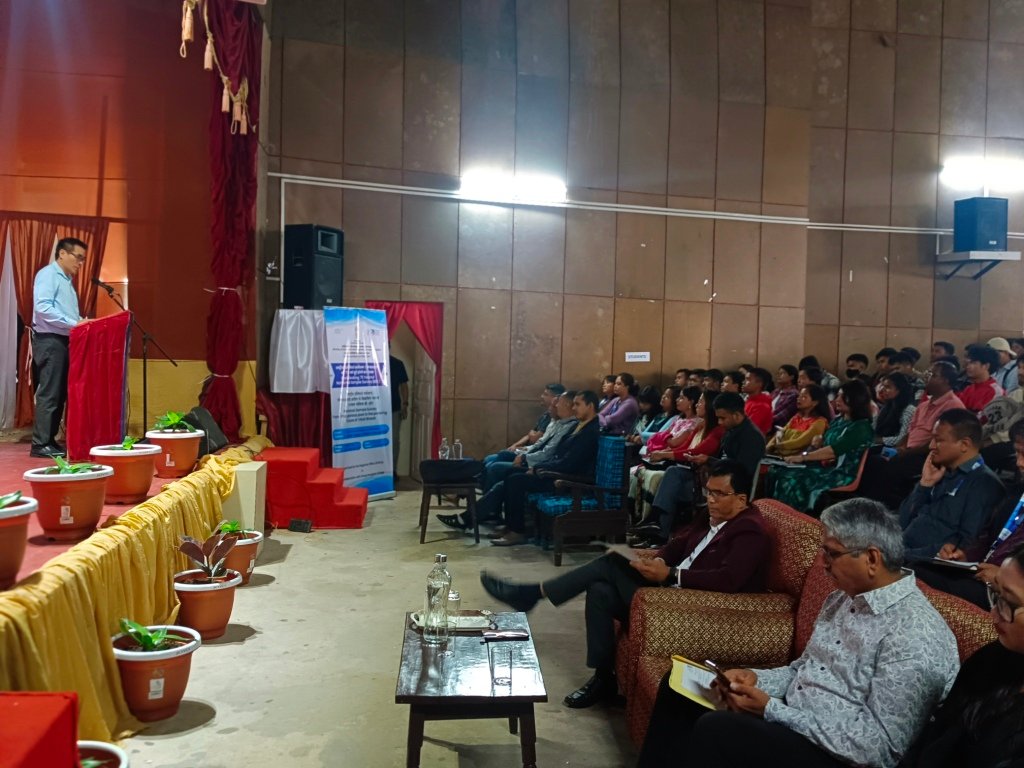
Shillong, Aug 2: A seminar and awareness programme on National Sample Survey, its overview, role and responsibilities was organised recently at Kiang Nangbah Government College Auditorium, Jowai.
Local communities, bureaucrats, government officials, scholars, students, faculty members and local bodies attended the session aimed to highlight the significance of field surveys in analysing societal trends, challenges, and community needs.
The programme was also to discuss how systematic data collection can enhance our understanding of societal structures, behaviours, and transformations.
NSO (FOD) Regional Deputy Director O. Patton highlighted on NSS, its role and responsibilities, impact and how it plays a vital role in informing decision-making, resource allocation, development planning, and policy formulation.
The keynote speaker, Deputy Director General Anil D. Patil emphasised on the importance of data collection through fieldwork to gain firsthand insights into social issues such as education, health, employment, housing, access to basic services and gender disparities.
Participants were introduced to various types of surveys conducted extensively on large scale socio-economic survey like Household Consumption Expenditure, Periodic Labour Force Survey, Annual Survey of Industries, ASUSE, Tourism and Travels, ASUSE, Health, Education, Crop Estimations, and on different Price surveys and the methods of field surveys, including structured interviews, questionnaires, and observational techniques undertaken and conducted by National Statistics Office nationwide.
He also highlighted the purpose by stating that the primary purpose of socio-economic data collection is to gather information on various aspects of people’s lives and that these data help in understanding the current socio-economic conditions and trends within a population.
Further, he expressed the essentiality of reliable socio-economic data in the formulation of effective policies, Planning and Development, Monitoring Inequality and in Research and Academic use. Besides that, he also said socio-economic data collection cannot be overstated in today’s data-driven world as it provides evidence-based decision making for policy makers; whereby maintaining transparency, accountability and setting a benchmark across countries. He expressed that the ultimate goal of data collection is to improve living conditions and data identifies problems and reveals solutions, forming the backbone of sustainable development initiatives.
Associate Professor of the college H Toi explained that data collection is not merely a technical exercise but a foundational tool for community development. It supports inclusive growth, efficient resource use, and responsive governance by embracing data-driven practices, local communities can advocate for their needs more effectively and build a better future based on factual understanding rather than assumptions.