




By Pynshai Joel Dkhar
When India gained Independence in the year 1947, there were two political units, the Princely States under the rule of the native princes, subject to supreme authority of the British crown and the British Province under the direct rule of the British Government. The Indian Independence Act (1947) gave three options to the princely states-to join India, join Pakistan or to remain Independent. Out of the 552 princely states situated within the boundaries of India, 549 joined India and the remaining three—Hyderabad, Junagarg and Kashmir refused to join India. However, in course of time they were also integrated with India- Hyderabad by means of Police Action, Junagarh by means of referendum and Kashmir through the Instrument of Accession.
After the integration of the princely states, there had been a demand from different regions, particularly South India, for re-organization of states on linguistic basis. The Government of India in June 1948 under the Chairmanship of S.K.Dhar appointed the linguistic Provinces Commission to examine the feasibility of this. In December 1948, the Commission submitted its report and recommended the reorganization of state to be on the basis of administrative convenience and not on the basis of Language. There was a lot of dissatisfaction and resentment and this led to the creation of another Committee to again re-examine the whole issue. The Members included Jawaharlal Nehru, Vallabhai Patel and Pattabhi Sitaramaya, this Committee was also known as JVP Committee and it submitted its report on April 1949. This committee rejected language as the basis for State Reorganization.
It is interesting to note that on October 1953, the Government of India was forced to create the first linguistic state, Andhra Pradesh, by separating the Telugu speaking areas from the Madras State. This was due to the popular agitation and the death of Potti Sriramulu, a Congress person, after a 56-day hunger strike for the cause of creation of a new state.
The creation of Andhra state intensified the demand from other regions for creation of States based on linguistic basis. This forced the Government of India to again appoint another Committee in the year 1953 under the chairmanship of Fazl Ali and K.M.Parikar and H.N.Kunzru as its members to again re-examine the whole question. The Committee submitted the report in the month of September 1955 and broadly accepted language as the basis of reorganization of states.
The demand of creation of some more states on the basis of language or cultural homogeneity resulted in the bifurcation of existing states. In 1960, the bilingual state of Bombay was divided into two separate states- Maharashtra for Marathi speaking people and Gujarat for Guajarati-speaking people. Gujarat was established as the state of the Indian Union
In 1966, the state of Punjab was bifurcated to create Haryana, the 17th state of the Indian Union. On the recommendation of the Shah Commission the Punjabi Speaking areas was constituted into the unilingual state of Punjab, the Hindi-speaking areas were constituted into the State of Haryana.
Coming to the Hills of North Eastern states and the Khasi and Jaintia Hills, before gaining Independence in the year 1947, there had been an attempt by the British to remain in the Hills and to still take control of it in the form of the Crown Colony and the Protectorate. There had also been an attempt and luring from the side of Pakistan for the Khasi Hills to be part of it. Muhammad Ali Jinah the leader of Pakistan demanded that the Khasi States belonged to them but leaders like Rev. J.J. M Nichlos Roy rejected this idea. Meghalaya was carved out of the State of Assam consisting of the Former Garo Hills District and United Khasi Hills District of Assam.
In the 1960s, all the leaders of Political Parties under the banner of All Party Hill Leaders Conference (APHLC) joined EITU and intensified the movement. In 1968 Prime Minister Indira Gandhi approved the Autonomous State of Meghalaya (under Assam) for Khasi-Jaintia-Garo tribes, The Sub-State was rejected by many leaders and they intensified the movement.
The autonomous State was inaugurated by (L) Prime Minister Indira Gandhi on 2nd April 1970. Subsequently in December 1971, the North Eastern Areas (Re-organizing) Act was passed by the Parliament and conferring full statehood to the Autonomous State of Meghalaya.
The rulers of the Khasi-States acceded to the Dominion of India by virtue of the Instrument of Accession. –So the demand of a separate state by the indigenous people belonging to two different and unique communities residing in the state is a valid and within the ambit of the Constitution.
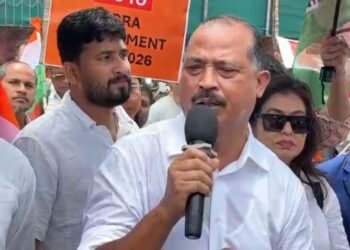
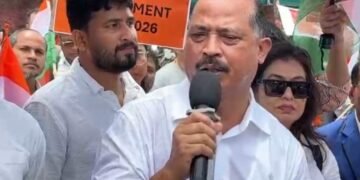
We want Khasi-Jaintia State, No Khasi-Jaintia no rest, We want Garoland, No Garoland, No Rest. These were the voices that echoed at Jantar Mantar, New Delhi on the 14-15 December 2022. The origin of this idea or concept can be traced way back to the year 1998. In the year 1999 at the old Assembly Building of the Meghalaya Legislative Assembly, Mr. Clifford Marak (Elected Member of the Garo National Council) moved a resolution demanding a Separate State. This resolution was strongly supported by (Lt) Mr. Hoping Stone Lyngdoh (Elected Member of the Hill States Peoples Democratic Party). These two gentlemen had a great vision that there will come a time that the tribal people of two unique customs, cultures, languages and beliefs should mutually and peaceful separate themselves into two different states. Demanding a separate State is a Democratic and Constitutional Demand.
Mr. Hoping Stone Lyngdoh in all his public meeting would reiterate the need of a Khasi-Jaintia State. Many meetings and procession had also been held earlier at different headquarters to sensitize the people about the demand.
A bit of comparative study will depict the following.
| Meghalaya | Sikkim | Goa |
| Total Area: 22,429 sq.km
Population 29,64,007 |
Total Area: 7.096 sq.kms
Population 5,70,077 |
Total Area: 3,702 sq.kms
Population 14,58,545 |
The idea of renovating, rediscovering and reviving this issue is gaining grounds as the two political parties of our present State (HSPDP & Garo National Council) had already submitted series of joint memorandum to the Govt. of India. In 2023 the HSPDP and Garo National Council officially joined the National Federation of New States a federation that comprise of different Groups from all over the country demanding their own separate State.
There are also other growing demands for Autonomy and Statehood in the North East Region as a whole. In Assam we have the demand for a Separate Bodoland. In Tripura, the demand for a Greater Tripraland is gaining momentum in tripura. There is a growing demand for a Kukiland in Manipur, where most of the people believe that this would be a solution to end the ongoing conflict.
Article 3 authorizes the Parliament to form a new state by separating of territory from any state or by uniting two or more states, increase the area of any state. Diminish the area of any state, alter the boundaries of any state and alter the name of any State. How will the political parties and pressure groups will take this issue forward will be an interesting story that will unfold sooner or later.