











Meghalaya, Gujarat, Karnataka and Meghalaya have been ranked as India’s top states for start-ups as they provide the best support environment in the country for the firms to set up, build and proliferate.
The three states won the top honour in the third edition of ‘Ranking of States on Support to Start-up Ecosystems’. As many as 31 states and union territories were assessed based on their performance across seven reform areas.
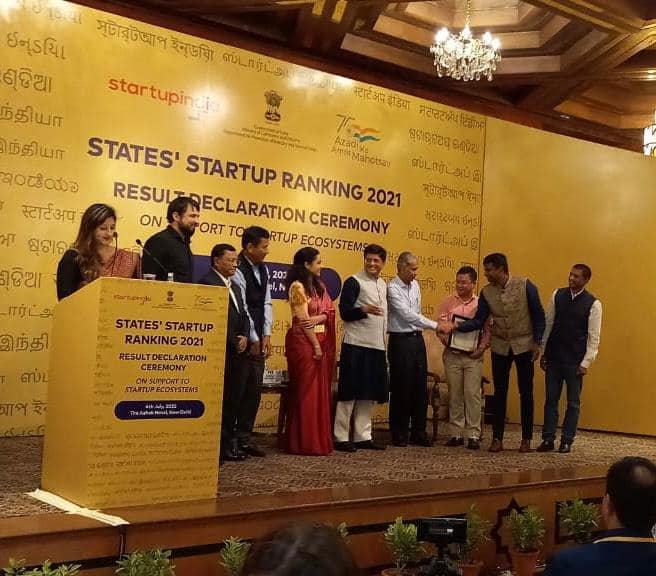
The report of the ranking was released by Piyush Goyal, Minister of Commerce and Industry, Consumer Affairs, Food and Public Distribution, and Textiles today at The Ashok Hotel, New Delhi.
For the purposes of the ranking, states and union territories are classified into five categories – Best Performers, Top Performers, Leaders, Aspiring Leaders and Emerging Start-up Ecosystems.
Gujarat and Karnataka emerged as the ‘Best Performer’ in a category of states which included NCT of Delhi. Meghalaya won the top honour among union territories and North East states.
Kerala, Maharashtra, Orissa and Telangana got the ‘Top Performer’ award among states. Jammu & Kashmir emerged as the ‘Top Performer’ among union territories and North East states.
Assam, Punjab, Tamil Nādu, Uttarakhand and Uttar Pradesh were adjudged the winners in the ‘Leaders’ category among states; Andaman & Nicobar Islands, Arunachal Pradesh and Goa bagged the ‘Leaders’ honour among the union territories and North East states.
Chhattisgarh, Delhi, Madhya Pradesh and Rajasthan were declared as ‘Aspiring Leaders’ among the States. Chandigarh, Dadra and Nagar Haveli & Daman and Diu, Himachal Pradesh, Manipur, Nagaland, Puducherry and Tripura were the ‘Aspiring Leaders’ from the union territories and North East states. Andhra Pradesh and Bihar from States category and Mizoram and Ladakh from the union territories and North East states were clubbed under the Emerging Start-up Ecosystem.
The Department for Promotion of Industry and Internal Trade (DPIIT) has been conducting the States’ Start-up Ranking Exercise since 2018 to facilitate the ease of building a start-up and doing business across the country.
The exercise has grown in its impact over the last three editions, with 31 participating states and union territories in this edition, the highest till date. The State Start-up Ranking Exercise aims to support states and union territories in developing their start-up ecosystem and learn from the best practices in each state and union territory.
The consideration period for the third edition of the States Startup Ranking Exercise was October 1, 2019 to July 31, 2021. The documentary evidence submitted was evaluated over a six-month duration. The evaluation committee across 14 meetings assessed each document and was composed of representatives from 19 government departments and 29 non-government startup ecosystem stakeholders, for fair and transparent evaluation.
The participants were evaluated across seven broad reform areas consisting of 26 Action Points ranging from Institutional Support, Fostering Innovation and Entrepreneurship, Access to Market, Incubation support, Funding Support, Mentorship Support to Capacity Building of Enablers. The exercise plays a crucial role in easing the business environment for start-ups in the country.
The States Startup Ranking 2021 highlighted the support being extended by over 30 states and union territories through startup policies to the ecosystem. There were only four states with startup policies prior to 2016.
The state startup teams have been extending support across mentorship, incubation and funding. Moreover, feedback was gathered from more than 7,000 beneficiaries through surveys made in 13 different languages to grasp the real situation at the execution level.
The felicitation ceremony was accompanied by the release of the National Report which highlights the vision, framework, evolution across the years, methodology and implementation, and the way ahead for the States` Startup Ranking.
A State Specific Report for each of the 31 participating states and union territories has also been released, containing an extensive analysis of each ecosystem, which highlights strengths and priority areas for future.