









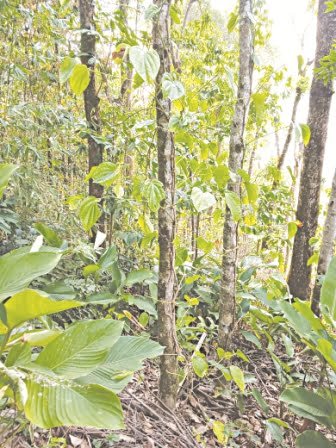
The exorbitant prices being charged for the ubiquitous betel leaf has left farmers shocked and they claim that middlemen, not the agriculturists, are the ones benefiting.
The high costs have put off many street vendors from selling kwai – the combination of the betel nut and betel leaf – at present.
The price of betel leaf has recently skyrocketed to Rs 1,500-2,000 for shi tap, which is a bundle of 240 leaves, while the price of shi biah, a bundle of 60, now costs Rs 200-250.
Although it is normal for the price to go up during spring, current prices are unprecedented.
When Highland Post inquired about the exorbitant cost of betel leaves from the farmers cultivating it in Pynursla and other areas, the growers had no idea that Shillong was paying through the nose for the humble betel leaf.
A farmer in Nongkhlieng village, Hamepynwanborlang Khongsit, said that most of the betel leaves that are sold in Shillong’s markets come from the War villages under Pynursla Block or Ri-Bhoi or Silchar.
“We sell our finest betel leaves, called pathi kynsai, to the traders here at Rs 500-600 shi tap. Then comes the pathi Khasi that is of medium quality that are sold at Rs 250-300 and then the pathi Dkha, which is of the lowest quality and is sold at Rs 150-200,” he said. “I am surprised to learn that the leaves cost so much in Shillong because the farmers who do all the hard work are deprived of the maximum profit, which is instead enjoyed by the middlemen while the poor selling kwai in the street bear the maximum brunt.”
Informing that the betel leaves produced in the War areas and Silchar are longer lasting and can be exported, he said that cleanliness is the utmost priority and farmers make sure to bathe and wash their hands thoroughly before touching the betel plant and leaves since they are very sensitive and susceptible to a disease locally know as tramp that kills the whole plant if contaminated.
He also informed that from October to spring he water the betel plants daily using bamboos as irrigation pipes.
“I have about 400 betel plants that produce and an average of 20 bundles daily in very rough terrain and around 40 households in this village cultivate betel leaves,” Khongsit added.
Meanwhile, echoing similar views, Kitbok Surong, a farmer from Mawpran village who cultivates more than 3,000 betel plants, said that the price charged for the finest and biggest betel leaves does not exceed more than Rs 1,000 per bundle.
“We sell our leaves in Pynursla market at normal prices but I never imagined that the price in Shillong has skyrocketed. I think it is us who deserve the profits because we do all the hard work, especially the herculean task of watering the plants in the dry season besides providing job opportunities to many here,” he said.