









Shillong, Sep 27 (Alt News): In the hinterlands of Bengal, mostly hidden from the attention of the mainstream media, Hindutva outfits are mounting a sustained assault against small Christian communities.
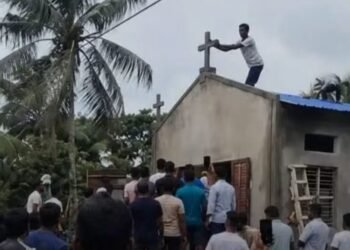
Since the Bharatiya Janata Party (BJP) assumed power in West Bengal earlier this year, these minority communities have faced rising hostility, a report by independent fact-checking website Alt News said yesterday. Hindutva outfits and fringe groups have attacked community members, disrupted church services and vandalised churches, frequently alleging forced conversion or proselytisation as justification for the harassment and violence.
The report is all the more pertinent to Meghalaya as the BJP is targetting the state for expansion from a very small base.
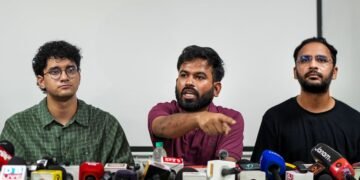
Bengal police have registered FIRs in several of these incidents but no action has been taken against the perpetrators. Instead, victims are being taken to police stations, said Bangiya Christiya Pariseba (BCP) founder Herod Mullick.
“Over the past two-and-a-half to three months, such incidents have increased across districts, following a similar pattern. We have repeatedly sought a meeting with the Chief Minister, demanding an impartial investigation. But the government is not paying heed. So many people are being beaten, crosses are being broken, and someone or the other is being subjected to harassment every other day. The chief minister has not said a single word. We are all frightened and anxious,” Mullick told Alt News.
Asked about the allegations of forced conversion, he said, “Conversion does not happen by simply gathering people and sprinkling water on them. False narratives are being deliberately created. The Christian church is totally opposed to converting people forcefully or through fear. If any group is engaging in anything unlawful, we dissociate ourselves from it.”
Mullick explained that an established church is a long-standing congregation with its own church building, while a free or house church comprises smaller congregations, often of first-generation Christians, who are not affiliated with an established church. In most of the cases, these house churches are facing the attacks.
Alt News has documented around 35 such incidents from July to September 20.
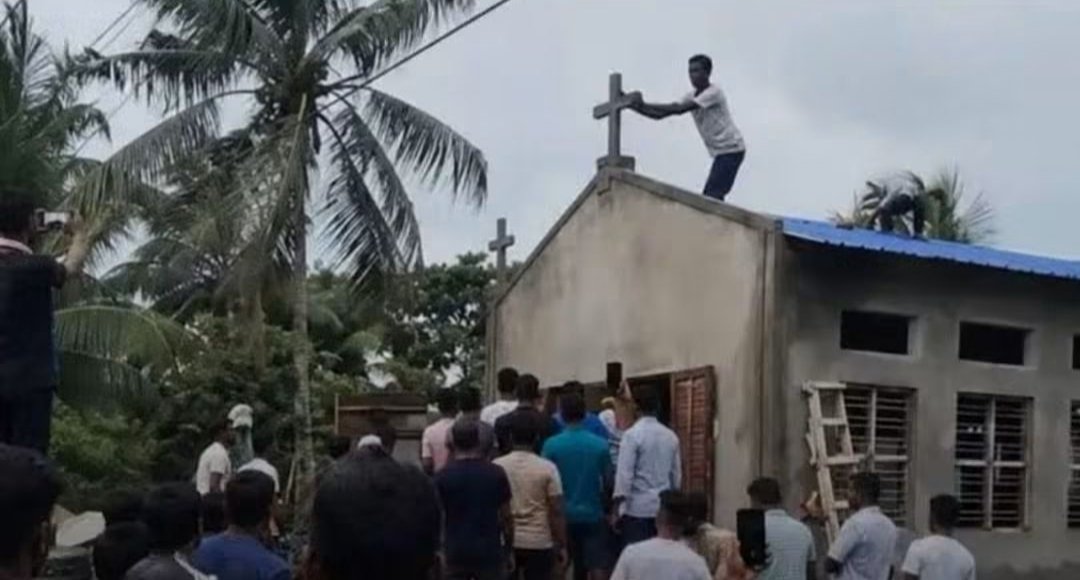
In the most recent incident, a group of around 50 people affiliated with the Vishva Hindu Parishad (VHP) and Bajrang Dal raided a Church in Dekhali Jalpai village of Khejuri Block II, East Midnapore, during Sunday prayer service on September 20, demanding that the church be immediately shut down.
Video shows one of the members of the mob saying, “Christianity is not an Indian culture” and that the Bible was not written in India or in an Indian language. The discussion soon escalated into a confrontation, with worshippers allegedly being assaulted, heckled and manhandled.
Speaking to Alt News, Lucky Jana, who led the prayer, said, “Around 12 noon, around 70-80 unknown men entered the church chanting ‘Jai Sri Ram’. They told us to stop the proceedings and warned us to close the church.” There were around 20 worshippers today. Jana said, “The group refused to listen to our attempts to reason with them, and suddenly, the situation became violent.” Additionally, Jana said, “They physically heckled us. They pulled my collar and intimidated me. Multiple attendees got hurt. They even hit a juvenile– grandson of the Pastor.” Jana added that the church has existed for 28-30 years and that this was the first time they had faced such intimidation, apart from isolated incidents during Christmas.
Jana said the church had anticipated possible disruption and had requested police protection for its Sunday prayers. Two civic police personnel were present during the altercation. An FIR was filed at Khejuri police station.
The attackers locked the church and wrote ‘Ram’ all over its walls and doors.
Four days earlier, Putul Manna and her husband Kanchan Manna, residents of Ghoraberia Dakshin Bhatora village in Amta, told The Times of India that a group of men barged into their house while they were hosting a prayer meeting on September 16. The couple alleged that the group threatened them with eviction and told them to renounce Christianity failing which they would be forcefully evicted from their property.
Digital news outlet Inscript.me interviewed the distressed couple, who recounted their ordeal. “When we said we can’t renounce our faith, we were told we had to leave that night itself,” says Kanchan.
On September 13 a group of saffron-clad men disrupted a Sunday prayer service at a house church in Sirni village in Talda, Dantan, in West Midnapore. The group chanted ‘Jai Sri Ram’ slogans.
In a video uploaded by one of the disruptors, Indrajit Das, the men appear to intimidate those attending the prayer. One of them can be heard saying, “Christianity is not an Indian religion. The Indian government doesn’t provide a national holiday or celebrate any Christian auspicious occasion”. He further claimed that India doesn’t allow the practice of Christianity.
The confrontation escalated into a heated altercation. The Hindutva team allegedly threatened to tie the worshippers to tree trunks if they did not comply.
Ashalata Murmu, who was leading the service, recounted the incident to TOI. One of the men told them, “Don’t you know that the government has declared churches and mosques are closed? None of this can be done anymore.” When Nayak said he was unaware of any such order and refused to comply, he was allegedly assaulted.
A day before this, a group of more than 20 men, identifying themselves as members of Hindutva outfits like Hindu Jagran Manch and Bajrang Dal, allegedly confronted a woman, Tulsi Das, at her home in Shalpudanga village, Shyamnagar, Joypur, Bankura, accusing her of forcibly converting Hindus to Christianity.
Das rejected the allegations. She said she is a Hindu but chooses to pray to Jesus, which she said is not illegal. Three or four other women worshippers present at her home said Das neither solicited nor offered money to them. They said she had told them that praying to God could help with healing.
The Hindutva members allegedly threatened that Das would be suspended from school, where she taught and socially boycotted unless she wrote a letter admitting to the “treacherous crime” of converting Hindus.
Some of the evidence of persecution against Christians is provided by the Hindutva propagators themselves.
A Facebook video uploaded by Raja Pramanik, who claims to be the head of the Bajrang Dal Kulpi unit, shows members of Bajrang Dal and VHP Kulpi together confronting “Christian Jihadis” in Patkelberia village of Ishwarpur, Kulpi, on September 10, announcing that they had stopped Hindus from being converted to Christianity.
In the video, the group is seen misbehaving with elderly people, shouting and aggravating the situation. They tore a Bible being carried by an elderly woman and threatened the worshippers with consequences if they did not stop praying to Jesus.
When the worshippers attempted to explain their position, one woman was threatened, “Jib tene chirey debo” (“I’ll tear your tongue out”).
The women in the house repeatedly said they had neither forced anyone to visit their homes nor pressured anyone to adopt Christianity, and that they were worshipping Jesus of their own choice.
Across the incidents tracked by Alt News, several recurring patterns emerged: Raising of Jai Sri Ram slogans, the claims by the attackers that it’s a ‘new Bengal’ under BJP rule where Christianity would not be tolerated, that Christianity was not in Indian culture, that every small private church was indulging in forced conversions, and that it was unacceptable for women to wear bangles and vermillion like some Hindu married women did, and then practise Christianity. In some cases, the attackers also claimed that at several prayer meets, attendees said they had turned to Christianity or prayed to Jesus after experiencing relief from health issues.
When Alt News asked pastors, evangelists and BCP founder Herold Mullick about the miraculous healing claims, they attributed such experiences to faith, saying that collective prayer and a person’s belief in recovery could contribute to the recovery of an unwell person. “We, on behalf of the Church,” said Mullick, “believe in a healing ministry. But it is not that a person is healed simply because of prayer. The person who comes to us develops a sense of faith.”
“Having said that, we do not support inviting people for practices such as jolpora or telpora (traditional water-based and oil-based remedies/ritual treatments, often associated with folk healing or spiritual practices in Bengal),” Mullick added.
“If I invite people solely by promising healing, that too becomes a form of inducement, and we condemn it,” Mullick clarified. “It is acceptable to say, ‘Come and pray to the Lord, have faith and you may get better.’ But saying, ‘Come to me and I will cure you’ is not right,” he explained.
About women wearing markers of Hinduism like vermillion, evangelist Geeta Haldar said, “Christianity does not restrict a person from expressing themselves or practising cultural traditions. A Christian couple may choose to apply sindoor during their wedding.”
Mullick attributed misconceptions about Christianity to its portrayal in popular media, particularly films. “What we see in movies and similar fictional representations is a Westernised idea of Christianity. We are Bengalis, and because of our culture and traditions, Bengali Christians wear bangles (sakha-pawla) and apply sindoor. It is quite common. The claim that Christians cannot wear these is false. These are part of our culture and tradition. There may be one or two sects that do not permit this, but their numbers are few and they do not represent Christianity as a whole.”