













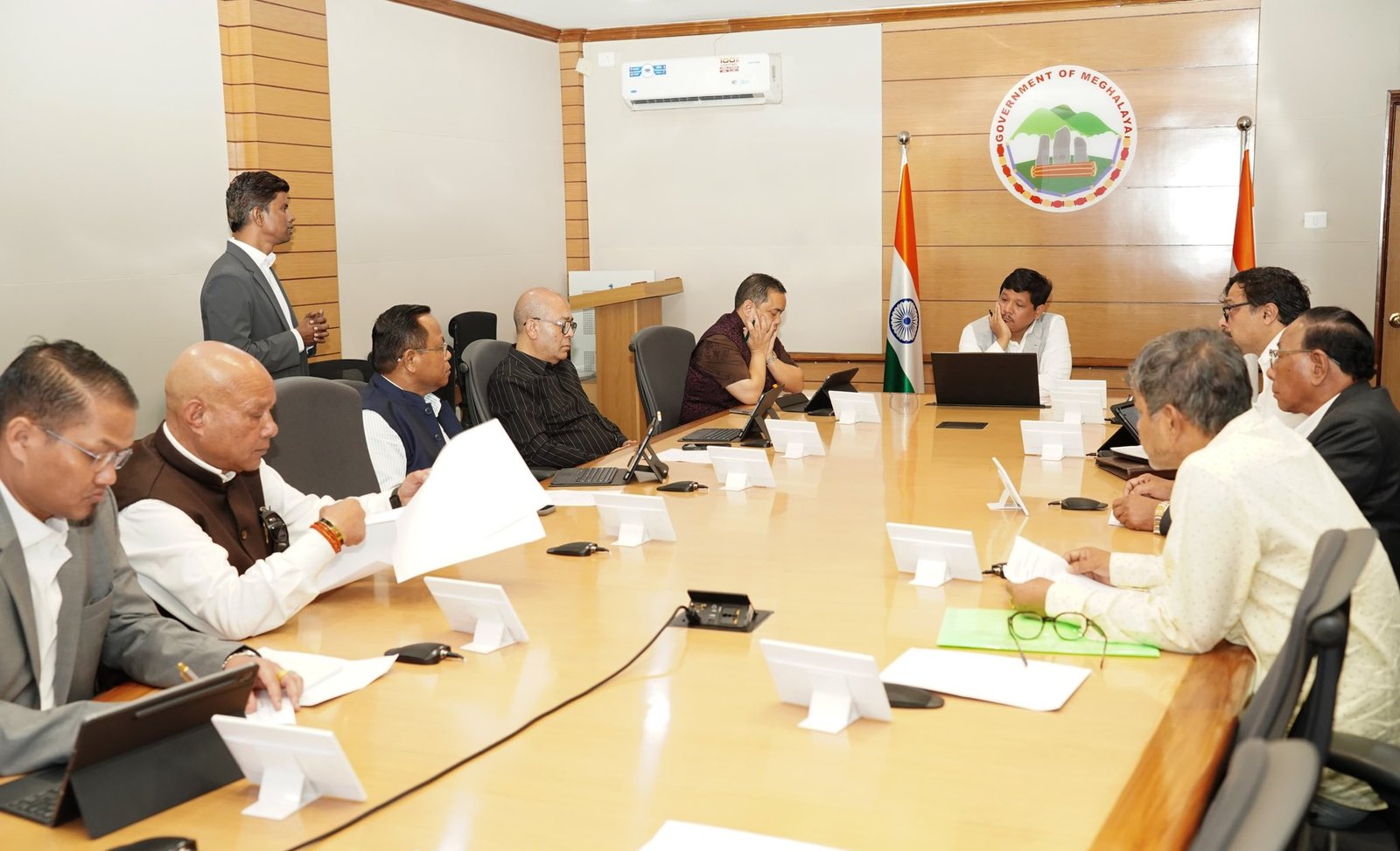
Shillong, Aug 19: The state cabinet today approved amendments to laws regarding the operation of private universities in Meghalaya.
Briefing reporters after the meeting, government spokesperson and cabinet minister Wailadmiki Shylla informed that the cabinet had approved the Maharashtra Institute of Technology of Meghalaya (Amendment) Bill 2026 and Mahatma Gandhi University (Amendment) Bill 2026.
These amendments bring the provision regarding the Visitor of the university in line with University Grants Commission (UGC) norms. Under the earlier acts, the Visitor was to be nominated by the sponsoring body. The amendment provides for the Governor to be the Visitor, as is the case with other universities, ensuring uniformity and compliance with UGC requirements.
Shylla further stated that the decision is also to increase the government representation of the members to the Board of Management from one to two and in the Board of Governors from two to three. The decisions apply to both amendments to previous Acts of MIT and MGU.
The cabinet also approved the Martin Luther Christian University (Amendment) Bill 2026. The amendment brings the university’s functioning in line with UGC regulations by restricting its operations to within Meghalaya, removing the provision for distance education and doing away with the power to affiliate colleges, provisions not permitted for private universities.
In addition, the cabinet approved the Sister Nivedita University Meghalaya Bill 2026 that proposes the establishment of a university at Byrnihat. It also approved the Khasi Jaintia Presbyterian University Meghalaya Bill 2026 that proposes the establishment of a university at Sohiong.
Shylla said the approval to both new university bills will further strengthen Meghalaya’s higher education ecosystem and expand opportunities for students within the state.
The cabinet also took a decision regarding the Khasi Hills International Open University Meghalaya Bill 2011, which was brought up for reconsideration. Although the act was passed 15 years ago, no action followed for several years until 2022 when individuals came forward with a power of attorney relating to the university, followed by developments that raised a dispute over the institution.
The cabinet decided to repeal the act as the proposed name violated UGC norms. The term “International Open University” was found to be non-compliant, since the use of both “International” and “Open University” together is not permitted under UGC regulations. This decision has been taken to avoid any future legal or regulatory issues.