













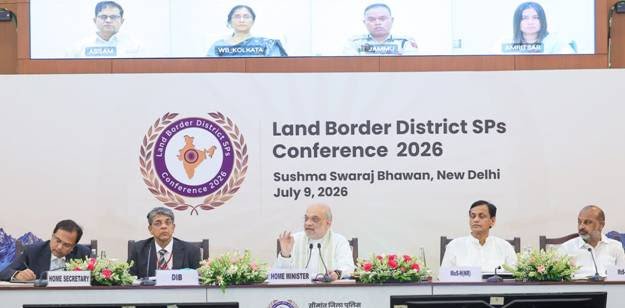
Shillong, Jul 9: With “terrorism” in the North East dead, the central government today promised to inflict “serious damage” to the illegal drugs trade within the next three years.
This was stated by Union Home Minister Amit Shah today during the ‘Land Border Districts’ Superintendents of Police Conference 2026’ in New Delhi.
Union Ministers of State for Home Affairs, Nityanand Rai and Bandi Sanjay Kumar, Union Home Secretary, Director of the Intelligence Bureau (IB), Directors General of Police of the border states and several senior officials were present on the occasion.
Shah said that India’s border security system, based on the vision of a ‘Smart Border’, will become the most modern in the world in the coming years. He said that the government, along with the associated border guarding forces, state and district administrations, relevant stakeholders and local citizens is constructing a strong “quadrangular security grid” and moving away from the current model of individual border outposts.
Under the Modi government, the country has been freed from Naxalism and terrorism in Jammu and Kashmir and the North East, “which is an indicator of our collective success”. The narcotics “menace” will next be tackled in the coming years.
He added that a strong system is being built to make the country completely infiltration-free. Shah added that border districts are undergoing “abnormal” demographic changes brought about by illegal migration, which will be ended by the government through its new Demography Mission.
The central government has increased investment in border infrastructure by 400 percent and has adopted a scientific approach to strengthening border security, he said. Under the Vibrant Villages Programme efforts are being made to prevent migration, generate employment and ensure 100 percent implementation of government welfare schemes.
The Centre is fencing the 1,610km-long India–Myanmar border at a cost of Rs 31,000 crore. He said that the government’s objectives are to prevent proxy war, illegal infiltration, the spread of radicalisation, narcotics trafficking, smuggling, drone-related threats, cybercrime, organised crime and demographic changes; to make border areas more livable; to prevent migration from these regions; and to ensure their security.