
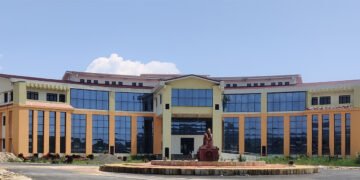

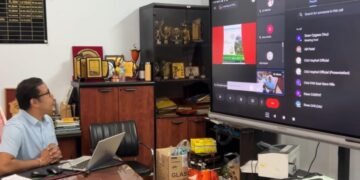






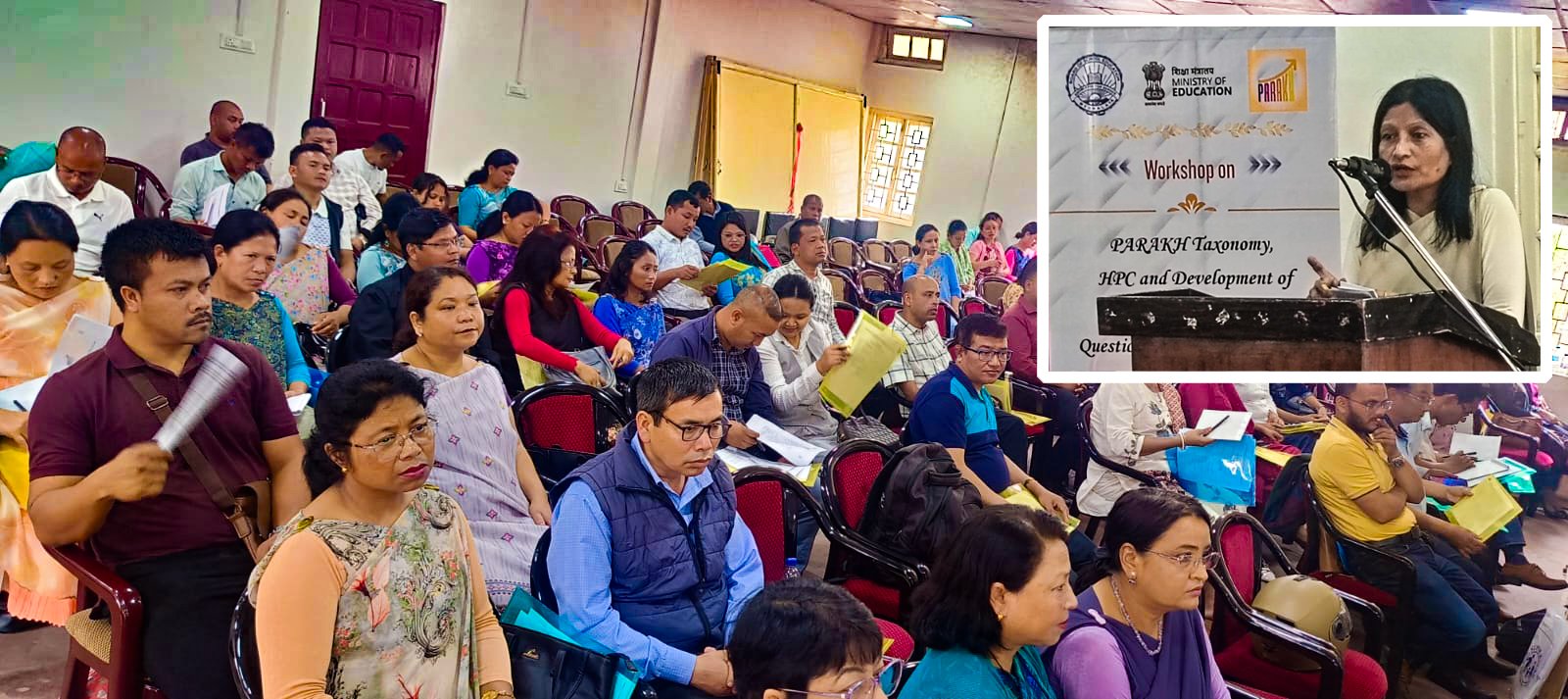
Shillong, Jun 1: In line with the vision of the National Education Policy (NEP) 2020 and its commitment to strengthening a digital assessment ecosystem, the Meghalaya Board of School Education (MBOSE) began a four-day workshop on ‘PARAKH Taxonomy, Holistic Progress Card (HPC) and Development of Question/Item Banks for the Integrated Test Management System (ITMS)’ at its regional office.
The workshop aims to train teachers and vocational trainers across various subject areas under the “Equivalence of Boards” initiative of PARAKH, NCERT, New Delhi. Altogether around 80 teachers of various institutions from across the State participated in the workshop.
PARAKH, which stands for Performance Assessment, Review and Analysis of Knowledge for Holistic Development, is a national assessment regulator established by NCERT under the framework of NEP 2020. The PARAKH Taxonomy promotes competency-based learning and assessment by moving beyond rote memorisation and focusing on three core dimensions—Awareness, Sensitivity and Creativity.
The workshop is being conducted by resource persons Vinod Prasad Semalti, Secretary, Uttarakhand Board of School Education, and Shailendra Joshi, Academic Officer and PARAKH Cell Coordinator. The programme is being supervised by Dr. Esther J. E. Shongwan, Chief Academic Officer and PARAKH Cell Coordinator, MBOSE.
Shongwan highlighted that conventional assessment systems have traditionally emphasised memory-based testing. The PARAKH framework, integrated with the HPC, seeks to provide a more comprehensive evaluation of learners by assessing critical thinking, life skills, creativity, and socio-emotional development alongside academic achievement.
A key component of the workshop is the introduction to the ITMS, an innovative digital platform developed by NCERT to support competency-based summative assessments. The ITMS enables educators to generate customised question papers from a curated repository of assessment items aligned with the PARAKH Taxonomy.
Each question in the system is mapped to specific competencies under the categories of awareness, sensitivity and creativity, ensuring that assessments measure higher-order learning outcomes rather than rote recall. The platform is also expected to contribute towards standardising assessments across State and Central Boards, thereby promoting greater equity and comparability in school education.
Through this workshop, MBOSE seeks to equip educators with the knowledge and practical skills required to implement modern assessment practices and support the transition towards competency-based education envisioned under NEP 2020.