


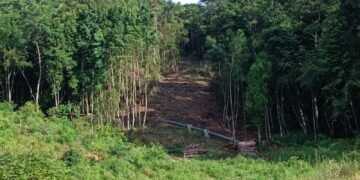







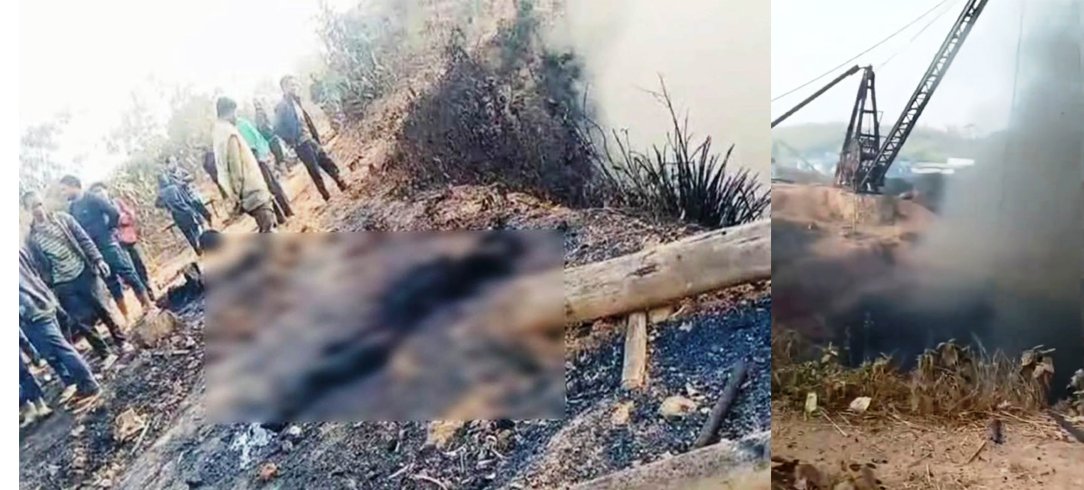
Shillong/Khliehriat, Feb 5: At least 18 persons were killed while several others are trapped in a suspected dynamite blast at an illegal coal mine in Mynsyngat, Thangsko area under Umpleng Police Outpost, East Jaiñtia Hills today morning.
Police this time confirmed that there was an explosion at the mine and a major rescue operation is ongoing.
A mine worker captured today’s incident despite shouted orders to stop, as can be heard in the video. This was shared and went viral giving the lie to the police denials of such incidents.
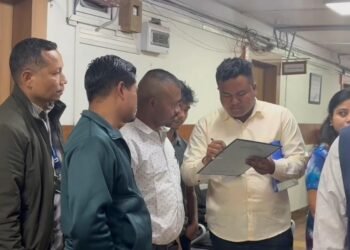
“A total of 18 bodies have been recovered from the site of the explosion. One injured person was rescued and initially shifted to Sutnga Community Health Centre (CHC) and subsequently referred to a higher medical centre for further treatment,” Superintendent of Police Vikash Kumar said.
Meanwhile, sources said two of the injured identified as Dawa Sherpa (54) and Raju Tamang (34) were brought to a private hospital here.
Kumar said teams from the National Disaster Response Force (NDRF), State Disaster Response Force (SDRF), and Special Rescue Team (SRT) are actively engaged at the site, and rescue and recovery efforts are continuing.
He said a suo motu FIR has been registered at Khliehriat PS under Section 105/118(2)/3(5) BNS and Section 21/21(1) MMDR Act, Section 3 of the Explosives Substances Act and investigation in on.
“If any person has any information about other miscreants involved in this illegal act, they are requested to inform the local Police Station immediately. Their identity shall be kept secret and suitable reward shall be given,” the SP urged in a statement.
This is the second dynamite blast inside a coal mine at Thangsko. Similar incident occurred on December 23, 2025 where two miners were killed. A graphic video emerged showing several men with serious injuries. But preliminary inquiries cast doubt on the location of the blast being Thangsko after the headman and residents claimed not to recognise the individuals in the video or the location. Police also denied that there was any blast and claimed the video was shot elsewhere. However, one victim, Ashok Tamang, made a “dying declaration” that was recorded on video. He later died at Shillong Civil Hospital on New Year’s Eve.
The incident was noted by Justice (Retd) BP Katakey, head of the single-member committee constituted by the Meghalaya High Court, who had sought a report from the Meghalaya Police on the reported death of the two coal miners and the Meghalaya Human Rights Commission (MHRC), that directed Chief Secretary Shakil P Ahammed to conduct an effective inquiry and submit a detailed report within one month.
State authorities continue to deny illegal mining of coal and its transportation. What becomes difficult to gather information on many incidents is people don’t come forward to speak about it. The rat hole mining areas are shrouded in secrecy and fear. As illegal mining goes on, a kind of omerta law prevails in the Jaiñtia Hills region as anyone talking about it could get targeted as it has happened in the past.
According to sources, mining has been going on in the area despite a ban by the Meghalaya High Court and a National Green Tribunal court.
Recently, activists cited Moolait village as a hotbed of illegal coal mining in the State. They named villages of Sakhain and Tangsko as areas where illegal mining operations are being carried out under the nose of authorities.
Reports suggest that local authorities exhibit either indifference or complicity towards these illegal activities, allowing them to thrive unchecked. It is also learnt that in the past, farmers from Jarain, Moolimen, Sakhain, Tluh, Moolammyliang and Tyrke used the land called, “sorkari” by the locals, for agricultural purposes.
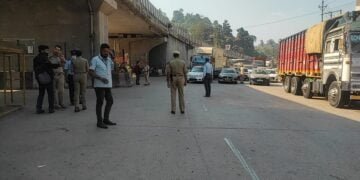
Activists and residents have alleged that local officials, particularly those associated with Elaka Sutnga, are involved in facilitating illicit activities, and are influential figures in the government. They have called for the Meghalaya High Court to take suo moto action and get the Central Industrial Security Force (CISF) instead of the state police, to check illegal mining activities and the transportation of illegal coal through the highways.
By monitoring transportation of coal from the Sookilo area, considered as a gateway for illegal transportation of coal, the CISF can help prevent illegal activities, activists felt.