












Shillong, Dec 30: Ah, the New Year! A delightful time to reflect on the highs and lows of the past. As we flip through our archives, crime in unprecedented savage versions was the biggest headline hogger in 2025.
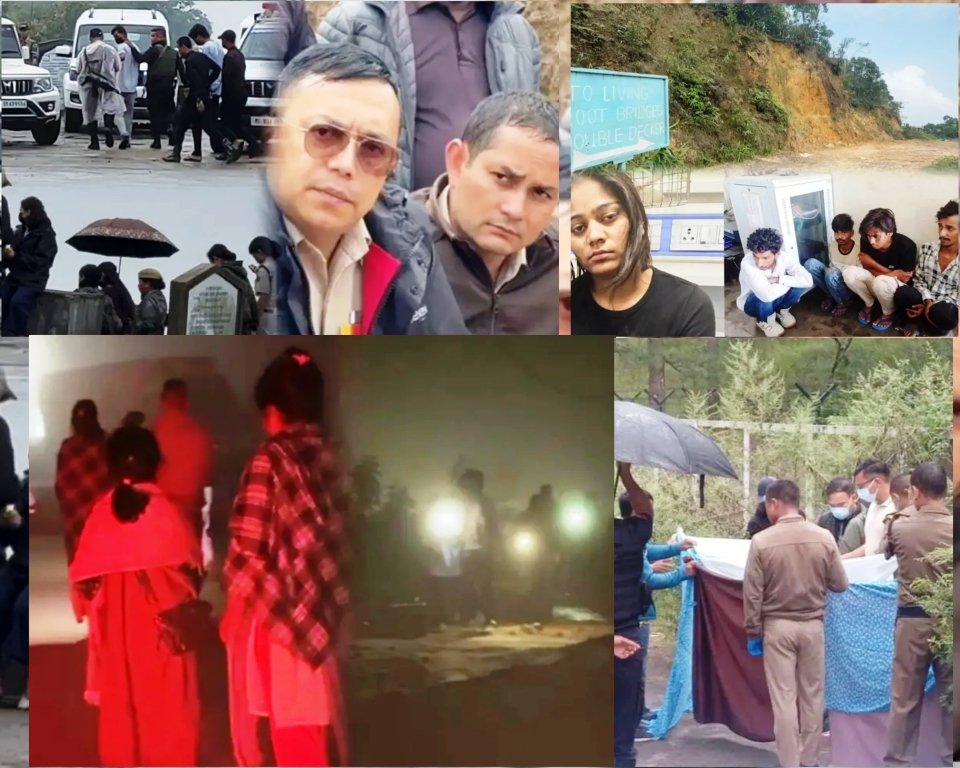
The sensational case which became known as the “honeymoon murder” took the lead. A couple from Indore, Madhya Pradesh, Raja Raghuvanshi and Sonam Raghuvanshi, went missing in May only to reveal one of the most diabolically planned murders and spousal betrayals that shocked not only Meghalaya but probably ranked as one of the top crime stories of all time.
They came (and in hindsight Raja was lured) to Sohra for their honeymoon but the groom was allegedly murdered by the bride and four friends. The dramatic story splashed across metro and local channels of the entire country making it one of the most intensely consumed national news feeds of all time as far as Meghalaya is concerned. The state was also the victim of malicious slander, painted as a lawless place home to savages, but the critics had to change tack (and several apologised) after the spousal murder angle was revealed.
Even as the year ended, the bail plea by the alleged murderer bride, Sonam, is creating another wave of headlines as angry family and friends react.
A 4-year-old girl found dead near her home is another horror story that struck fear in the public in September this year. The allegation after investigation by the Meghalaya police was that the murder was planned by a 13-year-old boy, a close neighbour, who was influenced by porn videos he watched on his mother’s mobile phone.
Another case exploded on October 9. A 7-year-old boy was found dead after he went missing in the same area of Shillong. The killer has not been found and is most probably still normally walking around town, which is truly a chilling thought.
A day later, the body of a 13-year-old girl was recovered near a village in Ri-Bhoi. This was a rape and murder case and the perpetrator was arrested. The cold-blooded nature of these crimes was enough to spark fear psychosis in the people’s mind, particularly parents.
These created panic waves in the community, which again led to unsuspecting individuals being accused of practising witchcraft and targeted by superstitious mobs in localised cases in Khasi Hills. The story of a young city girl thrown out of a moving vehicle and dying, another young woman killed in broad daylight in a busy place, while the domestic violence case of a pregnant mother of 13 children continued to focus attention on the lawlessness prevailing within families and society in general.
All in all, the atmosphere reeked of fear and insecurity as people grappled with neighbourhood crimes.
With rising drug related burglaries, drug addiction and growing drug trade, not to speak of local militant groups setting off the occasional IEDs, alleged mine owners or small time politicians masquerading with bodyguards and simulation assault weapons (who were arrested) the Meghalaya police have their job cut out for the coming new year.
The unrest in Bangladesh has created another line of sensitivity along the whole 400-plus kilometre border the state shares with this disturbed and unstable neighbour.
For the first time, the state set up an Anti-Terror Squad (ATS), a dedicated unit of the state police to focus on serious cases that threaten the peace and tranquility of the state. Along with that, forensic units were set up in every district of the state, which is a dire necessity with the rising crime graph and the serious nature of crimes taking place.
The shift in people’s political alignments continued this year with the new regional party, Voice of the People Party (VPP) sweeping the Khasi Hills Autonomous District Council polls held in the beginning of 2025. The VPP, armed with brand new, first time Members of District Council (MDC) set forth to prove that they have the will and mandate to clean the Augean stables and be a better administrator than all the past old parties. The “rough” and “tough” policy, though, hit a snag when their campaign to rid the council of political appointees started by dismissing the lower echelons of Council staff. These young employees were no pushovers and challenged the VPP order. The stay they got from the Meghalaya High Court served to bring down the VPP nose a few notches.
Among impacts of other decisions, their tax collection department landed in a controversy while their treatment of the traditional institutions, which even otherwise has always been a sensitive issue, has antagonised many, the most recent being the executive committee’s decision not to recognise the Syiem Khynnah of Hima Sohra as the new Syiem after the demise of the old Syiem, Paiem Freeman. All these and more promise some serious fireworks in council affairs in the coming year.
The Garo Hills Autonomous District Council (GHADC), which has always floundered in a pool of corruption, debts and mismanagement, got some respite this year after the state government released finances to pay the salaries of the staff after they publicly protested.
As for the Jaintia Hills Autonomous District Council (JHADC), the same criticism against the council was its inability to stop tribal lands from being destroyed by rampant coal and limestone mining, takeover of land by corporations like cement factories and other industries.
The year ended with fresh campaigns by NGOs against the agreement to sell land to set up a new cement company in East Jaintia Hills.
A major cabinet reshuffle in September added to the governance churn, with eight ministers resigning and eight inducted as the Meghalaya Democratic Alliance recalibrated coalition representation across the NPP, UDP, HSPDP and BJP. Senior politicians like Paul Lyngdoh and Ampareen Lyngdoh lost their cabinet seats, but were accommodated as “advisors” with all the perks of a minister yet this still did not stop tongues from wagging. But, then, 2026 could be the safe zone Chief Minister Conrad K Sangma is looking for as his party, the National People’s Party (NPP) has a simple majority by itself.
The last Congress legislator also joined the NPP in September this year, sending the grand old party into oblivion inside the Meghalaya Legislative Assembly, which it had held sway over nearly continuously since its birth in 1972.
For the first time in the history of the state, the Meghalaya government signed off on the first so-called scientific mining project located in East Jaintia Hills. The Ministry of Coal has approved three scientific coal mining leases in East Jaintia Hills and West Khasi Hills, with plans to approve 11 more soon.
Despite getting the green signal for such “scientific” mining, illegal rat-hole mining continued despite the ban. One of the newsbytes that created a ripple on this count was a remark by Kyrmen Shylla, then a minister in the government, who justified the disappearance of 4,000 tonnes of coal from an NGT designated coal depo saying that “the rains had washed” it all away to Bangladesh, which qualifies for anti-mining activists as the joke of the year.
The CM himself added to the coal controversy by ending the year all but justifying illegal coal mining by claiming “coal mining” is a 200-year-old livelihood occupation of the people of the state.
The Assam-Meghalaya border saw progress with the erection of the first physical boundary pillars in July, marking tangible steps in resolving the 12 disputed areas agreed upon in a 2022 MoU. But in October and December clashes erupted over farmland, leading to one death in Lapangap, West Jaintia Hills, bordering Karbi Anglong, Assam, and in December in Pilangkata where people were injured. The long drawn boundary demarcation effort is likely to remain sensitive with potential for flare-ups in 2026.
On the environmental front, Byrnihat, a small industrial township in Ri-Bhoi near Guwahati was declared the most polluted metropolitan area in the world by the 2024 IQ Air World Air Quality Report, shocking the entire state. 2025 will also be remembered as the year when the world famous cleanest river Umngot was muddied by the dumping of debris from the four-lane road earth cutting in the nearby hills.
The State Investment Promotion and Facilitation Act, 2024 was passed only after the government removed the controversial sections which authorised the government to create land banks through outright purchase. This averted a major law and order flare up over concerns that the new law was an assault on tribal land rights and jobs.
The Geographical Indication (GI) tag accorded to Meghalaya’s traditional Eri silk fabric, Ryndia, is seen as one of the standout achievements of India’s textiles sector in 2025. Not only as a unique indigenous brand, but its contribution to rural livelihood and sustainable production practices. With this recognition this sector is expected to become one of the mainstays of rural livelihoods.
This year the government invested heavily in tourism with projects like the Shillong Ropeway and Mawkdok Skywalk, totalling Rs 3,914.51 crore. Plans for seaplane operations from Umiam Lake were in motion.
The year saw another parcel of land deal signed off for handing over land for the new Taj Umiam Resort & Spa, a significant Rs 330 crore project set to be the state’s largest hospitality development. The state hopes all these will contribute to making the state a prime tourist destination.
As we wave goodbye to the past, let’s do so with a flourish! Some memories are embarrassing. We can prance into January like a celebratory confetti explosion and also expect that life might throw the occasional curveball.