











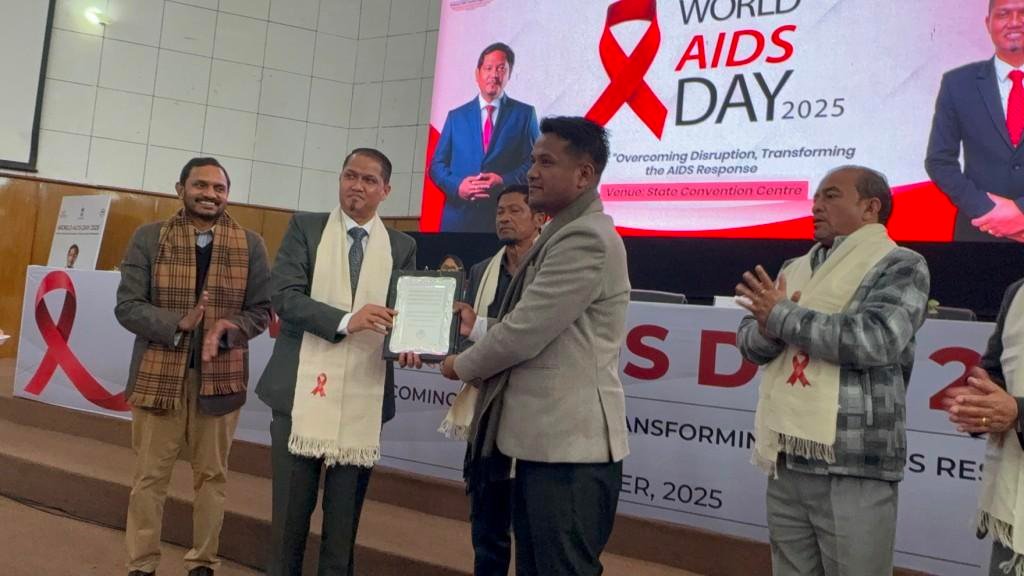
Shillong, Dec 1: With HIV cases in Meghalaya now above 10,000, the Health and Family Welfare Department and the Meghalaya AIDS Control Society (MACS) will start a five-year mission mode programme to improve awareness, especially in rural areas where information is limited.
Speaking at the state-level World AIDS Day programme on Monday, Principal Secretary Sampath Kumar said the effort aims to increase awareness, prevent new infections and encourage people to go for regular and early testing.
According to the National Family Health Survey (2019–2020), only 14–16 per cent of people in Meghalaya are aware of HIV, showing a clear gap in knowledge.
The government has set a goal to make Meghalaya HIV-free by 2030.
Health Minister Wailadmiki Shylla said the mission mode proposal will be placed before the cabinet in its next meeting. Under this plan, the government will expand testing centres, treatment facilities and awareness programmes across Meghalaya.
“In addition to support from the National AIDS Control Organisation, the state government will invest over Rs 25 crore in the next five years,” Shylla said. He added that many people do not know that HIV treatment is free and effective and he urged citizens to come forward for early testing.
Regarding stigma, the minister recalled a case where a child was removed from school because the parents were HIV-positive. He said society must be more accepting. “Who will come forward for testing if we are not willing to accept them? HIV is not a death sentence. Treatment allows a person to live a dignified life,” he said.
Kumar shared that more than 9,000 people in the state are currently living with HIV. East Khasi Hills and West Jaintia Hills have over 3,000 cases each and East Jaintia Hills over 2,000. He said around 900 new cases are detected each year due to proactive testing.
Responding to questions on rising numbers, Kumar said new detections are a sign of better testing, not an increase in risk alone. He highlighted that substance users account for nearly 30 percent of HIV-positive cases and stressed the need for testing among people with high-risk behaviour, including unsafe sex with multiple partners.
He shared an example from East Jaintia Hills where, after a school awareness session, five students visited the PHC for testing because they were unaware of the risks. Kumar said all medical officers have been asked to conduct similar sessions in nearby schools and schools can also request such visits.
Addressing the students at the programme, Kumar said young people must act as ambassadors and spread awareness in their communities. He expressed hope that Meghalaya can reduce new HIV cases to zero in the next five years.