











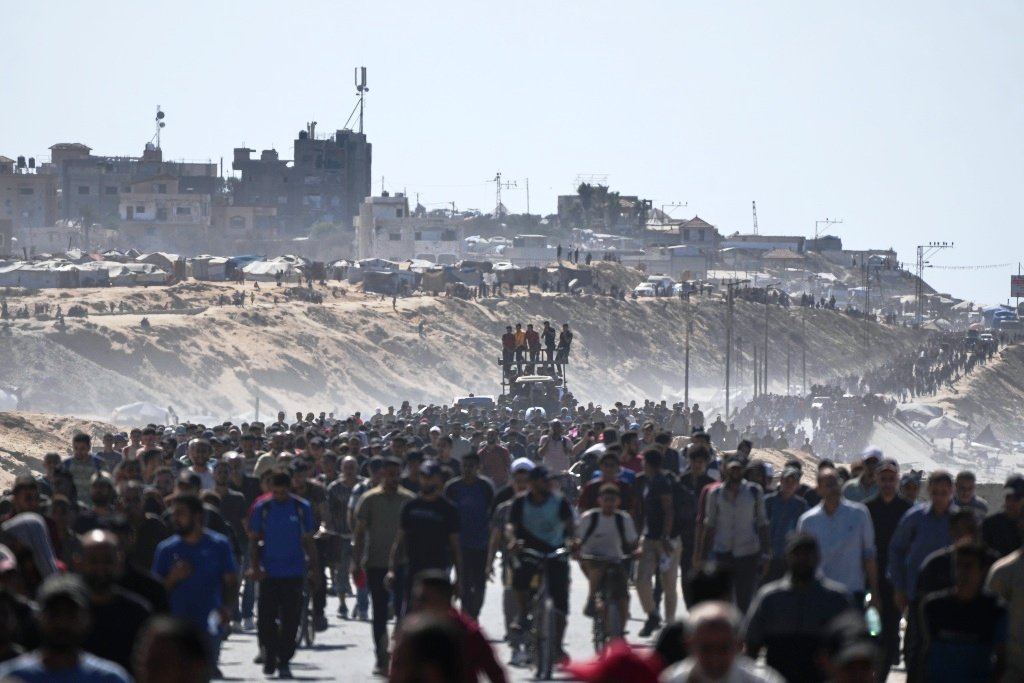
Wadi Gaza (Gaza Strip), Oct 10: Tens of thousands of Palestinians headed back to the heavily destroyed northern Gaza Strip on Friday as a US-brokered ceasefire came into effect in a deal that raised hopes for ending the Israel-Hamas war. All the remaining hostages were set to be released within days.
Questions remain over who will govern Gaza as Israeli troops gradually pull back and whether Hamas will disarm, as called for in US President Donald Trump’s ceasefire plan. Prime Minister Benjamin Netanyahu, who unilaterally ended a ceasefire in March, hinted that Israel might renew its offensive if Hamas does not give up its weapons.
The latest truce nevertheless marks a key step toward ending a ruinous two-year war that was triggered by Hamas’ 2023 attack on Israel. The fighting has killed tens of thousands of Palestinians and displaced around 90% of the Gaza population of some 2 million, often multiple times. Many of them will find fields of rubble where their homes once stood.
The military confirmed the start of the ceasefire Friday, and the remaining 48 hostages, around 20 of them believed to be alive, are to be released by Monday. Palestinians said heavy shelling in parts of Gaza earlier on Friday had mostly stopped after the military’s announcement.
Netanyahu said in a televised statement Friday that the next stages would see Hamas disarm and Gaza demilitarised.
“If this is achieved the easy way — so be it. If not — it will be achieved the hard way,” Netanyahu said. He added that Hamas agreed to the deal “only when it felt that the sword was on its neck — and it is still on its neck.”
The Israeli military has said it will continue to operate defensively from the roughly 50% of Gaza it still controls after pulling back to agreed-upon lines.
Meanwhile, the United Nations was given the green light by Israel to begin delivering scaled-up aid into Gaza starting Sunday, a UN official said. The official spoke on the condition of anonymity to discuss details not yet made public.
The aid will include 170,000 metric tons that have already been positioned in neighbouring countries such as Jordan and Egypt as humanitarian officials awaited permission from Israeli forces to restart their work.
In the last several months, the UN and its humanitarian partners have only been able to deliver 20% of the aid needed in the Gaza Strip, according to UN humanitarian chief Tom Fletcher. (PTI)